POWER OF THE PRESIDENT

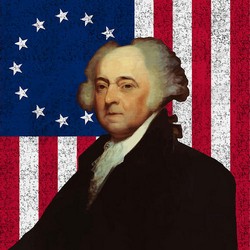
john-adams-war“Power always thinks it is doing God’s service when it is breaking God’s laws.”  – John Adams

Nearly 250 years ago, a bunch of guys got together and decided they had enough of being ordered around by some guy wearing hardware on his head. They decided they wanted to let everyone in on the act of running their country. Even though there was not a large populace, there were obviously too many people to get together in one place and debate issues without the whole thing degenerating into a riot. There were also logistical issues since they were lacking planes, trains, automobiles, phones, radios and such, not to mention the massive undertaking of assembling adequate numbers of port-o-potties.
The solution of course was to have the people select citizens of like mind to represent them and assume responsibility for running the country. In spite of their abhorrence to one person rule they realized it was necessary to have an executive type person charged with the duty to implement their decisions. Since this person was to represent everyone, he was elected by a nationwide vote. Of course, there is nothing in this overly simplistic civics lesson that is not already known by anyone capable of reading this thing however my point is to suggest that we have deviated from the original script handed to our Presidents by those original designers of our government.

WHO IS THE BOSS?
It is clear that the Constitution expects the President to do the bidding of congress. Although he is free to initiate some actions on his own, most require congressional approval. Politics is all about power, and those guys writing the Constitution were wise enough to realize that the pursuit or even lust for power is an inherent quality which afflicts all mankind. I suspect they were well aware there would always be those lurking in the shadows looking for an opportunity to take over consequently; they saw fit to distribute power among three separate branches.

In addition to a legislative body charged with making laws and an executive to implement them, there was need for a judiciary to resolve differences in interpretations of the Constitution. It was to be headed by a supreme court which would be the final arbitrator. In an effort to provide those judges with immunity from political pressure, they were given lifetime tenure. Now these judges render decisions that are very predictable and just happen in most cases to coincide with the political party which sponsored their appointments. This lack of objectivity is so blatant that we now label each judge as either liberal or conservative, and their votes reflect their political biases. But that is another story, and for now I wish to focus on what I see as problems with the power of the President.

THE OLD BAIT AND SWITCH
It is obvious the original intent was for the balance of power to be heavily weighted towards the legislative branches, and that the President couldn’t do much without their approval. It appears to me that the roles have been reversed, so that the President now carries the big stick and congress sucks up to him. As a matter of fact, the President is now often referred to as the most powerful man on earth. The question arises as to how this power shift came about.

THE SHOW MUST GO ON
Consider the State of the Union address mandated by the Constitution: The President “shall from time to time give to the Congress Information of the State of the Union and recommend to their Consideration such measures as he shall judge necessary and expedient.” Article II, Section 3, Clause 1. Those of you who have managed to put boredom aside long enough to listen to some of these performances may have noticed that those “recommendations” often sound more like demands these days.
Indeed, his entrance to the hall is greeted with a reception fit for a king or even a rock star. He is announced with great fanfare, and his fellow travelers surround him reaching for his hand or the opportunity to touch the cloak of the great one as he moves toward the podium. As he speaks his fans cheer from one side of the aisle while the opposition ensconced on the other side glowers. The entire spectacle reminds me of a high school football game where the fans of each team sit on opposite sides of the field cheering for their guy no matter the content of his words. In the game of politics the prize is power. With millions watching worldwide this is the ultimate in “bully pulpits”, and POTUS uses it to great advantage.

WHAT YOU SEE IS NOT ALWAYS WHAT YOU GET
Image is most important as a means of gaining power. A popular President can be of great help to a congressman seeking reelection, and likely result in a tendency to bow towards the President’s demands. FDR made effective use of radio with his “fireside chats” as a means to not only reassure the nation but to bypass congress and appeal directly to the people to support his views. Now we find there is hardly a day goes by without some pronouncements from our President on TV, not to mention his very effective use of social media to influence voters.

PROBLEM SOLVING VS. FOOD FIGHTS
Our two-party system nearly guarantees support from congressional members of like party affiliation. Consequently; when his party is in the majority he is unlikely to face much opposition, and even when faced with a majority opposition he needs to schmoose only a few, in order, to have his way. The extreme divisiveness we have experienced in recent years results in what Truman called “a do-nothing congress” with the chief executive taking charge by default. The hostility of political debate has become so intense that it often seems as if those we elect show more loyalty to their political party than to their country. This allows a power-hungry person (and aren’t they all) to rise above the fray and be seen as the adult in the room. The current divisiveness encouraged by our political parties was predicted by both our first and second Presidents even though Adams laid the groundwork for the 2 party system.

FOLLOW THE MONEY
The nearly limitless budget of the executive branch allows the president other opportunities to curry favor and therefore power. For example, Woodrow Wilson was able to overcome the resistance of U.S. involvement in World War I by hiring a full-time person and staff charged with selling the idea to the public, all of which naturally was paid for by that same public targeted by the propaganda. A more current example concerns the amount of costs to taxpayers of travel to deliver “campaign style speeches” by our current president. There appears to be no such accounting available. In similar manner Presidents early on learned of many ways to influence public opinion by using taxpayer money to burnish their image and enhance their power.

NEED TO KNOW
Secrecy is vital to maintaining a grip on power, and generous use of the rationale of withholding information due to alleged risks to national security has become commonplace. The most egregious example in my lifetime was the continued involvement in the Vietnam war long after it was clear to those in charge that the war was lost, yet I don’t recall any apologies by our leaders, including the commander in chief, for the thousands of lives lost in order to protect the image of presidential infallibility. More recently of course was the use of black sites for torture, and procedures designed to invade the privacy of the citizenry. These activities also had been kept under wraps and only disclosed via the work of the press and so-called leakers who in many cases should be renamed as patriots.

TRUST, BUT VERIFY
Yes, we are living in the information age and information is power, even more so than in the early days of the country’s formation. The liberation of secrets is the job of the press, which must remain apart and free from government influence. Following a debacle early on in which a number of publishers were actually imprisoned, the founders wisely passed the 1st amendment to the constitution which among other things guaranteed the freedom of those truth finders to accomplish their missions. Many Presidents’ relationships with the press have been contentious to some extent as the struggle for openness is continuous. Our current leader disdainfully describes the press as “enemies” of the people, but our founders saw them as protectors of liberty.

WHEN THE PRICE IS RIGHT
As our government has grown exponentially so have the number of jobs controlled by the President. There are staff members, judges, lawyers, a cabinet, department heads, ambassadors, an office staff, advisors, and many other positions to be passed out to the faithful. Generally, the president is given a great deal of latitude in choosing these people, and confirmation by Congress when required is usually a formality. The power to hire or fire in these highly valued jobs is considerable, and an effective form of patronage which guarantees loyalty and influence.

THE BIG CLUB
The impetus for writing this little ditty came about as I recently noted that a number of executive orders were being reversed. I set out to find what the executive order thing was all about, and found it had its origins from Article 2 of the Constitution. My take on that was that they saw the need for the president to have sufficient power to implement laws passed and to make decisions regarding his operation of the executive branch. Congress could also cede power to him when required. I also learned that executive orders are subject to judicial review and carry the power of law. The biggie of course is the President’s ability as commander in chief to wage, but not declare, war which in the atomic age is about as powerful as one can get.

The executive order has been used with great effect to increase the power of the President. It was not until Theodore Roosevelt that it found its greatest utility as he averaged nearly 3 EOs per week during his tenure. The fad caught on quickly and successive presidents upped the ante with Teddy’s cousin FDR, who has remained all time champion, with twice that amount. His three term total was 3,721. Not to be outdone, our own Donald Trump is on track to sign the most such orders in 50 years.

People being the way they are, it is not surprising that our presidents continue to test the limits of executive orders. In response to an article in the New York Times titled “Shift on Executive Power Lets Obama Bypass Rivals” Bruce Fein writes in a letter dated April 24, 2012, the following:
“Executive branch power at the expense of Congress and the Constitution’s checks and balances has mushroomed since World War II. Examples include President Truman’s undeclared war against North Korea; President Eisenhower’s executive agreements to defend Spain; President Johnson’s Gulf of Tonkin Resolution regarding Vietnam; President Nixon’s secret bombing of Cambodia and assertions of executive privilege; President Clinton’s undeclared war against Bosnia; and President Bush’s countless presidential signing statements, Terrorist Surveillance Program, waterboarding and Iraq war.”

Another problem with executive orders is that they can be rescinded by subsequent Presidents as has been the case with nearly all of President Obama’s orders. This does not provide for a great deal of consistency especially when they involve issues involving other countries, leaving them to wonder if they can count on our commitments.

SORRY GEORGE
George Washington in his farewell speech cautioned against “foreign entanglements”. We have ignored that advice in spades and Presidents are largely responsible for many of the worst entanglements from which we now find nearly impossible to extricate ourselves. Granted the world is now smaller and more interconnected than in the early days, thus isolationism is no longer an option, but promises to deliver “shock and awe” or “fire and fury” must imbue one with a greater sense of power than to engage in some mundane international trade agreement.

HELP IS JUST A DICTATOR AWAY
As the world shrinks not only our own troubles but those from thousands of miles away appear as if on our doorstep. The presence of an ocean separating us offers little protection, and the world becomes a scary place. The world is now troubled and there are volunteers everywhere promising to fix everything. Today there appears to be a trend towards authoritarianism with some leaders now in office for life. Madeline Albright in her book “Fascism A Warning” points out conditions that lead to fascist take overs. In a previous blog, I mentioned Erich Fromm a German psychoanalyst who proposed in his 1941 book “Escape From Freedom” that freedom is anxiety provoking and that in times of crisis people naturally look for someone to take charge and tell them what to do and how to do it. There is an upsurge of fascist activities throughout Europe and the U.S.

According to the Economist’s Democracy Index of 2017, they have noted a worldwide trend towards autocracy including Hungary, Egypt, North Korea, the Philippines, Poland, Russia, Turkey, and Venezuela. Their 2018 report indicates continuing decline, and they re-categorized the United states from a democracy to a flawed democracy. Perhaps, even more disturbing was a report from the Pew foundation which showed a decline in Americans’ faith in their government from 70% to below 20% in the past 50 years. Albright says, “We are becoming disconnected from the ideals that have long inspired and united us.”

TOO BUSY TO VOTE?
Those ideals were put forth by a group of revolutionaries many years ago who so believed in those ideals they were willing to risk being hanged as traitors. It is difficult for a wimp like me to imagine the courage required by their decision to go up against the most powerful man on earth, or to imagine the courage of the nearly 3,000,000 Americans serving in the military who have since died in defense of the ideals that are the foundation of this great Republic. Though some of those efforts may have been misguided, they certainly were real to those who fought for them. The ultimate shame must reside in those in positions of power who may have sent them in harm’s way for any reason other than the defense of those ideals.

There are many who believe that we are now facing a time of greatest threat to our democracy since its birth. In any event we can now longer take it for granted. If we really care we must become involved. Our voting records are appalling. The greatest threat to our democracy is and perhaps has always been from the inside. My favorite birther of our nation John Adams recognized this in the very beginning in the following statement: “Remember, democracy never lasts long. It soon wastes, exhausts, and murders itself. There never was a democracy yet that did not commit suicide”.
Some of our current President’s behaviors may seem laughable but they are not funny! They deserve our serious attention.

The Power of Belief

WHAT SHOULD I BELIEVE

          A few months ago in a blog about conspiracies (May 2017, Conspiracy Theories) I attempted to find answers to the question of why so many of us seem willing to subscribe to stuff even when it is far from the truth, or in some cases totally illogical.  The question has been of particular interest to me having seen many, many patients through the years with disordered thinking leading to false beliefs.  The extreme example of the phenomenon is seen in the paranoid psychotic person whose perceptions are so distorted that his interpretations of reality are far enough removed from that of the average person that he lacks credibility.  They are often so bizarre as to make others sufficiently uncomfortable that he may be shunned.  As a matter of fact, it is not a stretch to describe paranoia as conspiracy theories on steroids.

ARE WE ALL A LITTLE CRAZY?

We now realize that there are many conditions that can impair brain function resulting in paranoia, yet when comparing the paranoiac to the conspiracist, we see they have much in common, which begs the question as to whether the paranoid’s extreme suspiciousness rather than qualitatively different is merely an aggravation of the basic human condition.  After all, suspiciousness has been adaptive behavior for the human race.  It has contributed to our survival and those without suspicions are called gullible and looked down upon.  On the other hand, the conclusions arrived at by delusional thinking are rigidly held in spite of whatever logic or facts are presented.  In like manner, the political zealot’s ideas seem set in concrete, and he brushes off contradictory information as either irrelevant or untrue.

THAT TRUTH THING AGAIN?

If suspiciousness is not only protective but in search of truth, why do we so often believe stuff when there is no evidence that it is true.  Any good con man will tell you the best way to gain trust is to tell the mark what he wants to hear, and the best lies are those that confirm what he already believes.  As a personal example, there is the case of Donald Trump, who I thought was a jerk long before his TV show.  Granted, that opinion was based on feelings and maybe not even rational for obviously I didn’t really know him.  Nevertheless, I am now even more convinced that he is a jerk and moreover a bad President.  Consequently, I suck up what is said about Trump on MSNBC and reject what Fox News has to say as bullshit.  I find it difficult to understand how some of my friends can listen to the Fox News bullshit, and I am sure they feel the same way about me and MSNBC bullshit.  As a consequence, we rarely discuss politics, but I am sure that they talk politics to friends who are of like mind while I rap only with the anti-Trump contingent.  Perhaps this is not such a bad thing. One study indicated that groups with opposing beliefs actually became more extreme in those beliefs while discussing the issues with those who differed with them.  Thus, there may be wisdom in the maxim that “one should not discuss politics or religion in polite company.”

CATCH 22 AGAIN

Unfortunately, that policy presents us with another one of those unresolvable dilemmas, for if one assumes that it is impossible to resolve differences without discussion and discussion simply reinforces beliefs, compromise is unlikely to occur.  The phenomenon does offer a measure of security to politicians or political parties in that limited exposure of their base to contrary ideas will keep them in the fold.  With that, he can devote more resources to winning the independent vote.

When I was a kid we played a game called Follow the Leader in which participants were to follow the behaviors of the designated leader, and those who failed to mimic the leader were expelled until there were only two players remaining, at which point the one survivor would become the leader and the game would resume with the new leader.  There is ample evidence that similar behaviors are seen in nearly all aspects of human behavior, and that we are indeed herd animals.

SO YOU THINK YOU ARE A THINKER?

There is a famous British study in which a large group of volunteers were asked to walk aimlessly around a large hall without talking to anyone, while a few were secretly given instructions as to where to walk, and to appear confident of their destination.  95% of the crowd followed those who appeared to know where they were going, in much the same manner as would a flock of sheep follow a Judas goat.  This phenomenon, only one example of what has been called herd behavior or herd mentality, has received a great deal of study through the years by philosophers, psychologists, sociologists, economists, theologians, historians and even psychiatrists like Freud and Jung.

The principles of herd behavior, or tribalism, have been found to have great utility in influencing all manner of human behaviors.  Indeed, it is difficult to imagine any aspect of our lives that is not affected in some way by our tribal memberships.  Those of us who fancy ourselves to be independent thinkers have little awareness as to how these and other genetically ingrained behaviors unconsciously affect not only our behaviors, but our thought processes, opinions and beliefs.  To belong, one must conform and conform we do, often with little awareness of why we do so.

HERMITS NEVER MAKE IT

The importance of herd behavior is not lost on the world’s politicians and despots.  They know how to make use of our need to belong to a group or to use a shrink term to be “validated.”  In order to brainwash someone or start a cult, one must begin by isolating the prospective victims in order to deny them validation so they will eventually align themselves with their persecutors.  They make use of the fact that as herd animals, contact with other living things is essential, and they hope that their victims will eventually accept whatever relationship is made available to them.  Similar dynamics undoubtedly play a part in the development of the “Stockholm Syndrome” as in the case of Patty Hearst, who joined the cause of her anarchist kidnappers after having been isolated and abused by them.  As I mentioned in a previous blog, it has been shown in several studies that solitary confinement often results in the development of psychosis, further evidence of the importance of relationships.

JUST ONE OF THE GUYS

It is largely accepted as fact that negative political campaigning is more effective than merely focusing on issues.  In such cases the emphasis is not on issues, but rather on his/her opponent’s character and identity.  The candidate will set out to show that he is like his audience and thus is a member of their tribe while his opponent does not belong.  When addressing a blue-collar audience, he may shed his coat and tie and roll up his sleeves.  The recent election has demonstrated that a baseball cap can generate more votes than a resume in those rallies while more formal attire will be chosen for $1000-a-plate dinners.

HERDS GONE WILD

Nowhere is the herd concept better illustrated than at athletic events.  I have been an Ohio State fan all my life, which by the way is a long time.   Of course, football is the most raucous of all modern sports and one in which tribalism is on full display.  I paid significant sums of money for the privilege of sitting in crowded uncomfortable seats sometimes in rain or snow. Surrounded by 100,000 fellow tribe members all rooting for the enemy to be vanquished, I felt I truly belonged.  Fellow tribe members were readily identified by clothing adorned with the school colors.  We pledged our fidelity by singing the alma mater followed by the school “fight” song.  Seating was arranged so that the opposition fans were separate from us good guys, and the cheerleaders encouraged our totally uncivilized behavior.  The best seats are those on the 50-yard line not only providing a better view of the action but placing the fan in the center of the crowd much as other herd animals jockey for position to be in the center of their herd.  Our loyalties also affect our beliefs, e.g., questionable calls by the refs are bad if they favor the other team, and the boos of one are apt to be taken up by other fans.

In similar manner mob behavior can be initiated, and there have been instances where those officiating games have feared for their lives.  Soccer games seem especially prone to mob behaviors.  Political rallies can be orchestrated to take advantage of that same dynamic.  It is said that Hitler frequently placed plain-clothed SS agents in crowds when delivering his tirades. Their job was to stir up the crowds by cheering his every word thereby stimulating herd behavior, a technique not lost on modern day political organizers.  For example, it is clear that the “lock her up” chants during the last presidential campaign were not entirely spontaneous.

GOOD GUY, BAD GUY

Throughout history leaders have come into power by designating a person or group of people as enemies.  A prospective leader must be able to place blame for whatever widespread complaint exists, and convince his audience that they are under assault by the bad guy or a group of bad guys.  It is helpful if he can induce hatred, for passion increases voter turnout, and the resulting divisiveness is encouraged.  An opponent will feel compelled to respond in kind to the accusations and the campaign becomes a battle of personalities rather than ideas.  Charisma triumphs and meaningful debate never happens.

We are all under a great deal of pressure to believe as are our fellow tribesmen. Consequently, we are strongly influenced to share our beliefs with those who are sympatico, which often leaves us isolated from those who don’t share those beliefs.  In a previous blog, I referenced a study which demonstrated that people are more apt to believe information obtained from a friend than from conventional sources, another indication that belonging is enhanced by sharing beliefs.

IS INDEPENDENT THINKING A LOST CAUSE?

Although many of our beliefs are buttressed by facts, there is also a certain amount of volition involved.  We sometimes reject beliefs that we find objectionable in spite of significant corroboration, and readily adopt those we find appealing despite limited evidence of their validity.  Religions demand professions of belief if one is to enter into the fold, be eligible for an afterlife or in some cases even one’s mortal life.  Early Christians presented their captives with a choice of believing or dying.  Radical Muslims are reported as doing the same even today.

Today, there are powerful pressures brought to bare in efforts to channel our beliefs.  We are drowning in information, much of which is distorted or false.  We are affected by advertising so sophisticated that it is personalized to each of us.  News sources which we trusted to provide truths are under assault.  Then there is that whole internet thing which muddies the waters even more.  Perhaps it is understandable that in our search for a lifeline we should reach out to our tribe to tell us what to believe.

Addendum by eshrink’s offspring (Maggie)

So, what is the answer to this dilemma? Maybe recognition of our need to belong is the first step to evaluate our own ability to think rationally. Instead of convincing or attempting to persuade others, maybe more listening and less talking will lead to greater understanding. No matter our opinions and thoughts, greater understanding and close relationships are what define the human condition.

One of the primary teachings I learned while earning my journalism degree was one of neutrality and learned objective behavior. “A reader should never know what your opinion is. Save that for the editorial page,” a professor preached to our class. To counter the need to disagree, I was taught to ask why. There is always more value in understanding why someone believes something than trying to convince them why their thinking is flawed. To ask the question and learn about their thought process (if there is one) can lead to greater understanding for the person asking the question and sometimes illicit the process of critical thinking in the one whose opinion differs from your own.

At the end of the day, this life is about relationships. Humans connecting with one another. Maybe we can be an example for the pundits and the politicians who want to gain power by dividing rather than unifying. One can only hope.


HARASSMENT IN THE WORKPLACE

Not since the 1920s has there been more activism on the part of women in protest against male domination. Their current complaint is much different than that of the suffragettes, for it involves sex. This was a taboo topic for women of the ’20s, who were products of the Victorian era. The unintended consequence of such societal restrictions gave men free rein to sexually harass, abuse, humiliate, and denigrate women who would be too embarrassed to publicly complain. She could also be subjected to the time-honored policy of blaming the victim.

There has been much news recently about a big-time movie mogul who is currently under the gun from a platoon of gals alleging not only harassment but assault. This brought up memories from my childhood when there was a lot of talk about how movie starlets “screwed their way to the top.” It was said by those supposedly knowledgeable about the industry that the road to stardom was via a producer’s couch (the “casting couch”), and of course, people said that it was the directors who were taken advantage of, for they were seduced. I don’t recall ever hearing an actress, or anyone else for that matter, complain about sexual abuse. What suffering they may have endured was done silently.

Ah, but how times have changed. Women have come out of the closet en masse, determined to seek retribution in spite of their fears and embarrassment; they instantly changed from shamed to heroic. It doesn’t hurt that one third of all judges in the country are now women and that women can no longer be depended upon to vote the same as do their husbands. Consequently, they have become a political force to be reckoned with.

Among the torrent of disclosures are stories of workplace abuse going back decades. Although I have always found physical abuse abhorrent, I must confess that in years past I was oblivious to the discomfort that even off-color remarks could actually inflict on a woman. Were she to complain, I would undoubtedly accuse her of lacking a sense of humor. When such situations evolved in social situations, Barb was usually there to set me straight. However, when such behaviors occur in the workplace it becomes much more complicated. Indeed, in any situation in which there is a hierarchical power structure, sexual harassment, or even unwanted physical contact, will be initiated by the more powerful person almost without exception.

Of course, this leaves the victim in an untenable position, often forced to choose between tolerating the abuse or putting his or her job in jeopardy. Defensiveness is likely to curry disfavor with her superior which could result in disaster. Not only could chances for promotion become limited, victims could even lose their jobs. They then could be labeled as troublemakers and carry that label with them as they search for a new job. Larger companies are likely to have a Human Resource department where one can lodge a complaint, but they may be more interested in protecting the company than the employee.

The increased number of harassment and abuse charges in the workplace is certain to provide another cash cow for the lawyers who could find such cases as lucrative as auto accidents. For many years, businesses have been concerned about the problem of sexual harassment in the workplace. Many have spent large sums on programs designed to educate employees regarding rules for interactions with fellow employees of the opposite sex. As a matter of fact, I was told by a person who had previously worked in a supervisory position for a fortune 500 company that he had been required to repeat such a course annually.

He also said that those accused of sexual improprieties were subject to immediate dismissal. In spite of these efforts, there continued to be complaints of harassment. Those complaints may have been exaggerated at times, for the company, apparently more concerned with reputation than money, initiated a policy of negotiating payments to these complainants in return for a pledge of secrecy without regard to the legitimacy of their complaints.

But, the most flagrant example of the payment of hush money was by the recently exposed Congressional Accountability Office. It was revealed in the November 15th, 2017 issue of USA Today that this office, under direct control of our elected representatives, had paid out over 17 million dollars of taxpayer money with the proviso that such payments remain secret. This had all occurred since the agency was established in 1995, and it got some attention since it involved dollars from the voter’s pocketbook. The inherent assumption that these alleged perpetrators were falsely accused was exemplified by the the caveat that the victims, not the accused, must agree to engage in counseling, another example of blaming the victim without any attempts to confirm or negate the claims.

This reminded me of problems that similar policies caused during the height of the epidemic of medical malpractice suits several years ago. Nearly all physicians carried malpractice insurance, but many found that when they were sued, their insurance company found it cheaper to settle than to fund a court case. Doctors who felt the charges against them were unfounded wanted their “day in court,” but found the terms of their policy did not give them that option unless they wanted to pay the expenses of a trial.

It was a tidy arrangement: the plaintiff could pick up a few thousand bucks, the lawyer would get 20 or 30% of the take for not much more effort than it takes to write a letter, the insurance company avoids the risk of getting one of those multimillion dollar judgments from an unusually sympathetic jury, and everyone is happy except for the doctor who will find himself registered in the National Practitioner Data Bank with a forever sullied reputation. He will be looked on with suspicion when applying for hospital privileges or virtually any professional activity, and if he is unfortunate enough to be sued for the second time, he will probably be forced to hang it up, as he will undoubtedly become uninsurable. I knew a physician whom I thought to be very competent who was forced to end his career prematurely this way. A few of the uninsured risked losing everything by “going bare” i.e. practicing without insurance.

None of this should be construed as to minimize the importance of this issue or to excuse the centuries in which women have been left powerless to defend themselves. It does appear to me that women are on the threshold of finding tools with which they can exert more control over their own lives, and defend themselves from those behaviors they find abhorrent. That is not only as it should be, but as it must be as women gain credibility and status. They may even prove themselves superior in areas previously exclusively occupied by men and, consequently, come to occupy positions of leadership in spite of long held exclusionary policies.

With leadership comes power. Let us hope women will use that power in a more judicious manner than have men, and the traditional “battle of the sexes” will no longer be played out in the workplace. This appears to me to be unlikely, as I believe the reasons for the continuation of the love-hate relationships between the sexes are deeply ingrained in our species, perhaps even in our DNA. This is an issue which I discussed in a previous blog. The women’s movement has a stated goal of equality. After they achieve that goal, perhaps there would even be more problems should they move onto a quest for domination.

Workplace problems do not have a simple solution. There are people of both sexes who have longstanding anger towards members of their opposite gender. How can accusations be adjudicated? Does the policy of paying hush money give the rich license to violate as they please? On the other hand, does it allow those falsely accused to be legally blackmailed? How about flirting—when does it cross the line? When is a friendly attitude mistaken for an invitation to be intimate? It is reported that many office romances end in marriage—would they happen if all were able to ignore another’s appeal? What about relationships between co-workers outside the workplace? What about the use of “feminine wiles” to advance one’s position at the expense of another competing for favorable treatment?
If my assessment of the male’s need to dominate is correct, those who attempt to solve these problems are in for an uphill struggle, for despite society’s best efforts, there remains in mankind only a thin veneer of civilized behavior. Nevertheless, our culture is changing in ways which often conspire to make traditional male-female relationships dysfunctional. I read somewhere that some smart guy said change only occurs with revolution, and revolution is accompanied by chaos. We now appear to be in the midst of the next phase of a revolution that began over 100 years ago. Change is needed. Let us hope that the chaos will be limited and that the change pendulum will not swing too far.

PANTS ON FIRE: the truth about truthfulness

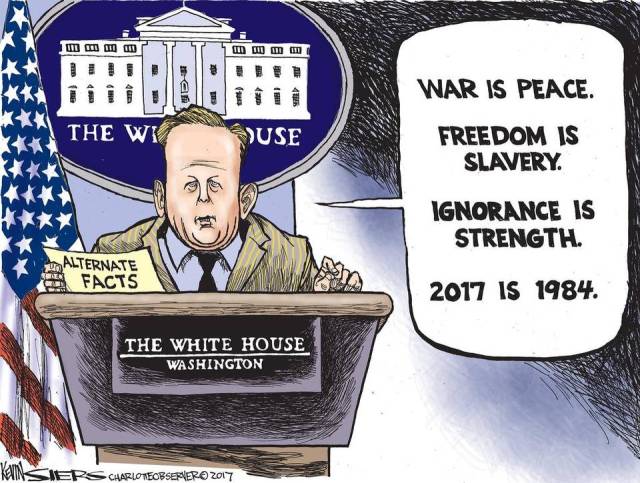
Since our fearless leader arrived on the scene, there has been much debate over the matter of truthfulness. Though the word truth may not be as fashionable as it once was, it is still used a great deal in everyday language. I have my own ideas about the definition of the word, but etymologists tell us language is in a constant state of flux. With that in mind I decided to look up the definition of the word to see if its meaning had changed during the past 80 or so years. It seemed to not have changed appreciatively since the day a few decades ago when I lied about throwing a hatchet at my brother.
The definitions of the word “truth” I found confusing in most cases; for example, one was “the quality or state of being true,”  which I did not find to be helpful. It reminded me of the meaningless cliche “it is what it is.” However, I was pleased to learn that some of the synonyms used george-washington-cherry-treefor truth, such as candor, honesty, and sincerity, are still associated with the word. Along with a few million other kids I was indoctrinated with the fable of George Washington and the cherry tree. The moral of that story was very clear that lying about the deed was as bad or worse that the deed itself. To that end when my father confronted me about a misdeed, and said “don’t lie to me” I soon learned that I was more likely to escape corporal punishment if I confessed.
 

Truthfulness in the “good ole days”

According to my recollection, truthfulness was highly regarded in those days; although there were situations in which lying was condoned. For example, horse traders, much as the used car salesmen of today, were famously expected to lie. In those days I am told that transactions involving horses were seen as a competition testing the ability of the buyer or trader to judge horses, and the rules about truthfulness were suspended. In most situations however; truthfulness was considered a virtue and liars were regarded as on the same level as wife beaters.
My indoctrination into those ideas about truth was successful, and I value them even today, although I must confess that I have transgressed a few times. In most cases I have rationalized by telling myself they are only white lies, minor exaggerations, or embellishments, and that there are times when truth can be hurtful. As a consequence, I tend to classify lies as to their size in order to excuse my behavior. However, according to the Smith classification, any prevarication uttered by the most powerful man in the world is a whopper with the potential of dire consequences for the entire world.

I Don’t Care if Trump Lies

With all that in mind, you can imagine my chagrin when I ran across an article in the January 23 issue of “The Daily Wire” titled 5 REASONS I DON’T CARE IF TRUMP LIES. It was written by John Nolte who had previously been editor of the far right web based Breitbart News which was also the former home of Steve Bannon, Mr. Trump’s advisor. Mr. Nolte justifies the lying by using “the old everybody does it” strategy we used in grade school by saying: “Politicians lie. That is what they do.” He goes on to say “In politics lying is a tactic, and if you don’t use that tactic, you’re screwed.” 19c05de8e57fda9170ee3a1e7a95e269How many times in history have we heard that. If indeed the most talented at lying have an advantage at the polls, it might explain why there appears to be so much dissatisfaction about the performance of our elected officials. Nolte is not so charitable with the major news outlets that he describes as “evil” due to their dishonesty, but assures us that “I will not lie.” Yes, I am sure George Washington would be pleased to know someone is following in his footsteps.

Fake News. Confirmation Bias. The Internet Conundrum.

4e6661deeb79365cf2ad34752f12c3f7The term “fake news” has been bandied about a lot lately, but that seems to me an oxymoron. If it is fake, it is simply a lie, certainly not news. No matter what it is called, the internet has become a fertile field for its growth. It allows any individual to send whatever lie he chooses with impunity to large numbers of people who are then capable of spreading it to others like an epidemic. The more outrageous or unusual the story, the more likely it is to be widely dispersed. The volume of such misinformation is such that there is something for everybody so that a person is more likely to believe something if it supports his own beliefs or prejudices, and discard that with which he disagrees. This has been called the confirmation bias.
As he continues to surf the web, he will be drawn to those sites, truthful or not, which confirm his beliefs. So armed, he becomes even more entrenched in his opinions and more unlikely to listen to alternative ideas. In my opinion this is one of the major contributors to our divisiveness. Unfortunately his conclusions may have been influenced by faulty evidence.

In an optimistic essay in the December 29, 2011 issue of the Atlantic, by Rebecca Rosen titled TRUTH, LIES and the INTERNET, she acknowledges that the internet is a repository for much misinformation, but comforts us by insisting “the internet has brought a golden age of Fact Checking,” and goes on to say “…..the good news is that the Internet is nurturing accuracy.”

So much for prophecies: here we are six years later with the development of wonderfully complex lie machines, which are not only capable of reaching millions of people, but can actually tailor their lies to appeal to certain groups or even individuals. In the face of such onslaughts, all the fact checkers in the world could not keep up with their output.
Not only has the internet provided a convenient platform for the delivery of lies, new techniques such as the twitterbot are now used to overwhelm and prevent access by competing messages.

In contrast to the Atlantic article, Richard Clarke’s book, Cyber Warfare has turned out to be prophetic. He had warned in his book that the US was sorely lacking in preparedness for cyberattacks. Russia has proven him correct in his assessment by their role in attempting to undermine our electoral process. I have heard several comments on TV which attempt to assure us that the outcome of the election was not affected by these cyberattacks; however I find it hard to believe that anyone could be certain of that since there are so many intangibles which may affect such outcomes.

Whatever the effects they may have had on the outcome of the election, the specter of even the possibility of an illegitimate presidency or treasonous staff members is a win for the Russians due to the loss of confidence in the process. Slanderous comments about various politicians are accepted as fact by some which further undermines the trust in our system. Attitudes so developed may also result in a cynicism about our government which may discourage our brightest and most dedicated from a career in public service.

Facts. The truth. The whole truth. And nothing but the truth.

When testifying in a court of law all people must swear to tell “the truth, the whole truth, and nothing but the truth”. This oath is said to have been traced to the 13th century. Those guys must have been pretty smart, for they already were aware of how one could make a lie appear to be the truth. Unfortunately, counterfeit truth tellers are not required to take such an oath in ordinary situations. They can avoid telling the “whole” truth by taking something out of context, usually a word or modifying phrase that changes the meaning of what is said. The “nothing but the truth” phrase forbids the mixing in a lie or two which can also change the gist of the message. Such strategies seem to me to be used more frequently now than in days past.

190583Beliefs and opinions are not facts. Facts are a necessary component of truth; however truth is more than that. Truth requires an understanding of the meaning of the facts, their relevance to the issue at hand, and their context. Truth is necessary for our survival. Truth is essential for development of trust. Without trust, chaos reigns and society disintegrates. Truth is honest, sincere, and respectful. Truth is especially important in today’s messy world, but currently seems to be in short supply.
Since I began this essay, I noted that Time Magazine featured a lead article on truthfulness. Although I was initially dismayed to have been scooped, I was nevertheless heartened that the issue is getting the attention it deserves. Of course lying is not a recent development.  It has been said that THE TRUTH WILL SET YOU FREE which leads one to ponder the question of the effect of its absence.   Plato addressed its seriousness a bit before my tenure when he said:
“FALSE WORDS ARE NOT ONLY EVIL IN THEMSELVES, BUT THEY INFECT THE SOUL WITH EVIL.

SEARCHING FOR PATRIOTS:

PEOPLE WHO LOVE, SUPPORT, AND DEFEND THEIR COUNTRY AND ITS INTERESTS

The fat lady has sung and it is finally over. Hillary won the battle (most votes) but lost the war. It’s time to wipe away the tears and take off the black arm band. The center of the universe has been relocated to the lobby of Trump tower, where supporters arrive hoping to take the elevator to the top and be rewarded by the great one. We were wrong about so many things. We expected this to be a landslide victory for the Democrats, but we were also wrong about Mr. Trump. From the very beginning of this crazy campaign, he had been telling us that he was the greatest, and now here he sits at the top of his tower dolling out goodies to the faithful as he becomes the most powerful person in the world. It doesn’t get much greater than that.


THE NASTIER THE BETTER
Conventional wisdom says that negative campaigning works, and this election has set new records for the use of that strategy with name calling, character assassination, unproven accusations, misquotes and even threats. In most any other situation, such discourse would be labeled slanderous. There has also been a great deal of scapegoating, divisiveness, and fear mongering. I, for one, can see no benefit to my country by the use of such tools by our leaders, which inspired me to ask the question: “Where are the Patriots?”

We hire our leaders in jobs all the way from school boards to presidents to run things and look out for us. We expect integrity, and we hope for wisdom. It seems to me that both are too often lacking. The size and complexity of the operations of the federal arm of our government must make for endless opportunities for corruption. When those we have hired make self-serving decisions rather than for the common good, we are betrayed. Rude and disrespectful behavior by our leaders cheapens us all. Those who promote hatred between groups of citizens weaken our country, for as one of our most famous Patriots said, “We must all hang together or we shall all hang separately.”


IF YOU CAN’T BREAK IT, GO AROUND IT
The separation of powers principal was wisely developed by the founders to hopefully eliminate the effect of the lust for power that is so common in many job seekers. Congress is charged with the making of laws, the Supreme Court with deciding on their legality, and the president with the power to veto. Initially those selected to govern considered it a sacrificial duty to serve, and there were not many clamoring to leave their farms to spend time in Washington. However, it was not long until debates in the halls became a bit rancorous, factions developed, and eventually the two party system evolved. Nevertheless, issues continued to be debated. Recently, however, congressional rules have been used to stifle debate, and the majority leader in the senate not only refused to bring up for vote bills unpopular with his party, but shamelessly announced in public that his first priority was to prevent the president from having a successful term. This was said without any apparent regard as to the effect such obstructionism would have on the country.


NAÏVE ME
This statement floored me, for, despite my inherent cynicism, I still believed that those whom we had employed were more concerned about their country than their political party, or their reelection. The idea that 250 or so people could all sit in the same room and have the same opinion about anything flies in the face of anything we know about people, yet the party proceeded to vote in lock step against every issue proposed by their congressional opponents, or the President. There were record numbers of filibusters. Compromise became a dirty word, analogous to the N word to describe our President. Of course, Democrats were not entirely blameless. The dislike each side had for the other reached an intensity bordering on outright hatred. I ask you, how could these guys call themselves patriots?

This level of dysfunction virtually guaranteed that little work would get done. There was more time and money spent on investigating each other than legislating. As a matter of fact, they passed fewer bills than at any time in recent history. People were fed up, and Congress’ approval ratings fell dramatically to record lows. Congress was judged to be even worse than the President, who was very near the bottom himself. Rather than having rational, adult discussions in search of solutions to the country’s problems, they chose to blame each other.  Much time was wasted, and there was little time to waste. After all, this had become a part time job. Some of these guys admitted that they spent more time raising money than on governing.


PARTY LOYALTY
The people were angry and were looking for someone different to run things, and they found such a person in Donald Trump. Oh was he different. In fact, many in his own party scoffed at him for entering the race. They refused to endorse him and cited a number of reasons why they judged him unfit to be president, yet, after he was nominated, they said they would vote for him. They gave no reason for their vote, and few indicated their opinion of his competence had changed. I was appalled at the thought that elected officials would vote for a leader who they were convinced was unfit. Anyone who believed Mr. Trump was unfit to be President would obviously believe that such a presidency would put our country at risk. How could anyone put party politics ahead of their country? I was also disappointed that no one seemed to take note of this behavior, which I thought was, if not treasonous, certainly unpatriotic in the extreme. I am sure that if questioned about this decision to vote, we would hear that the other choice was worse, but that doesn’t excuse it in my opinion.


IS ANYBODY OUT THERE?
It would be reasonable to expect to find a lot of patriots in the halls of our government, and I am sure there are many who satisfy the criteria as defined in the subtitle of this paper; although at times they are not very visible.  It seems to me that patriotism should be a requirement to be considered for the job and that applicants should understand what that word entails. An American flag behind a desk doesn’t guarantee its occupant is a patriot.  That can be known only by his deeds. Although this country screws up occasionally, we have much for which we can feel proud and grateful. One of such things is the freedom to say most anything, and even to be a jerk, but civility is probably more effective as a strategy to get things done. That freedom has been paid for with the blood of patriots. It demands our respect and should never be abused. Let’s hope patriots  prevail, and our leaders read their job descriptions carefully.

THE DONALD

My new editor has suggested I comment about our imminent election from a shrink’s point of view, so I interrupt my series of wondrous insights about work to follow her directions.

The American Psychiatric Association has determined that it is unethical and unprofessional for psychiatrists to attempt to make diagnoses without doing a face-to-face examination; consequently, I will confine my comments to what I have observed, although some of the mental mechanisms involved are hard to ignore. Psychiatrists are taught to be aware of their feelings towards their patients in order to be reasonably objective in their analyses. With that in mind, I need to confess that I am not only a wild-eyed liberal (a term most democrats are afraid to use these days), but I am convinced that Mr. Trump is a jerk of the highest order.

With these biases out of the way, I now feel I can be a bit more objective in my analysis of his behaviors, to which we have been exposed continuously throughout this ridiculously long campaign. While most of the obscenely rich avoid the limelight, the Donald appears to relish it. He has a long history of self-promotion beginning long before his foray into politics. This has prompted some to label him as the possessor of a narcissistic personality disorder.

There are other behaviors which lend support to this impression. For example:

  1. He states repeatedly that he is the only one capable of solving whatever problem is mentioned
  2. He does not admit to mistakes
  3. He does not apologize
  4. He blames others when he loses
  5. He denigrates others in order to magnify his own achievements and self-worth.

Others look at the business dealings where he has been accused of failing to pay those who did work for him, his escape from a failed venture with a huge profit while investors lost money, and his use of bankruptcy on more than one occasion to line his own pockets while others lost. However, to me, the most egregious of all was how he was able to extract large sums of money from those who could ill afford it with the formation of the so-called university which bears his name. Those who feel victimized don’t find legal recourse a realistic option, for few have the resources to take on Trump’s army of lawyers. Mr. Trump is not the least bit apologetic concerning any of this, nor does he demonstrate any remorse, but rather describes these strategies as evidence of his outstanding talents as an astute business man. These characteristics undoubtedly contribute to the judgement by some non-professionals that sociopathy is the hallmark of Mr. Trump’s character, but of course, the two diagnoses are not mutually exclusive.

There are also those sexist comments and allegations which do little to polish his image. Those women who have accused him of sexual assault have apparently been silenced since he threatened to turn his platoon of junkyard-dog attorneys loose on them. While professing to be champion of the people, he uses his power to intimidate people by threatening to bring suit against those who do not have the resources to fight a court battle. He has even promised to appoint a special prosecutor to investigate Hillary Clinton in order to “put her in jail.” So much for the peaceful transfer of power.

One should not make the mistake of thinking that Mr. Trump is stupid just because he says stupid things. I am convinced that his outrageous behavior is all part of his game plan. First of all, he needed to get attention, a process in which he was well versed, having spent much of his life working to be noticed. He was wildly successful and totally dominated the news cycles. The more outrageous he became, the more press he received, all without cost to him or his campaign. His pugnacious attitude, name-calling, ridicule, and character assassination was well received by a large segment of the population, who felt they were not well represented and had been left behind.

He validated and even encouraged the anger these people felt. He promised to wipe away all their grievances and take them back to a better time. The “never Trump” crowd called him a bully and predicted that he would eventually implode, but they underestimated the depth of that anger. His followers cheered when he promised to resume water boarding when necessary and to “bomb the hell out of ISIS.” There was the famous wall he would build and force Mexico to pay for (hopefully not by bombing the hell out of them).   I also
Tyrants such as Hitler or the little dude Kim Jong-un  in North Korea have long used the technique of finding a common enemy, e.g. a person or group of people on which to blame the country’s problems as a means to unify them. For Trump, it began with his rant about the undocumented, and later he would incorporate Muslims. Although very effective, such tactics promote bigotry and even persecution, which help explain his endorsement by skinheads and the like. It also provides simplistic solutions to complex problems.

As we might expect from the previous comments, Mr. Trump is not one whom one would expect to be very gracious in defeat, and he has provided himself with insurance to guard against the “agony of defeat.” Whenever he has seen himself slipping in the polls, he insists that “the system is rigged.” He declares there are thousands, if not more, fraudulent votes counted each year, just one of many untruths delivered in his rants.

He also presented the FBI director’s decision to not recommend prosecution of Hillary as further evidence of “crooked Hillary’s” influence. He vilified the FBI and labeled the entire department and its director corrupt. When FBI director James Comey recently announced the discovery of emails which might be pertinent to Hillary’s case, Trump quickly switched gears, and extoled the virtues of the FBI and its its director in glowing terms.

Comey’s announcement violated a long-standing policy of withholding any information concerning an ongoing investigation. Pundits concluded that this was a C.Y.A. on the part of Comey so that he would not be embarrassed if a prosecutable offense was found in the emails after Hillary became president. Nevertheless, the timing, with only a week to go before the election, can’t help but make one wonder if some of Trump’s ramblings have intimidated Comey. It is also true that Comey, who was appointed by President Bush, is a Republican. Maybe the Donald was right all along, and it is rigged. But not in the direction he thought it was. How is that for ending with a tad of paranoia?

Be sure to vote on Tuesday, even if you are convinced both candidates suck, and remember: if Trump wins, we may need that wall to keep Americans from migrating to Mexico.

THE GUN BATTLE – Watch the Just the Facts Video

All those guys whom we elected to debate issues our country face have been locked in an adolescent food fight for several years. They are our employees, and are paid reasonably well. I contend they are not doing the job for which we pay them, but we don’t seem to be able to fire them. Statesmanship and decorum is lacking. Their so called debates have even included personal insults. It reminds me of the debates we had in grade school which were not designed to determine who or what was best, but rather who was worse. Most polls suggest that our congressional representatives are tied with each other for the honor of being the most inept, as they are the most unpopular congress in our history.

Independent thinking and deliberation are a thing of the past. On most substantive issues members of each party vote the “party line” with no apparent questioning of what is the most rational position on an issue. Since all Republicans think one way and all Democrats agree with each other, the whole lot would appear to fail the test suggested by Walter Lippmann that when “all think alike, no one thinks very much.” In that sense, they are more like a gang than a deliberative body.

It now appears that this august body has reached a new low in cynical disregard for the people who they are sworn to represent. The leadership has refused to deliberate or vote on a bill which is very important to a majority of their citizenry, apparently in order to avoid taking responsibility for their position. It is understandable that they would want to keep their positions secret since even a vast majority of republicans want a vote on this bill. The only logical conclusion is that the will of the NRA is more important than the will of the congressional representatives’ constituents.

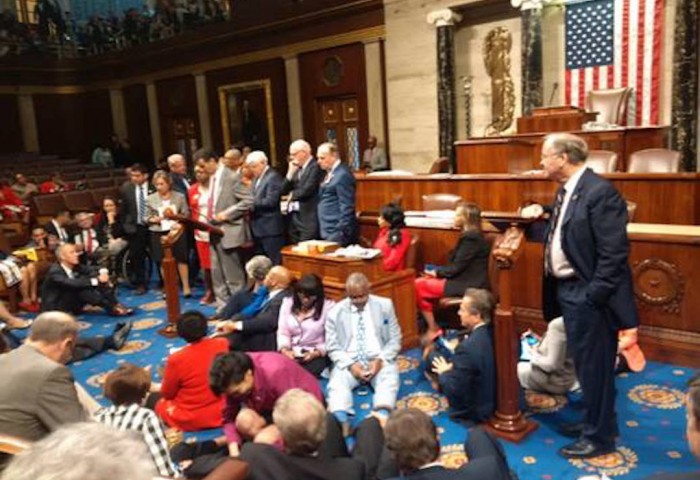
But let us not forget the Democrat’s role in this subversion of the will of the people. Both parties will blame the other for refusing to negotiate in a civilized respectful manner, but no matter who is to blame (I suspect both are ) they don’t seem to talk to each other anymore. The Democrats have said to hell with decorum and are engaged in a sit in within the house chambers. Perhaps this is progress, an indicator that they have matured beyond preadolescence  and have adopted a strategy more popular with college age kids.

The current situation could possibly be resolved by luring the Republicans into the house chamber with the Democrats and locking the door with the admonition that could not come out until differences were resolved. There is the risk; however, that that this could degenerate into an out and out physical brawl which has some precedent in other countries.

Since facts about the issues surrounding guns are hard to find if one only listens to the politicians, I found a video that presents “just the facts.” Enjoy, and let your representative know what you think.

Indeed, a government by the people needs to hear from the people in order to be effective. Email, write, call your congressional representatives. Click this link for contact information.

SUCCESS

carterThe other morning I awakened to a pleasant surprise. CNN had someone on the screen other than Donald Trump. Jimmy Carter was holding a news conference about his illness and plans for the future, a future that one could safely assume was rather limited since he acknowledged that he was about to undergo treatment for a melanoma with cerebral metastases.

As a cancer survivor myself (see: THE BIG C AND ME) I felt my admiration grow even more for this man who had always been my hero. This 91-year-old man of unshakable faith, showed no bitterness or self- pity, but was determined to carry on with his life’s work as long as he could function. His response to questions about how he felt about his illness was typical Jimmy Carter: “I will hope for the best and accept what comes.”
As I considered the accomplishments of this person who had come from inauspicious beginnings as a peanut farmer in a small town in Georgia, a feeling of awe came over me. As a young man he left the small town of his childhood to attend Annapolis, bent on a career in the Navy. Subsequent to that, he attained an engineering degree and was involved with Admiral Rickover in the development of nuclear submarines. After returning home, he not only was elected governor of his state and then to the highest office in the land, but won a Nobel Peace Prize after negotiating a treaty between Israel and Egypt that may have saved thousands of lives. It would also seem unlikely that a son of the deep south would become an outspoken foe of bigotry and a strong supporter of human rights throughout the world, but he did. A failed attempt to rescue American hostages in Iran is said to be responsible for his defeat for a second term as president.

Mr. Carter’s presidency was labeled by many as a failure, and his many achievements in economic and foreign policies have been largely ignored. His integrity however has never been challenged. His fulfillment of his promises to “never tell a lie” and to “never avoid a controversial issue” did not enhance his popularity, for as any successful politician will admit, truth telling is not a winning strategy in the political arena. His successor however could have used the tune “don’t worry, be happy” as his theme song.

The loss of his presidency would prove to be the beginning of even greater exploits. Most ex-presidents build libraries which are more like monuments to themselves. They seem to be very concerned about their legacy, which shouldn’t surprise us, after all those with weak egos are unlikely to ever make it to the top spot. Mr. Carter; however, used his monument as a platform on which to establish a center to “wage peace, fight disease, and build hope.” He did confess in his news conference that he has cut back his schedule somewhat, but still plans to remain involved in The Carter Center’s operation. When asked about his most fervent wish, he replied “to outlive the last guinea worm.” For those not familiar, the guinea worm has been a prevalent cause of much suffering throughout many parts of the world and has been almost totally eliminated through the efforts of the Carter Center.

Not only was I impressed with his vigor and enthusiasm, but by his abiding concern for issues he obviously considered more important than his own. Now I ask you, how could you not love a guy like that? For me, listening to him was very emotional. I experienced an intense feeling* of respect. A few days later, a grandson happened to be visiting and we were discussing my blog. As reigning patriarch, I have issued a hard and fast rule that all family members must read this stuff whether they like it or not. Accolades are appreciated, but not required. On the other hand, those who are critical should expect to move down a notch or two on the Christmas gift list. After successfully passing the quiz on the contents of my last blog (although not a fan of Ronald Reagan, I do subscribe to the trust but verify policy) he went on to suggest that I do an essay on success.
Since both my grandsons are beginning their senior year in college, I could understand why such a topic might be on their minds. I also felt the topic particularly serendipitous due to my recent encounter with Jimmy Carter. An analysis of his career brings up the problem of defining exactly what we mean by the word success, and how do we make that judgment? What do we mean when we say a person is a success or a failure? Does it make any sense to make such all encompassing judgments about people since the inconsistent conclusions arrived at by those who are judging would seem to prove that such distinctions are quite subjective. Is success like many other things in life in the eye of the beholder?

There generally seems to be a consensus that Carter was the most successful ex-president in our history, but the agreement ends there. As to the rest of his life, there are those who applaud and those who consider him a failure in many ways. One could say that his political career was a mixed bag. He lost his first bid for governor of Georgia, and his Camp-David_wareelection for president. His presidency was mired by so called “stagflation” for which he was blamed by some while others gave him credit for initiating policies that got the economy back on track. I believe most historians would agree that the negotiated peace treaty between Israel and Egypt was his most laudable success. In spite of this, he was accused of anti-Semitism for his book on Israeli politics: “Palestine Peace not Apartheid” in which he presented the Palestinian side of the story.

With this in mind one must conclude that the distinction between success and failure very much depends upon one’s values. Those of us of a more liberal position are more likely to judge Mr. Carter as a successful person than those of a different political persuasion. Our success in competitive activities such as sports can be more easily determined by winning. We also have developed tools, even though crude, to help us measure academic success. In business, success is generally measured in terms of profits generated, but we have no way to assess the most important facets of life such as honor, compassion, fidelity, fairness, integrity, parenting, and citizenship to mention a few.

The term success is usually viewed favorably by society, but can also have negative connotations. The most succinct definition I could find was “the accomplishment of an aim or purpose”. Obviously if that goal is nefarious in nature the accomplishment will not be viewed in a positive light. For example there are successful criminals, con-artists, and other asocial people. There may also be an issue with the means of accomplishing the desired goal. There may be not only illegal but unethical factors contributing to an individual’s success. Unfortunately such behaviors are many times ignored as successful people are often idealized.

Is the Key to Success Linked to the Courage to Fail?

With all this in mind I have come to the conclusion that each individual is the only one who can judge his success. Of course we need to set goals if we want to be successful in reaching them, but if the goal is to leap tall buildings in a single bound our chances of success are diminished. I have known people who are reluctant to set goals for themselves presumably due to fear of failure. I can only assume their life must be very boring. Success requires risk, and one must be prepared to accept failure for in spite of our best efforts we will not always succeed. It is said that many of the most successful people throughout history have had multiple failures prior to achieving their goals. In my own case, although I have never aspired to lofty goals, I figure my success rate to be about one success for every 10 failures. It is therefore logical that success usually requires a certain amount of determination, and the ability to not be dissuaded by failure. It also lends credence to the age old admonition: “If at first you don’t succeed, try try again.”

Flexibility in interpreting results may also be helpful. At times it may be necessary to revise or reframe one’s expectations. There may be unintended consequences of reaching one’s goal which may exceed or diminish expectations. If a goal is not attainable, it may be possible to modify it in such a manner that one can still enjoy the feeling of success. I have a brilliant close friend and colleague who has written much about psychiatry both for lay and scientific consumption, most of which has remained unpublished. I sense that he thus feels as if he is a failure even when I point out to him that he has been successful in producing thoughtful extremely well written material, and further remind him that his judgment is at least as good as the editors who reject his writings. It is always dangerous to allow someone else to be in charge of one’s self-esteem.
Most successes go unnoticed so it is important that we acknowledge our successes to ourselves. Patting oneself on the back does not necessarily denote arrogance, and will help us develop the confidence needed to pursue more successes. Failure sucks, but even an occasional success will rid us of that feeling. Mankind has undoubtedly been motivated by the search for that feeling one associates with reaching a goal.
At this point in my blogging career, I find it necessary to modify my goals for success. I have come to accept that my writings will not be appearing in the New York times, be going viral or be considered for a Pulitzer Prize; consequently my quest for fame and fortune must end. To that end, I will reread this thing and convince myself that it is worth reading, and crown myself a success.

*One of my friends who reads this stuff has questioned my definition of respect as a “feeling” in my last blog . The highlighted word is for her.

THE GREAT DEBATE

Republican presidential candidates from left, Chris Christie, Marco Rubio, Ben Carson, Scott Walker, Donald Trump, Jeb Bush, Mike Huckabee, Ted Cruz, Rand Paul, and John Kasich take the stage for the first Republican presidential debate at the Quicken Loans Arena Thursday, Aug. 6, 2015, in Cleveland. (AP Photo/John Minchillo) ORG XMIT: OHJM122

Republican presidential candidates from left, Chris Christie, Marco Rubio, Ben Carson, Scott Walker, Donald Trump, Jeb Bush, Mike Huckabee, Ted Cruz, Rand Paul, and John Kasich take the stage for the first Republican presidential debate at the Quicken Loans Arena Thursday, Aug. 6, 2015, in Cleveland. (AP Photo/John Minchillo) ORG XMIT: OHJM122

Along with a few million others, I recently watched the republican debate which had received nearly as much hype as the Super Bowl.  Well I should qualify that statement by admitting that I checked out and went to bed after the first hour.  When the next day I asked my political junkie wife if I had missed anything important, she thought I had, but couldn’t remember what.  It has always seemed to me a bit disingenuous to call these spectacles debates.  My understanding of debates is that opponents line up on either side of an issue and present their arguments in favor of or against it.  When I was in high school we had a debate team which the smart kids were invited to join; consequently I received no such invitation.

THE SWIMSUIT COMPETITION

Presumably those who reach the level of presidential candidates must be intelligent.  I heard one pundit mention that Senator Ted Cruz who is a graduate of Princeton and Harvard Law school was an outstanding student and is extremely intelligent.  Perhaps he is a more humble person than he appears, as he has managed to hide this quality quite well so far.  The show seemed more like a Miss America pageant as the presidential hopefuls were all putting their best foot forward and doing their best to look presidential.  Mr. Rubio was by far the handsomest of the group in a boyish sort of way.  Mr. Trump had appeared to modify his coiffure; although he did not show up in his baseball cap, which he wears at campaign stops presumably to let us know he is just one of the guys.  I have also noted that many of those running for the office now give their stump speeches dressed sans coat or tie and often even with sleeves rolled up, just like normal people.  But on this night they all wore suits and white shirts adorned with their favorite power tie.

NO LIVES WERE LOST

The viewership of these so called debates may also be explained by the public’s hope to witness an historic calamitous gaff, much in the same manner as some watch auto racing to see if there will be a crash.  Now, any politician knows that if one is to be successful it is imperative that he/she never directly answer any question.  During the time I watched I thought the interrogators did a credible job of asking questions, but they were outmatched by this chorus line of masterful diverters.  In most instances they were able after their non-answers to slide seamlessly into a dissertation of all the qualities and experiences that guarantee they are the most electable candidate.  Of course in politics electability always trumps ability.

FAMILY STUFF

There appeared to be a consensus that it was necessary to convince the electorate that they were all just like us.  Those with humble beginnings used their childhoods as proof that they were of high character, and understood our problems.  I did listen with interest as my own Governor Kasich listed his accomplishments.  Frankly, until then I didn’t realize how good I had it.  Although I thought he had done some good things, I could not understand how the fact that his father was a mailman figured in as a qualification to be President.  On the other hand when Jeb Bush insisted that he was proud not only of his father, but also his brother, I felt this called his judgement into question.

WHAT WAS I THINKING

After thinking more about the subject I realized that it would not have been possible for a debate in the classical form to have taken place.  Since all republicans in congress vote together on almost every issue, it would be difficult to find an issue in which one could find opposing sides.  While democrats seem to think it is cool to disagree, republicans agree with each other on all important issues, which brings to mind the famous quote by Walter Lippmann: “where all think alike, no one thinks very much”.  One should not generalize; however as they do have some outstanding thinkers in their distant past: Teddy Roosevelt and Abe Lincoln for example.  Far be it for me to disparage any of today’s best and brightest, but it seems unlikely that any of these contestants could channel those spirits.  Conversely; I believe it was Will Rogers who said “I am not a member of any organized political party, I am a Democrat”.  Somethings seem never to change very much.

NO NEWS EQUALS MORE PUNDITRY

It has been nearly a week since that momentous occasion, and the pundits are still at it.  Since there have been no major catastrophes to report other than a couple of shootings of unarmed citizens, which have now become so common that they are hardly newsworthy, they continue their focus on the big show.  My charming wife is addicted to CNN; consequently I have endured continuous exposure to a long line of experts with often conflicting observations.   There did appear to be a consensus that “the Donald” was the victor.  It is true that he made the most noise and received the most attention, and in this day and age that is probably all that is needed to be victorious.  He apparently subscribes to the widely held premise of agents and advertising experts that there is no such thing as bad publicity.

WHERE ARE THE GAFS WHEN YOU NEED THEM

There were a few negative comments about Ran Paul’s temper, but I sensed some disappointment at the lack of any major screw-ups. It would have been nice if someone would have forgotten their lines a la Rick Perry, or something like the famous John Kerry gaf: “I voted against it before I voted for it” could have spiced up the narrative.   Mostly the contestants “made nice” with Mr. Trump because of his implied threat to run as a third party candidate  if they were mean to him which would likely  result in a democratic victory.  Besides it would be sacrilege to violate their hero, Ronald Reagan’s, eleventh commandment that one “should never speak ill of another republican”.

THE SECOND TEAM IGNORED

In response to comments about the selection process, a preliminary affair was arranged for those who could not make the cut.  CNN gave the unanimous decision by a knockout to Carly Fiorina.  The ones I listened to seemed mildly surprised at her performance, but made no mention of her having been fired from Hewlett-Packard.  Since the show, I have heard little more of the also rans, and it seems unlikely that they will be able to raise enough money to buy a place on the ticket.

KICK THE BUMS OUT

If you a think I am cynical about politics, it is because I am.  From the looks of what is happening during this campaign, it appears that I am not alone.  One need only look at the crowds of thousands that are attending the speeches of an admitted socialist, and polls that show a person who had been labeled a joke a few months ago in the lead for the republican nomination to realize that the electorate is fed up.  They are clearly saying that anyone is better than those we now have.  How is it that when nine out of ten people disapprove of the job our congress is doing that incumbents continue to be reelected.

THE BEST GOVERNMENT MONEY CAN BUY

Something is seriously wrong when our representatives admit that they spend more time raising money to be reelected than doing the work for which we pay them.  There are some estimates that the Presidential election alone will cost 5 billion dollars.  Add an equal amount for all the other races for federal offices and as Senator Everett Dirksen famously said “a billion here and a billion there and pretty soon you are talking real money”.  Candidates sit at the feet of billionaires, and beg for contributions.  Commentators assume that those with the most campaign money will win their elections.  If money is speech as our ideologically tainted supreme court says, then thousand dollar a plate dinners speak volumes.  It seems to me that we could fix a lot of pot holes and feed a lot of children with a few of those billions.

ENOUGH ALREADY

The election cycle is a thing of the past for campaigning is now continuous.  The term: statesmanship is rarely heard anymore.  Campaign TV choreographers put more focus on personality than qualifications.  Ads denigrating and slandering opponents have proved to be effective; consequently we are deluged with negative ads.  The media outlets are the only ones I know who like this stuff, but it seems to work.  Repetition must be a necessary component for successful brainwashing.

CHEATERS NEVER PROSPER???  

In many countries elections are rigged usually by intimidation or fraud.  As an enlightened and democratic country, we are proud to say that our elections are fair and closely monitored.  That is not to say that our political parties have not looked for creative ways to shift the odds in their favor.  Undoubtedly those involved in these ploys would find ways to rationalize their behaviors, and deny unfairness.  Our news media give less coverage to these sorts of things than they due to an under inflated football, and it disappoints me that there is not more outrage.  My favorite peeve of these strategies is the gerrymandering which has become an accepted means of revising boundaries to give one side an advantage.  It has become accepted practice by both Republicans and Democrats.  Even more outrageous and deserving of contempt however are those attempts by some states to limit voting of certain groups by requiring ID not readily available to them.  In most cases they are not only undemocratic, but racist as well.  These are the kinds of shenanigans that bring shame to a democratic society, and undermine the faith we need in our government if we are to survive in a hostile world.

KEEPING THE FAITH

There is no doubt in my mind that we live in the best country on earth.  It is also clear to me that it can be better.  History informs us that no government is free from risk of decay from within.   We remain the most powerful nation on earth but we need to remember that power does not guarantee righteousness.  I am grateful that in my country I am able to write these kinds of criticisms of my government without being hauled off to jail or worse.  In my opinion that is the most important freedom of all.  Well there I go again, starting to preach when my assignment was only to apply my extraordinary journalistic skills to cover the debate.  Hey, that giant ego thing works for Trump, why not me.