The Way It Was | Part 2

Note from the editor: Click here to read Part 1 of “The Way It Was”

Conversations Overheard

There was a fringe benefit for me from the depression in that I received my first indoctrination into the ways of the world which included comprehensive discussions of politics, economics, world affairs, and morality but with a special focus on means of survival in difficult times.  My education occurred while lying on our living room floor listening to Dad and friends (not to be confused with Fox and Friends) debate all kinds of issues while they focused on possible work sites.  The men were regular visitors to our house where they met and planned strategy to find work.  It is likely that they were attracted to our house as a meeting place by Dad’s famed home brew.  Although he was not a bootlegger per se, he was known to have occasionally traded a bottle or two for some needed commodity.    I was an accomplice in the enterprise as I took great delight in placing a cap on each bottle and watching Dad press it in place. 

There must have been a robust feeling of camaraderie amongst those guys who were all in the same sinking boat.  There was laughter in spite of their dire circumstances, and there were frequently told colorful stories which without benefit of Dad’s home brew would not likely have reached my tender ears.  The coarse language was not lost on me, and was quickly incorporated into my vocabulary, the use of which would often get me in trouble.   One particularly memorable event occurred when Dad took the guys down to our cellar to show them his success of the day.  He had received a feisty old rooster in return for a day’s work, and the rooster was confined to the cellar, a small space with a dirt floor cool enough to render the beer palatable.  Someone stumbled over the pan of water left for the rooster and Dad filled it with beer.  Surprisingly, the old guy imbibed with gusto and was soon stumbling, flapping his wings, and attempting to crow in a falsetto voice.  If he was hung over in the morning it was short-lived as a few hours later he would be on a platter sharing space with some drop dumplings.

Work

In spite of the bravado most of the conversations had to do with work or rather the lack of it.  The meetings were unscheduled and men would drop in at various times during the evening with comments like “I thought I would drop in to shoot the shit.”  There were always rumors of things to come both good and bad… this place was laying off, another was going to be hiring, another business was in trouble and about to go under, etc.   In 1933 the unemployment rate is said to have been 25%, but that number does not tell the whole story.  Many who were said to be employed were actually able to work only part time.  For example, Barb recalls her Father listed as an employee at a local steel mill, but usually actually working only one day a week and sometimes sent home early even for those days.  He avoided eviction by painting houses owned by his landlord. 

One conversation in particular stands out in which one of the men who was employed at a local glass container factory said he had just come from his workplace and had been turned away.  He reported that at every shift change there were huge crowds of employees at the entrance hoping to be chosen to work that day, but few would be chosen.  He loudly and profanely complained that the foremen “suck asses” and relatives were always the first chosen to work.  Some jobs or professions previously considered ordinary were highly prized.  Postal workers, school teachers, and local government jobs were highly prized for their stability.  The lack of available cash led to a great deal of bartering, especially with farmers who had no one to whom to sell their crops.  Conversely, professionals such as doctors and lawyers along with day laborers were often paid with food (e.g. the story of the inebriated rooster).   

Civics (Yesterday’s Term for Politics)

No education is complete without lessons in civics and the down-but-not-outers were not shy about expressing their opinions in such matters which was probably enhanced by the tongue loosening effects of Dad’s beer.  There was considerable disagreement amongst the group with almost everything.  In our home Dad was registered as a Republican and Mom was a lifelong Democrat.  I have the opinion that in those days one usually belonged to the party with which they had grown up much as with they do with religion.  Dad in spite of his upbringing had experienced an epiphany: he blamed Hoover for the depression and lauded FDR’s efforts to restore the economy. 

Those on the negative side of the debate were equally vociferous in their ridicule of FDR’s “make work programs” and “socialist stuff.” There were all kinds of jokes referring to the WPA and their workers having a penchant to be seen leaning on their shovels.  With the establishment of social security in the mid- thirties the idea of government taking money out of his check (if he had one) and giving it to someone just because he got to be 65 years old did not sit well with the naysayers.  A typical analysis might go something like this: “What ever happened to the idea of saving for old age” or “If they can’t take care of themselves, they should go to the poor house” (large forbidding appearing buildings euphemistically referred to as county homes).  Families were expected to care for their elderly or infirm parents consequently; they shared in the disgrace, and were denigrated for forcing their parents to “suck on the public tit.”

The most often discussed and vilified make work program was the WPA (Works Progress Administration).  The average wage was $52 per month yet one of my uncles worked in the program until it was disbanded in the early 1940s.  During that time, he managed to raise two children with the help of his wife who was able to find work cleaning the house of an affluent neighbor.  Although largely removed from most employment opportunities, wives did find ways to contribute.  For example, Barb’s Mother did laundry in her home in spite of a childhood injury that left her crippled.  The WPA worked on infrastructure projects while the CCC (Civilian Conservation Corps) focused on environmental projects.  It was an organization for young men who were housed in barracks throughout the nation and paid even less.  They were best known for planting millions of trees, often in areas where logging had left a desolate landscape.  Roosevelt in announcing its formation said; “forests are the lungs of our nation.”  They also fought forest fires, worked in national parks and landmarks building roads, trails and camping facilities.  Many such projects remain in use to this day.

Philosophy 101

While listening in on those conversations from my vantage point on the living room floor I was also privy to discussions of moral issues some of which have bedeviled philosophers for eons.  For example, one evening one of the guys reported that he knew of a place where it was possible to steal casing head gas.  Although gasoline was 18 cents a gallon, he did not have 18 cents, his car was out of gas, and he couldn’t look for work. (For the unenlightened of my readership: casing head gas is formed by compression of natural gas by functioning oil wells.  It is a very low quality fuel and can cause significant damage to automobile engines.)  Since he was without the means to get there, he was attempting to recruit an accomplice.  This provoked a heated debate.  Not only was his proposal illegal there was that “thou shalt not steal” thing in the Bible for which some thought there were no exceptions.  This brought up oft delivered hypotheticals one of which was very relevant to their situation which was “would you steal food if your children were starving?”   

Keep Walking or Go to Jail

Vagrancy laws made homelessness even a greater problem than it is today for one could go to jail for “having no physical means of support.” When I looked up the origin of such laws, I was surprised to find they were written after the Civil War as as a means to get freed slaves off the street and into the chain gangs which could be rented out, a process some called a new form of slavery.  These laws were found to be useful during The Depression as a means to rid the parks and other public facilities of the homeless.  I had always wondered where all those men I used to see walking along the highways were going.  Later it became obvious that they must stay on the move or go to jail.

These were the same guys who would sometimes appear at my Grandmother’s back door offering to do work for food.  Of course, there was no expectation that work would be done.   Grandma would bring a plate out for them and after a brief repast they were on their way. Since farmers were those who were most likely to have food to spare and cops were scarce these backroads were fertile territory.   I heard stories of farmers who discovered “bums” asleep in their haymows especially during inclement weather.  Depending on the compassion of the farmer they might be awakened by the business end of a pitchfork or sent to the house for something to eat then on their way.

Many of these hoboes or bums as they were called in those days would become so enured to that lifestyle that they would spend the rest of their lives on the move never staying more that a few days in one place.  They became expert at hopping freight trains, knowing their schedules and where they slowed enough to get on them.  They often migrated with the birds following the seasons.  They eventually developed places where they could hide for a few days at a time usually close to a rail depot but far enough away to avoid the railroad police.  It is said they verbally catalogued places that were soft touches for hand-outs.  Thus, a nomadic subculture came into being demonstrating the remarkable change which can be brought about in an industrial society by an economic crisis.

An Early Exit Prevented

At some undetermined time during those preschool years I experienced life threatening incidents one of which would label my Father as an unlikely hero.  In what was probably an effort to provide food and recreation simultaneously, he had decided to take me, my brother and mother fishing probably with the hope of making a meal of our catch.  The site, called Pleasant Valley was a favorite of mine and was next to a small conclave of houses reached via a covered bridge over the Licking river.  Its only reason for existence was a Post Office situated next to a major rail line.  It was a mail distribution facility for a large part of the county, and its fascination for me was to be able to watch the train rush past at what seemed to me to be at least 100 mph, while a metal arm reached out from the mail car, dropping a bag of mail, while snatching a similar bag, and pulling it back into the car without even slowing.

Most likely, on that day I was preoccupied with the hope that the mail train would come by.  The river was high, and I recall staring at the water as it rushed by, then everything was suddenly brown.  Probably that memory remains so vivid due to fact that I would have a recurring dream of that incident for years although; such dreams were not frightening but consisted of the sensation of floating in that brown water.  I am told that Dad saw me fall into the swollen river and immediately jumped in although he could not swim.  I was told that my life was saved by a single button for I was wearing a light jacket with one button fastened and Dad reached out with one hand and was able to grasp the jacket with one hand.  He threw me upon the bank and as he was floating by, managed to grab a root growing out of the river bank and save himself.  Thanks be to God that the button held for had it not you would have been denied the joy of reading these blogs!

Editor’s Note: Stay tuned for Part 3 of The Way It Was! 

The Way It Was: Part 1

Being deeply loved by someone gives you strength.

While loving someone deeply gives you courage. 

Lao Tzu

                  My son Peter, the history buff, has requested I write something about my childhood with emphasis on my remembrances of World War II, and events preceding it.  He believes others may be interested in that subject in spite of the millions of chronicles already written of those times he suggested that I do my own version in a blog with emphasis on the experience of growing up in that era.  The most impressive oral histories of the thirties were carried out by the Federal Writer’s Project a division of the Works Progress Administration (WPA) under the auspices of one of Roosevelt’s New Deal creations.  Although designed to chronicle the travails of ordinary people living during the depression, it is best known for the verbal histories of former slaves.  Those manuscripts now repose in the library of congress.Federal Writers Project American-guide-week-fwp-1941

It is true that much of recorded history had its genesis in oral accounts passed on from one generation to the next.  It is also true that it has been shown that memories are frequently distorted, and further colored if they are passed on verbally through a series of listeners.  In an article on oral histories published by History matters, the impetus for verbal history taking is outlined as follows: “…..for generations history-conscious individuals have preserved others’ firsthand accounts of the past for the record,  often precisely at the moment when the historical actors themselves, and with their memories, were about to pass from the scene.”  I can only hope this was not Peter’s motivation in encouraging these reminiscences for I am not ready to “pass from the scene!”

In my own case, I often thought of events which occurred during my father’s lifetime and regret that I didn’t encourage him to talk more about his childhood.  My father was born in 1904 just 10 years prior to the onset of World War I.  It would have been interesting to compare notes for I was born 11 years before the onset of the next “great war to end all wars” and arrived only a few months following the Stock market Crash of 1929 which ushered in what came to be called The Great Depression.

My Mom & Dad

My parents had little to lose when The Depression hit, but what they did have was gone.  Dad had grown up in poverty, with an alcoholic father and a long-suffering mother whom he adored.  He had quit school in the 8th grade, and went to work as a common laborer in order to help the family.  He had three sisters and an older brother, who was rather passive by nature. My dad became the adult in charge, a role which he would occupy the rest of his life.  One of the more poignant stories of his childhood I remember was his explanation of why he was fixated with having eggs in the refrigerator.  He told me that when he was a kid, his mother sent him up the alley to the neighbor who kept chickens with a penny to buy one egg.  He was embarrassed and vowed to always have plenty of eggs when he grew up.

My mother, by the standards of the day, was well educated having spent a year at a local “business collage” learning secretarial skills which she would never utilize.  Although her father (one of my favorite people) was relatively uneducated, he was a strong believer that women should be able to “stand on their own.”  I suspect that for her time she would have been considered liberated.  Model T FordI recall seeing a photo of her standing beside a Model T Ford that she had been driving that she had rolled over on its top.  In those days, for a woman to be driving a car would have be en unusual if not scandalous.  That experience must have left her shaken for she would never drive again and her back seat driving performances were legendary.  In similar fashion, she would cede much authority to my father while firmly retaining control of her department, i.e. keeping house and raising kids, a very common arrangement at the time.
Their marriage began well and a year later my brother was born, an event which was followed three years later by the greatest financial crisis in the country’s history.  As a wedding present mom’s father, a carpenter, had provided them with the labor to build a house.  Shortly after that fateful day in 1929, dad lost his job and subsequently the house was repossessed.  To make matters worse, a year later I entered this already complex picture.  I am told that I was welcomed although I am sure another mouth to feed was one of the last things needed.  Just as my kids have endured the repetitive nature of my stories of their early life, so have I endured the following story of my birth hundreds of times.

Hello World

I was born in what was called Dr. Wells’ hospital located in the village of Nashport, the name originating from the fact that Mr. Nash had settled the area as a port on the Ohio canal in the early 19th century.  To call the facility a hospital was a bit of an exaggeration even in those days for it consisted of an extra room attached to his office.  Nevertheless, Dr. Wells must have been a progressive practitioner who had abandoned the practice of home delivery in favor of modern facilities.  In my mother’s case, he even offered her the choice of anesthesia, and my father confidently volunteered to “drop ether” (a term used by anesthesiologists for inhaling ether as an anesthetic).

Fortunately, mother and I both survived the procedure which was reported to have been difficult as I weighed in at 13 pounds and have been told I was “long and skinny,” a term that would be used to describe me throughout my childhood.  Dr. Wells is said to have remarked “look at those ears, he is a little Spinney.”  Spinney was the nickname of my Grandfather who was famed for the large ears which protruded from his skull at right angles and were probably made more noticeable by the irony that he was significantly hearing impaired.  I know little of what happened in my earliest years, but it is certain that there will never be a plaque on the door of Dr. Wells hospital commemorating it as my birthplace for the building was later razed and the village was moved to higher ground in order to make way for a flood control project.

My First Memories

My family’s history for the first few years of my life is hazy, but I did learn that they had moved frequently during my toddler years.  Whether this was due to evictions or looking for a better deal I can’t say.   Alfred Adler a Freudian psychoanalyst placed great importance on our first memory stating: “The first memory will show the individual’s fundamental view of life, his first satisfactory crystallization of his attitude.”   In my own case, this pronouncement may ring true for my first memory was of my introduction to Crackerjacks while watching a baseball game in a bleacher with my parents most likely around 3 years of age.  Indeed, I see it as a prophecy of my life to come, which has largely consisted of a search for the toy hidden among the tasty morsels of everyday life even though the occasional unpleasant experience of biting down on a kernel which hasn’t popped, is inevitable.

There is another pleasant memory of that time-period which competes with the Crackerjack story for first billing.  The standard tool for mowing lawns in those days was the person powered push mower with its rotating blades which could be disengaged by turning the mower upside down.  The incident must have occurred when I was less than 4 years of age based on the timeline of where it occurred, but the memory remains clear.  My Father had placed his folded coat on the mower and I was sitting on it as he pushed it down the sidewalk.  Of course, at the time this was simply a fun time for me, but later I would learn that he was cruising the neighborhood soliciting lawns which he could mow.  I now suspect that my presence may have been designed to add to the pathos directed at potential customers.

Dinner Time

The remainder of my preschool years as you might expect are clouded and I have no way to place these in any logical sequence.  In retrospect it is clear that some of these experiences related to the extreme stresses under which my parents labored.   It is clear that we were very poor and at times they were desperate for food, a fact of which I was blissfully unaware.   In recent years my brother reminded me of times when our parents did not join us at the dinner table and chose to eat later.   Since no one had money, food was cheap, and farmers had little incentive to produce more than they could consume.  City dwellers with backyards planted vegetable gardens, and Mothers learned to preserve the produce by drying or canning them.  An apple tree in one’s yard became a valuable asset.  Even some city dwellers kept chickens in their yard which were carefully guarded lest they become someone else’s dinner.

There were occasional distributions of food via the local “relief” organization, so named as part of FDR’s Federal Emergency Relief Organization.  Food was distributed at regular intervals at the local relief office.  At a time when independence and the ability to “paddle your own canoe” was valued it was embarrassing to be seen standing in the long lines when it was announced that food was about to be distributed, and many chose to suffer hunger rather than to be known to be “on relief”.  The type of food given must have depended on whatever was available to the states at any given time for I recall my Father, having braved the disgrace, coming home with a huge bag of rice.  Mother was talented at finding innovative ways to prepare food, but in spite of her best efforts the steady diet of rice dishes for what seemed like eternity to a kid, left me with an abhorrence of rice that took me 50 years to overcome.

Stay tuned for the next installment of “The Way It Was” where Eshrink gives us a glimpse of the camaraderie between his dad and his friends as they searched for work each day during the Great Depression of the 1930s; conversations overheard about survival, politics, world affairs, and morality; and the close call that almost ended his life.

Transitions

This title was chosen by my son for reasons which will soon be obvious. His youngest has just left home, this time for good, and he and Sue are now presiding over the proverbial empty nest. It is a frequently quoted truism that if you truly love someone you will let them go when it is in their best interest to leave. I was reminded of this last night as I watched Casablanca…one of my favorite movies in which that theme was paramount. Though it is a noble act to let go of those you love, separation is painful, and usually results in significant changes in our lives.
We experience multiple types of transitions during our lifetimes, but since we are at heart social beings, or to put it more crudely, tribal in nature, changes in our relationships are apt to generate the most intense feelings. It is something of a paradox that as the world gets smaller, we find so many people of whom we care to be geographically farther away. Yes, indeed we are able to communicate with ease yet Facebook is a rather poor substitute for a next-door neighbor, or a relative living in the neighborhood. Prior to the industrial revolution, one’s cadre of friends and relatives was unlikely to change very much, and most people were born and died in the same place, often even in the same house. Now neighborhoods are in a constant state of flux, and there is a lower expectation of lifelong relationships.

STUCK WITH THEM
No wonder our children are among the very most important people of our lives. Since humans require nearly 2 decades to reach maturity and carry our DNA, we tend to form very strong bonds. We are often identified as “Johnny’s” father or mother. We live vicariously through them and share their triumphs, failures, joys, and sorrows. In many ways they are our second chance at life as we attempt to steer them away from repeating our mistakes. As the years go by our intimate involvement in their lives blurs with our own–they become part of us and in doing so shape our identity, i.e. who we are.
GRIEF WITHOUT A CORPSE
With all that in mind, it is not surprising that separation anxiety is a common affliction. When the kids grow up and leave, something more than their presence is missing. It is as if a part of ourselves is gone. Not only is the nest empty, but we feel an emptiness within ourselves, a kind of psychological amputation. In my experience, this emptiness is most profound when the youngest one leaves  for with it comes the realization that nothing will ever be the same. This time they are leaving to build their own nest.
THE FUN TIMES
Life is an ever-changing process. We begin as totally helpless and dependent creatures and experience a myriad of transitions during our lifetime all designed to produce an individual capable of building and presiding over that nest. Some of those changes are more dramatic than others. There are the first steps, the first words, the first solo bicycle ride, the first day of school, the first sleep over and a few thousand other adventures all with a goal of achieving sufficient independence to allow them to face the world on their own.
WHY DID I GET INTO THIS?
But it is not all sweetness and light. There is the messiness, the lack of discipline, the terrible twos, the out of bounds phase, the adolescent rebellion, the sleepless nights, and the continued testing of limits to name a few of the frustrations inherent in the child-rearing business. Those little buggers are also expensive. According to the USDA the average cost of rearing a child in 2016 was over $245,000 which does not include costs for higher education (but for the kids, I could have been a millionaire). Considering all the chaos they generate it is little wonder that we don’t occasionally wish them to be grown up however; one should keep in mind the maxim to “be careful what you wish for.”
BEGINNING AND END
According to the Bureau of Labor Statistics 67.3 % of high school graduates enrolled in college last year (2017). It seems safe to assume that most of these kids would leave home while in school, but retain a close connection to their old familiar environs. In many cases the college transition is a prelude and training for that final fly away. The days when we dumped kids and their gear off to a strange new environment were certainly memorable to Barb and me.
Our first experience with the off to college scenario was painful for all involved. Molly, our firstborn (now deceased), who suffered from serious medical and emotional problems was unable to complete that transition. Next in the line of succession was Peter, who was much too macho to display his feelings, but I was already missing him by the time we pulled away from his dorm. After a four-year hiatus, it was Trudy’s turn. Trudy, the adventurous one, was on the phone almost immediately, tearful and very upset to find beer being consumed at the sorority rush parties that she attended. We had no idea where this came from for temperance had never been emphasized at home. As you probably already suspect. her distress was short lived and as was her habit she soon became involved in everything.
THE LAST ONE STANDING
Of course, those separations were painful, but none so telling as Maggie’s departure for we were now returning to a house inhabited only by Barb, myself and Grover the dog. Maggie was one who had insisted on an out of state school, for she was eager to assert her independent status. She wanted distance from childhood connections. Her reaction to the college transition was a convincing testimonial for that “be careful what you wish for” thing. Permanently engraved in my memory is the sight of that sobbing, skinny little red-haired girl who stood there all alone in that huge empty parking lot making feeble attempts to wave goodbye as we pulled away. Barb wanted to go for one last hug, but I insisted she had already had several last hugs. We were later told that she cried for the next month and lost 20 pounds. [See an earlier blog post about Separation Anxiety + Mental Health}
NOT ALL SWEETNESS AND LIGHT
In case you are thinking this gang of mine is the Partridge family incarnate, think again. It is true that to date we have come through our transitions relatively unscathed, but not without trials and tribulations. In spite of their best efforts some families are overwhelmed by circumstances beyond their control. Barb and I are indeed fortunate that in spite of our screw-ups we have ended up with 2 generations of exceptional people, and the beat goes on.
STILL AT IT
It so happens that this month marks the beginning of significant transitions for every one of my Grandchildren which of course they will undoubtedly handle better than do their parents (or Grandparents for that matter). My three oldest grandchildren are already emancipated and starting new and more challenging jobs. Another is off to her first year in college, and our youngest is entering high school. As mentioned in my opening statement, Carter’s room is empty, and home is now in another city far away. Trudy’s is the only nest still occupied.
LIFE GOES ON
Whatever distress the kids may feel from leaving those years of memories behind is apt to be short lived compared to that of their parents. There is hope for Mom and Dad however. In return for enduring the vicissitudes of child rearing God has rewarded us with grandchildren. Thus, we have an opportunity to get all the goodies and none of the crappy stuff ,which leaves me wondering what it would be like to be a great grandparent. Stay tuned for the answer!

A VACATION TO TAKE YOUR BREATH AWAY

Those who are interested in my well-being (there must be thousands) will be pleased to learn that I am recuperating satisfactorily from our recently completed family vacation.  This was the 23rd such event in which progeny and their spouses were included. Although previously there had been years of nuclear family vacations a la the Griswalds, some of which have been chronicled in prior issues of this blog, this year’s version was uneventful. We completed the week without a single emergency room visit, and it was cited by several as “the best vacation ever.” 

CHANGE IN VENUE

With much difficulty, we had been able to find a week when all 13 could attend.  Only 4 previous vacations had been held in land locked locations with the others at various beaches, from Cape Cod to Florida.  As reigning patriarch, I suggested this year we should go west to the mountains. To my surprise, there was unanimous agreement (a rare condition in this family) to the change in venue, and soon a house large enough to comfortably house us was procured.  It was located on a mountain above Breckenridge Colorado, elevation 9600 feet.

OXYGEN, PLEASE!

At this point, I asked myself the question: “What kind of idiot with diminished lung capacity would take a vacation at altitudes where oxygen is in short supply?” It is even less comprehensible when that idiot is also a physician who is supposed to know about that stuff. Of course, those questions are rhetorical and do not require answers, so those of you who leave comments need not provide them.  

Research into the subject of altitude sickness in puny people was not productive.  One paper emphasized the value of good hydration while another recommended the use of Diamox, which is a diuretic causing, among other things, dehydration.  This seemed to me analogous to attempting to put out a fire with gasoline.  My Internist predicted my Oxygen saturation level would probably drop to 90% which I would probably survive, but anything lower than that would be trouble.  My cardiologist suggested that I should leave if I couldn’t breathe (why hadn’t I thought of that?).  On arrival, I found there must be many other puny people for oxygen was doled out at a lounge which operated much like a Starbucks, where one could relax and take as many whiffs as he liked.  The kids rented an O2 generator and I was able to indulge at will, but thankfully remain housebound.

The breathlessness I experienced dashed any hopes I might have had to do mountain climbing, but that was no great loss as I am seriously acrophobic. There were secondary gains in that it allowed me to read, and continue my sedentary lifestyle without criticism.  I was able to experience all kinds of adventures vicariously via daily wrap ups supplemented by iPhone photos, not to mention the pampering which I found most agreeable.  

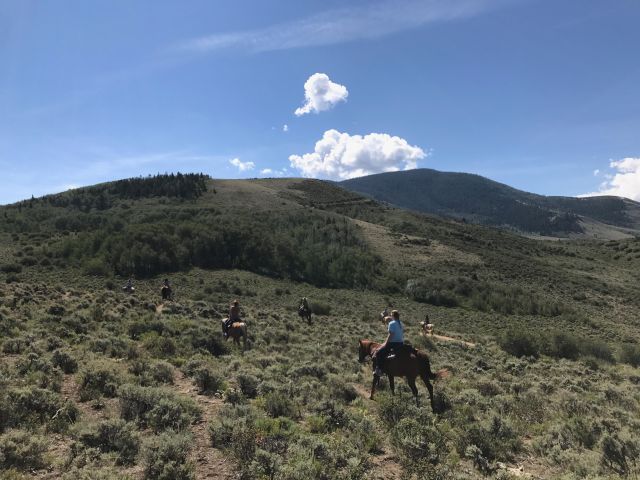
Tradition demanded that each branch of the family volunteer to prepare dinner one night of the week.  This year the cousins were assigned a night and did a bang up job.  Barb’s chili, always a favorite, came up short, literally that is. She had underestimated the capacity of those hiking, mountain biking, white water rafting, horseback riding appetites and the pot did not even survive the first round which gave the kids an excuse to head down the mountain and pig out on hamburgers and such. 

0

THE LOCALS

The family did befriend a long time resident of the area.  Fred was first seen looking into the kitchen through the patio door as were getting ready to eat.  Not coincidentally, he would return each evening at dinner time to take advantage of our generosity.  As a matter of fact, on our last night, he returned with Mrs. Fox and Freddy Jr., who also seemed to enjoy their dining experience.  In our family, volume rules in any discourse, and Maggie’s objection to feeding a wild animal were soon drowned out by rationalizations that one could hardly consider an animal who eats out of one’s hand to be wild. Plus the fact that he had become dependent on we naïve tourists seemed to be working out well for him and his family.  Besides, feeding a fox shouldn’t be compared to feeding a grizzly bear.

0-1

Our gang’s sojourn on the mountain ended all too soon, and I think all had a good time. As for me, I learned that although shortness of breath can be very inconvenient, under the right circumstances, it can offer significant advantages.


a2dfb198-80db-47ce-8291-931f0ce138a8_e6d47a71-939f-47fe-9cbf-84047b757c37_m.jpg

THAT MOTHER THING

These days, it is difficult to forget Mother’s Day as there are plenty of reminders on TV, radio, newspapers, billboards, and now even the internet.  Although the holiday (it even seems disrespectful to call it that) has been a boon to florists, candy companies, and greeting card businesses, it also generates a type of sentiment not found in other celebrations.  According to Mr. Google, there have been times set aside to venerate mothers and motherhood since ancient times, but our modern version is said to have its origins in Grafton, West Virginia in 1908, when Anna Jarvis promoted the idea of a day to honor mothers. She was soon to be disappointed when the day which was sacred to her became commercialized.  Anna spent the rest of her life attempting to correct the image which she felt dishonored her Mother, and died penniless in an institution.

DON’T MESS WITH MOM

We are all aware that motherhood is necessary for the propagation of the species, but the relationship between a mother and her offspring is like no other.  Mothers will fight to the death and endure any amount of hardship to protect and nurture their offspring.  This is true for most of the animal kingdom, but especially for humans.  Most animals who have live births nurture their young until the kids are able to make it on their own, but human moms never stop mothering.  You might think since they are around for a couple of decades it might be that they simply become like an old pair of shoes which you don’t like to get rid of, but there seems to be much more to it than that.

Back in the old days, when country doctors did pretty much everything except major surgery, I delivered a lot of babies.  Many times I would hear my patients in labor crying out that they would never go through this pain again, but when that baby was delivered into her arms the room would brighten with her smile.  The ordeal of birthing would soon be forgotten and often at the six weeks checkup there would be talks of having another child.  The mother of my children describes her feelings of holding our babies as a feeling of joy which she could not find words to describe.

Screen Shot 2017-05-13 at 8.30.46 PM.png

Kids do grow up and leave the nest, but they carry a piece of Mom with them for the rest of their lives.  No one or no other relationship will have such a profound effect on their lives.  Without nurture, it has been shown that children will grow up with significant deficits similar to those seen in Harlow’s monkeys when they were deprived of maternal contact.  With that in mind, it seems clear that mothers’ roles involve much more than merely giving birth and providing sustenance.

When children are born, they have no sense of who or what they are.  One can see an infant at times appearing to discover his toes and other body parts.  Likewise, in their early years, they will need help to develop an identity, and to do so, they will depend upon those with whom they spend the most time. However, perhaps the most important issue they learn concerns their lovability.  In my practice, those who felt as if they were unlovable were among the most unhappy.  They found it virtually impossible to establish meaningful relationships.  They lacked self-esteem, often to the point of self-loathing; consequently, they were vulnerable to exploitation of all kinds.  They were often used and abused, which they felt they deserved.  This opinion of self, which appears to have its origins in childhood, resists change and seems to persist throughout life even when told their picture of themselves is inaccurate.

ALL YOU NEED IS LOVE

Obviously, the only way one can know they are lovable is to be loved, which brings us back to the subject of mothers.  Traditionally, they are the ones in charge of loving.  Their love is constant, unremitting and lifelong.  They continue to love even when their children are total jerks or perpetrate the most dastardly of deeds.  It has been said that a father’s love is conditional.  I have always resented that characterization, for I felt I loved the kids as much as did Barb, yet I must admit that her capacity for forgiveness and tolerance exceeds mine.  After all, I was only an observer and not a participant in their entry to this world.

If you think mothers are lovers, take a look at grandmothers.  With the responsibilities of teaching kids manners, discipline and societal survival skills gone, there comes an avalanche of unimpeded love.  For me, grandparenthood has been an opportunity to enjoy the kids without feeling any responsibility.  I have concluded that grandparenthood is God’s reward for enduring the vicissitudes of parenthood.

It is true that in the past mothers have received a bad rap from we psychiatrists.  Mothers have been accused by us of causing everything from autism to homosexuality.  This fad began with Freud, who attempted to unravel some of the mysteries of early childhood.  Although his work provided an impetus to learn more about the effects of childhood experiences on later life, many of his conclusions have been discredited.

IT DOESN’T GET EASIER   

In the past, motherhood was a full time job.  Although mothers would engage in activities outside the home (my grandmother helped with the milking), their primary function was to care for their families.  Today’s mothers amaze me in that a majority of them also have full time jobs outside the home.  That puts an exclamation point after the time honored phrase “woman’s work is never done.”  Granted, fathers are now more involved in domestic activities than in the past, but I seem to remember reading something about a study that indicated the duties of the woman of house have changed little over the years.  Without our so-called modern household conveniences, it would probably be impossible for the hardiest of souls to accomplish what these warrior mothers do.

However, the most amazing mothers, to me, are the single moms who take on the total responsibility for feeding, clothing, teaching, disciplining and loving their children.  The fact that many single mothers accomplish this without any outside help is inspiring, especially when one considers the number of kids who grow up to be good people.  Unfortunately, these mothers are often derided rather than praised.

THEY AREN’T ALL MUSHY

You should not be surprised to learn that I too had a mother.  She loved me for no good reason that I could fathom, and I loved her too (although I would never admit it when I was growing up).  Mom was not a hugger.  She was a patter—i.e. when she was glad to see me, or pleased with something I had done, she would wrinkle her nose and pat me on the arm or shoulder a couple of times.  I suspect this was a result of her childhood, for her family was not demonstrably affectionate and never wanted to be “showy.”  She was a great cook and enjoyed feeding us.  In later years, a visit would see her “throw together some leftovers” with little obvious effort, and they would always be delicious.  I was a child of the Depression and barely recall my parents on occasion telling my brother and I they wanted us to eat first.  It would be years later before l realized why they did that.

SUPER MOM

It has been my good fortune to meet and marry someone who was born to nurture, and I have watched her in action for quite a few years.  When we were married, she announced that she wanted to have four children.  I thought two would be plenty, so we reached a Barb-type compromise and had four.  Since they were all exceptional from the very get go, I agreed to keep them all.  It was a good decision.

As with most mothers, Barb continues to exude love from a reservoir that never runs dry.  Every now and then, she will reminisce about those days when she had them all fed, bathed and tucked in, and how she felt “so rich.”  When we see a baby in the grocery, she tells me how she would like to hold it.  If there is a young one in a restaurant, she will approach the mother ask its age and tell her how beautiful is her baby (she seems to have never seen an ugly one).  Those tear jerking ads on TV featuring small kids do a number on her.  She insists were she a little younger she would adopt some of those starving African kids.

As for the grandchildren, don’t ask unless you have some time to spare.  It takes a while to tell you how wonderful they all are, but you will be able to see those tired brown eyes come to life.  Like it or not, you will probably also hear the complete package which includes their parents who are also “above average.”

SHE WILL JUST SAY YOU SHOULD SAVE YOUR MONEY 

Meanwhile, it is nice to send your mother flowers and stuff, but all she really wants from you is love.  She deserves all you have to give.

Barb and Darell Smith wedding

My Valentine

EDITOR’S NOTE: I thought I would commemorate Valentine’s Day 2023 by reposting the most read (#1 blog post from Eshrink). Enjoy! Love good…our family motto to honor our sister Molly, who died Feb 25th, 2014.

It was a beautiful argyle sock, but what does one do with one sock?  She assured me that she would get to work knitting its mate very soon.  That was seventy years ago, and I am still waiting for that second sock.  Granted, she has been busy during the last seven decades, but I really liked that sock and held onto it for many years expecting its mate to appear during some birthday celebration.

I have determined however; that hope does not spring eternal when it comes to missing socks, for this perfect example of period haute couture has been lost somewhere along the way.  In those days old pictures dad with familya pair of brightly colored argyle socks in a pair of white bucks (shoes to you youngsters) laid the foundation for the ultimate in sartorial splendor which usually included grey flannel pants, a navy blue “V” neck sweater with a white “T’ shirt visible in the sweater opening, and a crew cut. Maybe it was just that kind of fashion sense that caught her attention all those years ago…
She first accosted me while I was lying in the front yard with my cocker spaniel. She lived just down the street and I had noticed her from time to time, but paid little attention.  On this day, which would change my life forever, she was walking her cocker spaniel, and used the old “let the cocker spaniels meet each other” gambit to meet me.  It turned out the dogs did not like each other.  Later, she would insist that she had noticed that I looked lonely, and that she felt sorry for me.  My recollection is that during that time of my life, I enjoyed solitude; and not having reached my sixteenth birthday, I did not feel comfortable around girls.

I must admit she was a cute little thing.  Although a bit flat-chested, she had good legs, and some interesting rhythmic movements of her derriere that I found difficult to ignore.  She proved to be quite a good conversationalist, and after breaking up the fight between Susie and Cindy (the cocker spaniels) she moved on to get a comprehensive history about me.  Since, as with most people, my favorite topic is myself, my shyness soon vanished.  After a few more such visits, the dogs were discarded, and I found myself sitting with her in the swing on her front porch eating a piece of coconut cream pie.  Her mother was a great pie baker, but I will never know how Barb determined that coconut cream pie was my favorite.

Since I had not been able to find a job that summer, I had much free time and we saw each other nearly every day, went to a movie and even the county fair.  In the midst of all these platonic interactions there eventually came a day which would seal my fate forever.  Barb mentioned that she was having trouble with her bicycle.  I of course, always looking to score points and prove my mechanical prowess, immediately volunteered to look at it.  The problem was minor and the repair simple, but then I saw her standing on the second step of the basement stairs with those big brown eyes level with mine, and you guessed it. I kissed her—a bit timidly at first, but I had seen the professional kissers in the movies, and initially attempted to emulate them, but found I didn’t need lessons.  From her response, I guessed that I had done a credible job.

For the rest of high school we remained an item.  There was a brief hiatus after we had agreed that we needed to experience relationships with other people; however, that only lasted for about 72 hours.  She was a year behind me in school so after I spent a year at the local branch of OU she entered nurse’s training.  This was not her idea for her dream was to major in art.  Barb’s father, ever practical had decided she could never make a living drawing pictures, but more important was that nurses training was only three years long and about one tenth the cost.

Meanwhile, I decided to try pre-med, and was surprised when I gained admission to OSU medical school for my pre-med grades were not that good.  My excuse was that I worked a lot as a short order cook, a lab assistant in the physiology lab, and cleaning the cages in the animal lab.  The truth was that I did goof off more than I should have, and was not very disciplined when it came to the studying business.  I would nearly be undone by that character flaw.

I had received the notice of my admission to medical school during my final semester in pre-med contingent upon my completing the prerequisite courses among which was organic chemistry, not at all my favorite subject.  As usual, I had not kept up, pulled an “all nighter” prior to the final exam and overslept.  I toyed with the idea of feigning illness to get an excuse from the student health center, but Barb had already brainwashed me with that overdeveloped super ego of hers and taught me that honesty is the best policy.  The veracity of that truism was shattered when the prof said I could not take the exam in spite of the fact that I was only 30 minutes late and no one had finished the exam at that point.  I received my first “F´ ever, and began a frantic search for a summer course.

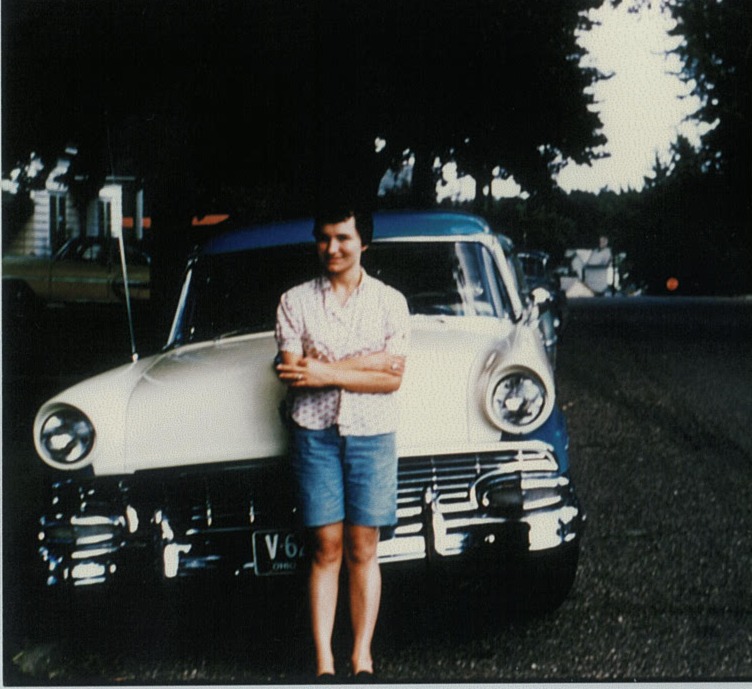
old picture mom in front of carMeanwhile, Barb had passed the nursing board exams, and was making the enormous sum of eleven dollars per day doing private duty nursing.  She had even purchased a 1947 Chevy in nearly mint condition further endearing her to me.  When as the saying goes, “I popped the question,” it was hardly a question for after six years of courtship it was not really surprising.

There are many advantages to having an aesthetically endowed wife.  Your surroundings will be made more pleasant, you will be dressed appropriately, and you will likely be made more aware of things beautiful in your life.  The down side is that you will find it difficult to find pleasing gifts unless you have remarkably good taste which I don’t, and when you produce that diamond ring of which you are so proud you may notice a raised eyebrow and hear her ask: “Is that the only mounting they had?”

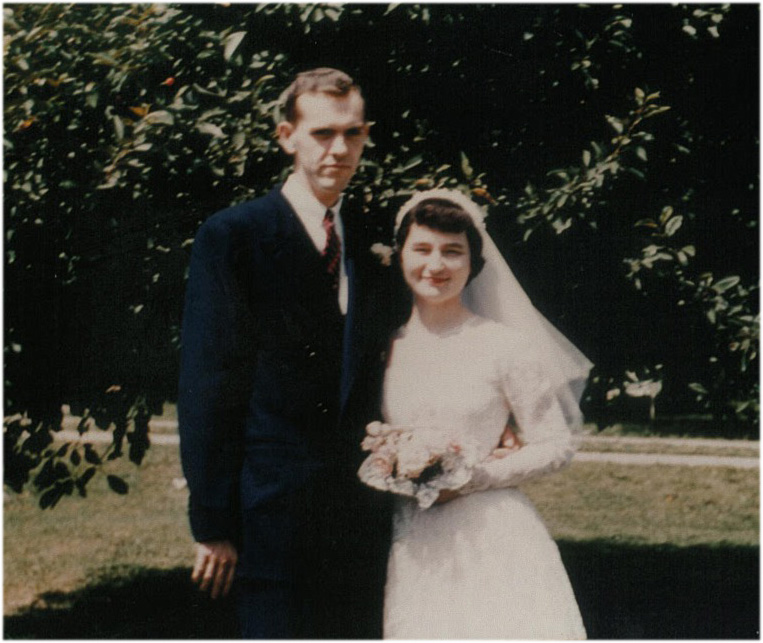
mom and dad wedding pictureWe were married on a hot muggy June day.  She was beautiful and I was hung over.  I had celebrated my last night of freedom with the boys, and she would later say that I “looked terrible”.   In those days virginity was highly regarded, and sex before marriage was frowned upon.  I suspect this may explain why people married at a younger age then.   In addition to conjugal bliss, Barb had promised me a back rub every night.  She was proud of her back rubs for she had received many appreciative comments from her patients extolling their virtues.  She made good on that promise for about 2 weeks; however since then I have determined that she is behind by approximately 22,243 back rubs.

The rest of that summer was a time of high anxiety. When I called the registrar’s office to check on the status of my transcript no mention was made of its big fat F.   I was only told they were awaiting notification that I had completed the organic chemistry requirement.   Initially only the University of Virginia offered a summer course in organic chemistry.  This presented a problem for I had no way to pay the out of state tuition, let alone the room and board.  There was also the relatively minor problem of the delay in enjoyment of that conjugal bliss thing. Besides there was no guarantee that I would still be admitted if I did satisfy the requirement.

At this point the same God who had engineered the cocker spaniel encounter, apparently forgave me for flunking organic, and for my murderous fantasies toward Dr. Tate (the organic chemistry professor), and arranged for the class I needed to be offered at Muskingum College which was only a few miles down the road.  Having already taken the course, the second time was a breeze and I aced the sucker.

Med school classes were to begin in two weeks, and I was still not sure whether I had flunked out of medical school before I even got there.  When I called to inquire if I were still enrolled, the secretary who was in charge of such things did not seem to know what I was talking about.  She responded saying of course I was enrolled.  Did I not know they had received the transcript of my chemistry grade.  To this day I am convinced that the record of my F had not reached the admissions committee perhaps because of someone’s carelessness.  Score one more for God, fate, or whatever you may prefer to call the entity which governs good fortune.

old picture mom and dad outside aptWith that we quickly  collected what furniture we could from various relatives, found a three room apartment a few blocks from the medical school and its  hospital and as the saying goes: “ the rest is history .” And what a history it would become.  Barb found a job at the University tuberculosis hospital where she was rapidly promoted to head nurse, and still made time to volunteer at the local planned parenthood clinic (this was prior to Roe vs. Wade).  This skinny little chick with the cute butt had morphed into a remarkable woman who had accepted the job of feeding and caring for me.  Our finances left no room for frivolity, but she never complained.

She spent all her free time making a comfortable homey environment of our little pad, and tending to all my needs (except for back rubs which were reserved for those lucky dogs in the hospital).  I recall her euphoria when we managed to buy a fifty dollar wing chair which we would make payments on for six months.   Medical school was difficult for us and internship even worse with me on duty often for thirty six hours and off twelve.  Our first child came along during my senior year, and Barb suffered a severe post partum depression during my internship at a time when I was rarely available.

It has been said, “what doesn’t kill you makes you stronger.”  In our case I believe that very stressful year of internship strengthened the bond between us. I came to appreciate her integrity which was never in question.  She not only said honesty was the best policy, she lived it.  I recall an incident when we were traveling and she thought the cashier where we had just eaten had given her too much change.  She insisted that I turn around and go back that eight or ten miles to return the money.  My response was “screw it, if she screwed up it’s not my problem.” She was concerned the waitress might get in trouble if the cash in the register came up short.   As you have probably guessed, we went back with me complaining all the way.

I am sure you also have surmised that she is my best friend, one who has supported, defended, and believed in me.  Her loyalty is absolute.  She genuinely cares about people.  Those fortunate enough to call her friend are well aware of that.  I have often said that she is the only person I know who gets high on people.  When we go to a social function where she has an opportunity to talk with many people, she frequently will have difficulty going to sleep much as if she were freaked out on methamphetamine.  On meeting someone new she will get a comprehensive history, and learn all about them and their family.  Later she will remember the names of children and grandchildren while I often don’t  even recognize that person if I should run into them again.  At those cocktail type functions, she is in her element while I try to be inconspicuous.  Once you make the cut and become her friend it will be forever, and if you or yours are in trouble you will surely hear from her for compassion is as much a part of her as breathing.

Although she has shorted me on socks and back rubs, she has made up for that by supplying me with four children who are (as in the words of Garrison Keillor) all above average.  I am sure that none would report they ever lacked for love from her.

maggies 3rd birthday with family She has always been especially fond of babies, the helpless age when they needed her most.  She enjoyed being a full time mother until the kids were all sufficiently grown so she could scratch that creative itch which had bedeviled her all those years.  She opened her dream store where she could surround herself with beautiful things. Many of her customers were in awe of her good taste, and some asked her to help decorate their homes and businesses.

Lest you think all has been sweetness and light in our marriage, let me assure you we fight viciously and often.  We have managed to avoid filing any domestic violence charges, although it does require a good deal of self-control on my part.  For you see she is very stubborn while I am quite compliant.  She thinks she is always right while I know that it is old pictures xmas in 70sI who is always right.

In spite of that, we have shared a bucket of tears and thousands of laughs.  We have been there for each other when most in need.  Together we have survived the loss of our first born child, the loss of our parents and many other relatives, cancer, and all of the changes that aging brings.  She is as much a part of me as one of my limbs.  Our love transcends affection, is comforting, and without compulsion.  This remarkable woman has been my valentine for 70 years.  I plan to keep her in that capacity as long as I can.

60th Wedding Anniversary Dinner

60th Wedding Anniversary Dinner

—————————————————————————————————-

From eshrink’s editor and daughter: I thought I would add my own thoughts about my dad’s valentine of seven decades. Below is an excerpt from the card I gave her a few years ago on her birthday. From my perspective, the longevity of my parent’s marriage isn’t about romance or fairy tales. My parents argued, but I learned in therapy the value of what they taught me: they always made up, they never called each other names, they talked about how behaviors made them feel. My parents are incredible teachers in how to love without condition.

I love how you always have surrounded us with

beauty—I didn’t appreciate it when I was younger,

but looking back I have such fond memories of

beautiful centerpieces, holiday dinners, and I

appreciate the ambience you created in all of our

homes that made me feel loved and special.

I love how interested you are in other people—their

experiences—good and bad—and how you manage

to always connect and empathize with them.

I love the generosity and thoughtfulness you

illustrate on a daily basis—always preparing special

gi! s for people, giving people in your lives not just

things, but your time, to make them feel loved and

appreciated. And not just for family, for people

in your life, like Kathleen, Judy, the girl who used

to cut our hair from Dresden. But I especially

appreciate the generosity and love you show your

grandchildren.

I love the way you always jumped in and gave me

a path whenever I even hinted I was interested in

something—modeling, tennis, piano, horseback

riding—you were always enthusiastic and supportive.

You made sure I had the tools (and the many

lessons) to pursue my interests instead of projecting

your interests onto me. It made me feel secure to be

my own person.

I love that you always insisted on family portraits for

Christmas and usually Easter.

I love how you made me feel good about being

“different” with that wild red hair, pale skin and

freckles during the age of straight, silky, long blonde

hair and golden brown tans (the 70s).

I love how you embraced “family planning” to make

sure I was born in the most beautiful month of the

year.

I love how you always welcomed my friends and

made them feel included in our family.

I love that you took the time, energy, and resources

to plan our annual family vacations that created such

wonderful memories I hold dear.

I love that you are always “you” …what you see is

what you get. (Probably why my friends always felt

so included at our house…no pretentiousness or

phoniness at the Smith house…we let it all hang out)

I love how you have always embraced “lifelong

learning”…watching you read all the books about

antiques and collectibles, going to auctions, learning

about decorating, taking classes at OUZ, starting

your business in your 40s, volunteering at Parents

Anonymous, and just always learning from other

people during each encounter.

I love that you were so open and honest about your

experiences in life—instead of being bitter about the

bad things, it always seemed you tried to use those

experiences to make me understand why you were

doing what you were doing or why you wanted better

for us (wanting to go to art school, the SIDs baby that

died when you were a nurse, the depression you fought,

your mom not letting you learn to cook). It gave me a

good perspective on how to process the stuff I can’t control,

the ability to learn from my mistakes, and taught me

how to see things from other people’s perspectives.

I hated it when you and dad argued, but I learned in

therapy the incredible value your openness gave me…

because I always got to see you make up and come

to some type of resolution (such an important gift to

realize that confrontation is sometimes necessary for

greater understanding, intimacy, and communication).

Happy Birthday Mom. I love you!