The secret to a happy marriage

HOW TO AVOID ALIMONY

Following the publication of my most recent blog in honor of Valentine’s day, my daughter/editor proposed a question which has been asked of me previously.  I am asked to divulge the secret to a long happy marriage.  Of course those terms are not necessarily synonymous, and my own marriage has certainly not always been happy; although, I would guess that it would register above average on the happiness meter.  The most encouraging thing for me is that it seems to get better as time goes by.

Marriage and Divorce in the “Good Ole Days”

In my day, lengthy marriages were the rule and divorce uncommon.  Divorced people were apt to be stigmatized. The women were referred to as “grass widows.” Men were often assumed to be philanderers.  In those times, most wives became stay-at-home mothers (housewives) who had been conditioned and trained to be just that.  Those few who had chosen a career were expected to give up their jobs as soon as they became pregnant.  Daycare centers were few and far between.  Consequently, a woman abandoned by her husband faced insurmountable obstacles to becoming self- supporting.

Men likewise faced financial hardship sufficient for them to eschew divorce.  This was during the days of alimony before the days of no-fault divorce, and adultery was the most common charge leveled by the complainant.  Awards could be punitive.  Divorces were often nasty, long, drawn out, and expensive.  Reputations suffered as the family’s dirty linen was made public.  At times, courtrooms were filled with spectators who had attended in hopes of hearing some salacious gossip.

Thus there were many pragmatic reasons to stay married and undoubtedly many men and women felt trapped in their marriages (quite a few of whom ended up in my office); however, there were also many more who were quite content with their marital relationships.  All of this raises the interesting question as to the ratio of happy versus unhappy relationships, both in those old days and now.  It could be argued that my contemporaries stayed together because they were stuck with each other or could it be that since the alternative was so distasteful that they were more diligent in finding ways to be compatible?

Although the divorce rate in the U.S. has been reported to be as high as 50%, there are some encouraging signs.  During the past decade this number has gone down some, and there appears to be a significant decline in the rate when the couples are married later in life.  As a matter of fact, there appears to be an inverse relationship between divorce and age beginning in the thirties.  Presumably this would indicate that maturity and/or life experiences might be an asset to a happy marriage.  That was not true for me as I was married at 22, and was as green, naïve and inexperienced as they come; although, I thought I was really cool.

Infidelity

As you might expect, infidelity is a frequent cause of marital discord.  I don’t believe this is only due to changing of societal sexual mores.  In my experience most problems of this sort occur in the workplace, which should not be surprising since women are now frequently side by side with men.  They may share in their accomplishments and failures much as happens in marriage, and may spend more time with a coworker than with a spouse.  Likewise, the coworker is likely to be more understanding of work stresses.  Those who work closely together are apt to see each other at their best, but may arrive home after a hard day tired and grumpy.   In addition the development of effective means of birth control lessened the risk of sexual liaisons.  Needless to say, fooling around can be a real downer for a marriage, and is not recommended.

Is an unhappy marriage better than divorce?

None of this should be construed to mean that I am unalterably opposed to divorce.  It can be very dangerous to live in a dysfunctional family environment.  The U.S Bureau of Justice reports that 6.5% of all murders in the US. are committed by spouses.  Obviously, family relationships are important factors that influence children in hundreds of ways, not only when witness to violent behaviors, but how they view those relationships affects their ability to express feelings, develop self-esteem, have healthy relationships and functional marriages of their own.

Although I have quarrels with some of Freud’s writings, I believe that he was right on with the concept of identification.  In simple terms the concept is basically “monkey see monkey do” and we often end up unconsciously adopting characteristics of others: usually our parents.  One of my former patients was a perfect example of this phenomenon.  This very sophisticated lady whom I had seen occasionally throughout the years had a great deal of animus toward her mother.  During one visit, she was discussing problems related to her daughter, and suddenly announced: “I have become my Mother,” an insight of which she had been blissfully unaware until that moment.  Many of us will have a similar experience and will end up unconsciously mimicking characteristics we found abhorrent in one of our parents.

All this brings to the fore a problem which has been vexing to me during my entire career.  Although I have rarely recommended divorce, I have always been troubled by the question of which is the more damaging to a child, divorce or growing up in a dysfunctional family.  The patients who focused on family as a cause for their problems seemed evenly split.  Some were angry that their parents had divorced while an equal number blamed them for staying together, so maybe it is one of those damned if you do damned if you don’t situations.

So, what’s the secret to a long, happy marriage?

I realize that up to now I have written little to answer Maggie’s question about how to stay happily married.   It is a simple question that deserves a complex answer.  The melding of two personalities into a functioning unit requires more than lust; although, that can certainly be helpful in the early stages.   In my early days as an academic, I was placed in charge of a family and couple’s therapy clinic where we made use of communications and systems theory in our treatment plans.  We have all had times when our messages have been misinterpreted, for example, the recipient thought we were being sarcastic (the words did not fit the music).  In other words, the tone or nonverbal message was inconsistent with the verbiage, a situation we called sending roses and feces in the same box.  This is only one example of the myriad ways in which communications can become garbled and result in a great deal of frustration.

Another characteristic of couples caught up in these systems is that they both are unaware of their part in the problem. It is as if they are swallowed up in their communications system and cannot see beyond its borders.  The therapist’s job is to become a meta communicator, that is to communicate to each of them about their communication system so that each can see the part they play in their problems.

The person who plays the part of meta communicator is not necessarily a therapist.  Barb and I have had therapy both together and separately, but the most insightful revelation for me came from one of my students who after a party said, “I can’t believe how you treat your wife.”   Initially, I thought: “Who, me?  The great communicator, insightful couple’s therapist, and kind considerate husband? The audacity of this pip-squeak!”

Then, I thought more about that observation and began to see our relationship in different terms.  With awareness, I was able to put forth some effort to improve our relationship, which was in need of some improvement at that time.  But old habits are hard to break and even after all these years I still relapse from time to time.

Of course people always bring their own unique personality characteristics to the relationship along with their needs, expectations (often unrealistic), and dreams.  In our case Barb and I probably fit into what I categorize as a complementary relationship.  Opposites often attract, and in our case (in addition to that swivel) Barb seemed to fill the void of my shyness with her outgoing personality, and sensitivity while I came across as an in charge, stoic person.  She must have felt that I could look after things and provide stability.

What turns you on is what will turn you off

In my experience the qualities that attract couples to each other are the same ones they will come to complain about after a few years.  True to form I found that her emotional responses eventually became irritating to me and she began to complain that she felt ignored and put down by my apparent lack of feelings.  She hungered for conversation, but after a day listening to people and talking to people, I wanted solitude.

We eventually worked that out by scheduling 30 minutes after dinner to talk.  I learned to listen, and she found she didn’t need that much time after all, mostly just needed to be appreciated which I learned to do.  She likewise has learned totolerate my  foibles and we now roll along with only minor skirmishes.  I know she will be there for me and she knows I will do likewise for her.

As you have undoubtedly noticed I have no secrets for success in this marriage business.  I do have some hints that you could just as easily have learned from your Grandmother as follows:

  • Be patient Rome wasn’t the only thing not built in a day.
  • Listen, I mean with both ears.
  • Sex may lessen the sting, but is not enough to solve the problem.
  • When you think you can’t stand him/her see if you can’t find a little bit of something good.  Nobody is all bad.
  • Don’t be sticky, you both need time away from each other occasionally.
  • Trust, paranoia will tank your marriage, if your mate is screwing around there will be plenty of time to shoot him/her later.
  • If you don’t “feel the love” mutual respect may well resurrect it.
  • If there is abuse, get the hell out.
  • Remember it often takes work to make it work, but when it succeeds it is well worth the effort.
  • If things still don’t click, find a professional who sees couples. Individual therapy is not likely to be very helpful.  Dancing lessons without a partner don’t work very well.


Barb and Darell Smith wedding

My Valentine

EDITOR’S NOTE: I thought I would commemorate Valentine’s Day 2023 by reposting the most read (#1 blog post from Eshrink). Enjoy! Love good…our family motto to honor our sister Molly, who died Feb 25th, 2014.

It was a beautiful argyle sock, but what does one do with one sock?  She assured me that she would get to work knitting its mate very soon.  That was seventy years ago, and I am still waiting for that second sock.  Granted, she has been busy during the last seven decades, but I really liked that sock and held onto it for many years expecting its mate to appear during some birthday celebration.

I have determined however; that hope does not spring eternal when it comes to missing socks, for this perfect example of period haute couture has been lost somewhere along the way.  In those days old pictures dad with familya pair of brightly colored argyle socks in a pair of white bucks (shoes to you youngsters) laid the foundation for the ultimate in sartorial splendor which usually included grey flannel pants, a navy blue “V” neck sweater with a white “T’ shirt visible in the sweater opening, and a crew cut. Maybe it was just that kind of fashion sense that caught her attention all those years ago…

She first accosted me while I was lying in the front yard with my cocker spaniel. She lived just down the street and I had noticed her from time to time, but paid little attention.  On this day, which would change my life forever, she was walking her cocker spaniel, and used the old “let the cocker spaniels meet each other” gambit to meet me.  It turned out the dogs did not like each other.  Later, she would insist that she had noticed that I looked lonely, and that she felt sorry for me.  My recollection is that during that time of my life, I enjoyed solitude; and not having reached my sixteenth birthday, I did not feel comfortable around girls.

I must admit she was a cute little thing.  Although a bit flat-chested, she had good legs, and some interesting rhythmic movements of her derriere that I found difficult to ignore.  She proved to be quite a good conversationalist, and after breaking up the fight between Susie and Cindy (the cocker spaniels) she moved on to get a comprehensive history about me.  Since, as with most people, my favorite topic is myself, my shyness soon vanished.  After a few more such visits, the dogs were discarded, and I found myself sitting with her in the swing on her front porch eating a piece of coconut cream pie.  Her mother was a great pie baker, but I will never know how Barb determined that coconut cream pie was my favorite.

Since I had not been able to find a job that summer, I had much free time and we saw each other nearly every day, went to a movie and even the county fair.  In the midst of all these platonic interactions there eventually came a day which would seal my fate forever.  Barb mentioned that she was having trouble with her bicycle.  I of course, always looking to score points and prove my mechanical prowess, immediately volunteered to look at it.  The problem was minor and the repair simple, but then I saw her standing on the second step of the basement stairs with those big brown eyes level with mine, and you guessed it. I kissed her—a bit timidly at first, but I had seen the professional kissers in the movies, and initially attempted to emulate them, but found I didn’t need lessons.  From her response, I guessed that I had done a credible job.

For the rest of high school we remained an item.  There was a brief hiatus after we had agreed that we needed to experience relationships with other people; however, that only lasted for about 72 hours.  She was a year behind me in school so after I spent a year at the local branch of OU she entered nurse’s training.  This was not her idea for her dream was to major in art.  Barb’s father, ever practical had decided she could never make a living drawing pictures, but more important was that nurses training was only three years long and about one tenth the cost.

Meanwhile, I decided to try pre-med, and was surprised when I gained admission to OSU medical school for my pre-med grades were not that good.  My excuse was that I worked a lot as a short order cook, a lab assistant in the physiology lab, and cleaning the cages in the animal lab.  The truth was that I did goof off more than I should have, and was not very disciplined when it came to the studying business.  I would nearly be undone by that character flaw.

I had received the notice of my admission to medical school during my final semester in pre-med contingent upon my completing the prerequisite courses among which was organic chemistry, not at all my favorite subject.  As usual, I had not kept up, pulled an “all nighter” prior to the final exam and overslept.  I toyed with the idea of feigning illness to get an excuse from the student health center, but Barb had already brainwashed me with that overdeveloped super ego of hers and taught me that honesty is the best policy.  The veracity of that truism was shattered when the prof said I could not take the exam in spite of the fact that I was only 30 minutes late and no one had finished the exam at that point.  I received my first “F´ ever, and began a frantic search for a summer course.

old picture mom in front of carMeanwhile, Barb had passed the nursing board exams, and was making the enormous sum of eleven dollars per day doing private duty nursing.  She had even purchased a 1947 Chevy in nearly mint condition further endearing her to me.  When as the saying goes, “I popped the question,” it was hardly a question for after six years of courtship it was not really surprising.

There are many advantages to having an aesthetically endowed wife.  Your surroundings will be made more pleasant, you will be dressed appropriately, and you will likely be made more aware of things beautiful in your life.  The down side is that you will find it difficult to find pleasing gifts unless you have remarkably good taste which I don’t, and when you produce that diamond ring of which you are so proud you may notice a raised eyebrow and hear her ask: “Is that the only mounting they had?”

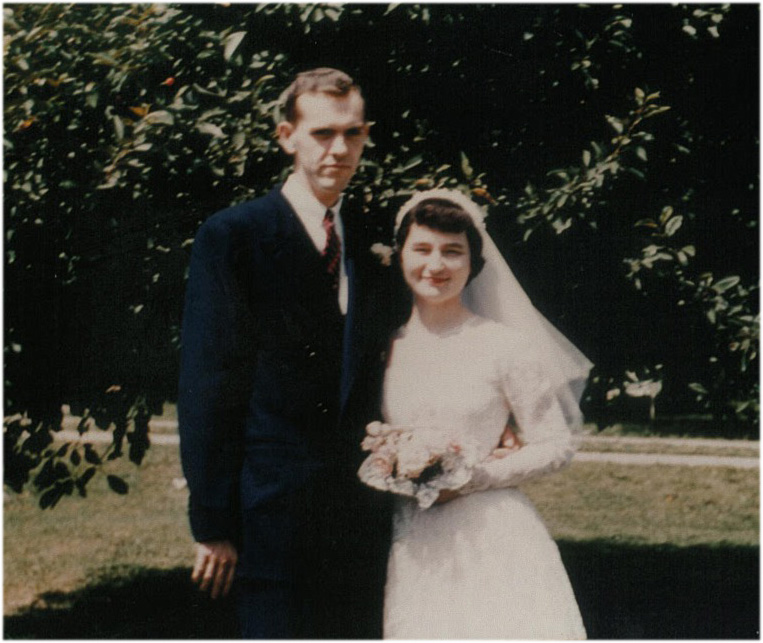
mom and dad wedding pictureWe were married on a hot muggy June day.  She was beautiful and I was hung over.  I had celebrated my last night of freedom with the boys, and she would later say that I “looked terrible”.   In those days virginity was highly regarded, and sex before marriage was frowned upon.  I suspect this may explain why people married at a younger age then.   In addition to conjugal bliss, Barb had promised me a back rub every night.  She was proud of her back rubs for she had received many appreciative comments from her patients extolling their virtues.  She made good on that promise for about 2 weeks; however since then I have determined that she is behind by approximately 22,243 back rubs.

The rest of that summer was a time of high anxiety. When I called the registrar’s office to check on the status of my transcript no mention was made of its big fat F.   I was only told they were awaiting notification that I had completed the organic chemistry requirement.   Initially only the University of Virginia offered a summer course in organic chemistry.  This presented a problem for I had no way to pay the out of state tuition, let alone the room and board.  There was also the relatively minor problem of the delay in enjoyment of that conjugal bliss thing. Besides there was no guarantee that I would still be admitted if I did satisfy the requirement.

At this point the same God who had engineered the cocker spaniel encounter, apparently forgave me for flunking organic, and for my murderous fantasies toward Dr. Tate (the organic chemistry professor), and arranged for the class I needed to be offered at Muskingum College which was only a few miles down the road.  Having already taken the course, the second time was a breeze and I aced the sucker.

Med school classes were to begin in two weeks, and I was still not sure whether I had flunked out of medical school before I even got there.  When I called to inquire if I were still enrolled, the secretary who was in charge of such things did not seem to know what I was talking about.  She responded saying of course I was enrolled.  Did I not know they had received the transcript of my chemistry grade.  To this day I am convinced that the record of my F had not reached the admissions committee perhaps because of someone’s carelessness.  Score one more for God, fate, or whatever you may prefer to call the entity which governs good fortune.

old picture mom and dad outside aptWith that we quickly  collected what furniture we could from various relatives, found a three room apartment a few blocks from the medical school and its  hospital and as the saying goes: “ the rest is history .” And what a history it would become.  Barb found a job at the University tuberculosis hospital where she was rapidly promoted to head nurse, and still made time to volunteer at the local planned parenthood clinic (this was prior to Roe vs. Wade).  This skinny little chick with the cute butt had morphed into a remarkable woman who had accepted the job of feeding and caring for me.  Our finances left no room for frivolity, but she never complained.

She spent all her free time making a comfortable homey environment of our little pad, and tending to all my needs (except for back rubs which were reserved for those lucky dogs in the hospital).  I recall her euphoria when we managed to buy a fifty dollar wing chair which we would make payments on for six months.   Medical school was difficult for us and internship even worse with me on duty often for thirty six hours and off twelve.  Our first child came along during my senior year, and Barb suffered a severe post partum depression during my internship at a time when I was rarely available.

It has been said, “what doesn’t kill you makes you stronger.”  In our case I believe that very stressful year of internship strengthened the bond between us. I came to appreciate her integrity which was never in question.  She not only said honesty was the best policy, she lived it.  I recall an incident when we were traveling and she thought the cashier where we had just eaten had given her too much change.  She insisted that I turn around and go back that eight or ten miles to return the money.  My response was “screw it, if she screwed up it’s not my problem.” She was concerned the waitress might get in trouble if the cash in the register came up short.   As you have probably guessed, we went back with me complaining all the way.

I am sure you also have surmised that she is my best friend, one who has supported, defended, and believed in me.  Her loyalty is absolute.  She genuinely cares about people.  Those fortunate enough to call her friend are well aware of that.  I have often said that she is the only person I know who gets high on people.  When we go to a social function where she has an opportunity to talk with many people, she frequently will have difficulty going to sleep much as if she were freaked out on methamphetamine.  On meeting someone new she will get a comprehensive history, and learn all about them and their family.  Later she will remember the names of children and grandchildren while I often don’t  even recognize that person if I should run into them again.  At those cocktail type functions, she is in her element while I try to be inconspicuous.  Once you make the cut and become her friend it will be forever, and if you or yours are in trouble you will surely hear from her for compassion is as much a part of her as breathing.

Although she has shorted me on socks and back rubs, she has made up for that by supplying me with four children who are (as in the words of Garrison Keillor) all above average.  I am sure that none would report they ever lacked for love from her.

maggies 3rd birthday with family She has always been especially fond of babies, the helpless age when they needed her most.  She enjoyed being a full time mother until the kids were all sufficiently grown so she could scratch that creative itch which had bedeviled her all those years.  She opened her dream store where she could surround herself with beautiful things. Many of her customers were in awe of her good taste, and some asked her to help decorate their homes and businesses.

Lest you think all has been sweetness and light in our marriage, let me assure you we fight viciously and often.  We have managed to avoid filing any domestic violence charges, although it does require a good deal of self-control on my part.  For you see she is very stubborn while I am quite compliant.  She thinks she is always right while I know that it is old pictures xmas in 70sI who is always right.

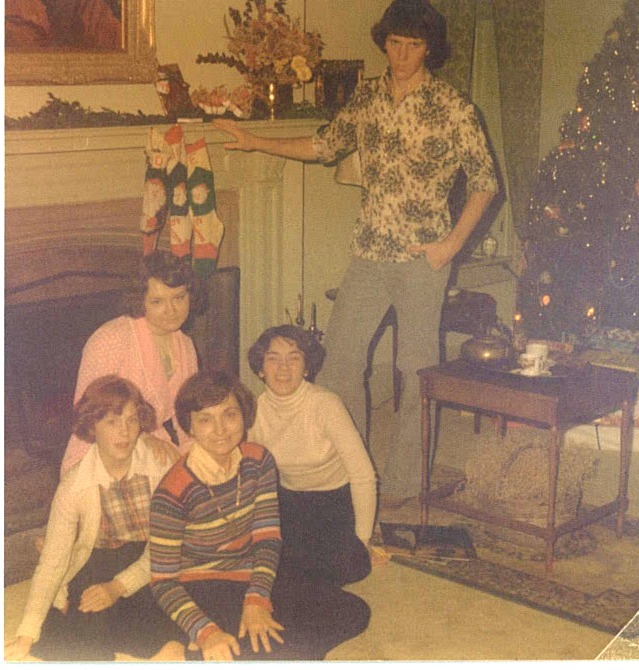
In spite of that, we have shared a bucket of tears and thousands of laughs.  We have been there for each other when most in need.  Together we have survived the loss of our first born child, the loss of our parents and many other relatives, cancer, and all of the changes that aging brings.  She is as much a part of me as one of my limbs.  Our love transcends affection, is comforting, and without compulsion.  This remarkable woman has been my valentine for 70 years.  I plan to keep her in that capacity as long as I can.

60th Wedding Anniversary Dinner

60th Wedding Anniversary Dinner

—————————————————————————————————-

From eshrink’s editor and daughter: I thought I would add my own thoughts about my dad’s valentine of seven decades. Below is an excerpt from the card I gave her a few years ago on her birthday. From my perspective, the longevity of my parent’s marriage isn’t about romance or fairy tales. My parents argued, but I learned in therapy the value of what they taught me: they always made up, they never called each other names, they talked about how behaviors made them feel. My parents are incredible teachers in how to love without condition.

I love how you always have surrounded us with

beauty—I didn’t appreciate it when I was younger,

but looking back I have such fond memories of

beautiful centerpieces, holiday dinners, and I

appreciate the ambience you created in all of our

homes that made me feel loved and special.

I love how interested you are in other people—their

experiences—good and bad—and how you manage

to always connect and empathize with them.

I love the generosity and thoughtfulness you

illustrate on a daily basis—always preparing special

gi! s for people, giving people in your lives not just

things, but your time, to make them feel loved and

appreciated. And not just for family, for people

in your life, like Kathleen, Judy, the girl who used

to cut our hair from Dresden. But I especially

appreciate the generosity and love you show your

grandchildren.

I love the way you always jumped in and gave me

a path whenever I even hinted I was interested in

something—modeling, tennis, piano, horseback

riding—you were always enthusiastic and supportive.

You made sure I had the tools (and the many

lessons) to pursue my interests instead of projecting

your interests onto me. It made me feel secure to be

my own person.

I love that you always insisted on family portraits for

Christmas and usually Easter.

I love how you made me feel good about being

“different” with that wild red hair, pale skin and

freckles during the age of straight, silky, long blonde

hair and golden brown tans (the 70s).

I love how you embraced “family planning” to make

sure I was born in the most beautiful month of the

year.

I love how you always welcomed my friends and

made them feel included in our family.

I love that you took the time, energy, and resources

to plan our annual family vacations that created such

wonderful memories I hold dear.

I love that you are always “you” …what you see is

what you get. (Probably why my friends always felt

so included at our house…no pretentiousness or

phoniness at the Smith house…we let it all hang out)

I love how you have always embraced “lifelong

learning”…watching you read all the books about

antiques and collectibles, going to auctions, learning

about decorating, taking classes at OUZ, starting

your business in your 40s, volunteering at Parents

Anonymous, and just always learning from other

people during each encounter.

I love that you were so open and honest about your

experiences in life—instead of being bitter about the

bad things, it always seemed you tried to use those

experiences to make me understand why you were

doing what you were doing or why you wanted better

for us (wanting to go to art school, the SIDs baby that

died when you were a nurse, the depression you fought,

your mom not letting you learn to cook). It gave me a

good perspective on how to process the stuff I can’t control,

the ability to learn from my mistakes, and taught me

how to see things from other people’s perspectives.

I hated it when you and dad argued, but I learned in

therapy the incredible value your openness gave me…

because I always got to see you make up and come

to some type of resolution (such an important gift to

realize that confrontation is sometimes necessary for

greater understanding, intimacy, and communication).

Happy Birthday Mom. I love you!

Super Bowl XLIX: Let the games begin!

Today, I along with over a hundred million other spectators will be tuned into watch “the greatest show on earth” (sorry Mr. Barnum).  The hype surrounding the Super Bowl leaves the World Series choking in the dust.  The gladiators will soon suit up and attempt to overwhelm their adversaries.  Many will be extremely large men, who in spite of their size will prove to be quite agile. They, along with others, will demonstrate remarkable physical attributes with innate athletic ability, enhanced by intensive training.

This is not a profession in which passivity is tolerated; consequently, most if not all, have a long history of having been trained to become more aggressive.  Their apprenticeship usually begins when they are little more than toddlers, and progresses through high school.  The most talented go on to play in college, but only a very few of those make it to the “pros.”  Since sports programs are now organized at much earlier ages, talented kids can be identified much earlier, and learn they are “special.”

Ray Rice

This has been a bad year for football in general and the NFL in particular.  The video of Ray Rice dragging his girlfriend out of an elevator as if she were a sack of potatoes after sucker punching her unconscious led to a public relations disaster further aggravated by the commissioner’s slap on the wrist.  This resulted in even more public outrage, and an indefinite suspension was ordered but rescinded following Rice’s appeal.

Adrian Peterson

The smoke had barely cleared before Adrian Peterson, another super star, was accused of child abuse after reportedly having beaten his four year old son with a stick severely enough to draw blood.

Aaron Hernandez

Of course these incidents occurred within the backdrop of Aaron Hernandez, a Patriots player, who is on trial for murder connected to the June 2013 death of Odin Lloyd.

Most would agree that football is a violent game in which serious injuries are not uncommon.  There have been serious attempts to minimize the problem; however, with the increase in size and speed of players, the forces exerted when two such bodies collide at full speed can be horrendous.  Many, if not most who have played for very many years, have experienced reparative surgery of some kind.  Violence is not only tolerated but encouraged.  Television commentators comment approvingly of a “hard hit.”  The late Jack Tatum was lauded as a “hard hitter“ and nicknamed  “the assassin” until  one of those hard hits left 26-year-old  Patriots receiver Darryl Stingley quadriplegic in 1978.  Stingley died from health problems caused by quadriplegia at the age of 55 in 2007.

Woody HayesPregame and half-time speeches are designed to nurture and enhance aggressive behaviors.  The so called fight song of my alma mater, Ohio State University (OSU), includes the phrase, “Hit them hard and see how they fall.”  Our venerable OSU coach, Woody Hayes, is said to have studied the tactics used by famous generals throughout history to formulate strategies for his game plans.

The most serious and far reaching problem of all is fortunately now gaining the attention it deserves, and affects participants of the sport at all levels.  That of course is the revelations regarding the long term effects of concussions.  A long list of retired veterans of the NFL have shown up with evidence of some type of pre-senile dementia which has been attributed to recurrent concussions.  This revelation should not have been surprising since the punch drunk boxer syndrome has been with us for a century.

There had been concerns about head injuries for at least a hundred years, and the fairly obvious solution was to protect the head.  When I was in high school the protection offered was little more than a helmet made of leather with some padding. (Link to the Evolution of the Football Helmet from The Smithsonian) 

In fact, helmets weren’t even required until 1943. Conventional wisdom would suggest that a more rigid padded helmet would offer much more protection, thus the plastic helmet was born in the 50s.  It was not long until heads protected by these rigid coverings were used as weapons, and the number of concussions seemed to increase as tacklers learned to lead with their heads.

Brains are very fragile and are protected by floating in a bath of cerebrospinal fluid, which in most instances prevents it from being damaged by sudden movements which could cause contact with the inside surface of the skull.  When very rapid movements are stopped abruptly this protection can be overcome and the brain may be bruised by being slammed against the skull.  This results in the development of the symptoms commonly seen in concussions.  Researchers postulate that repeated, such episodes eventually result in permanent brain damage. 

The rules makers have attempted to deal with the problem by adding rules against helmet to helmet contact or so called spearing with their head.  It seems to me; however, that the nature of the game is such that these so called contrecoup injuries cannot be completely eliminated by such rules.  Another well  known danger to players is the face mask which can be deliberately or inadvertently grasped by an opposing player.  Of course this is a rule violation but I doubt that the player with a broken neck would feel that a 15 yard penalty would be exactly proportionate.

Yes the NFL has a few problems, but I would not write them off for now.  Any organization which can convince 70 or 80 thousand people to travel great distances, pay thousands of dollars to watch some mayhem should not be underestimated.  Add to this a few hundred million bucks from their broadcasts, and royalties from the sale of all kinds of clothes and trinkets, and soon you may be talking real money.  It must also be gratifying to have free almost limitless advertising from the various sports talk shows.  But the shrewdest move of all has been their ability to get others (often we taxpayers) to pay for the venues in which they can display their gladiators. The draft system is guaranteed to provide some parity over the long hall to keep those loyal fans returning, but even the losing teams will share in the wealth by getting their cut of the proceeds.

That vaunted PR machine has already swung into action in order to ameliorate some of the bad press.  They have partnered with an advocacy group to let us know they are not in favor of domestic violence, and  I understand their will be a very impressive public service ad during the game to further convince us that such behaviors are unacceptable.  The news networks have interviewed many experts who are convinced that deflate gate is a red herring, and that all those coaches and players are totally committed to playing by the rules.

The concussion problem may not be as easy to extinguish, and I hear that some biddy league and high school coaches report they are noting that fewer kids are trying out.  Parents are increasingly concerned, and when the legendary football guru iron Mike Ditka announces that he would not allow a child of his play football, there is cause for concern.

As for me, I love to watch the game, but I don’t know why.  Is it the beholding of the skill of these marvelously conditioned athletes, or is it a toned down version of what those Romans went to see in the coliseum?  In any event, I will be there in front of that screen rooting for my team.  I still haven’t decided which that will be, but when I do those warriors I have selected will be fighting for me.  Go Bucks!

OLD DOGS and CHILDREN and WATERMELON WINE: Life in the 80s…and we’re not talking about the decade of big hair & shoulder pads

Introduction from editor/daughter Maggie: I have the pleasure of hearing my mom and dad’s funny stories at least once a week when we talk on the phone. When my dad shared the week’s activities, which included plenty of visits to medical offices, I completely cracked up when he started mimicking the verbal torture he endured by well-meaning nurses and office personnel who spoke to him in a manner usually reserved for toddlers or puppies. As any good editor would do, I told him to write a blog post about it! The post that follows had me literally laughing out loud. There’s something for everyone in this latest masterpiece from my dad. Enjoy!

Old Dogs and Children and Watermelon Wine

The above is the title to a Tom T. Hall song, which was popular a few years ago, presumably about a conversation with an old man.  Although I have never tasted watermelon wine, I strongly identify with his fondness for old dogs and children, for I am also an old man.  I cannot pass a dog on the street without feeling the urge to reach down to give him a scratch behind his ears.  Likewise, when I see a toddler in the shopping cart at the supermarket, I find myself talking to him/her and making funny faces hoping to illicit a smile.  The interaction is limited of course depending upon mother’s reaction, which may vary from the kindly old grandfather smile to the dirty old pedophile frown. Even infants draw my attention in ways they never did before.  I find myself wanting to hold them, hoping to get a positive response.  I have always been fond of kids, once even considered going into pediatrics, but fortunately got over that urge.  The only thing I can think of that may account for the recent development of more intense feelings towards kids and old dogs, is that I am now old like the character in Tom T’s song.

Old People in the Good Ole Days

As a child, I was curious as to what it was like to be old.  From the behaviors of old people I witnessed, it did not seem very promising.  When visiting my grandparents, we were required to visit my Great Grandmother who had been exiled to an upstairs room presumably because she was no longer able to navigate the stairs.  She was always ensconced in a large rocking chair surrounded by large fluffy pillows, and the image that she presented to me was of a very old wrinkled queen on her throne more akin to the wicked witch than an ancestor.  She would say little, and I would recite the script provided me and exit as soon as possible.  In retrospect, I now suspect she was demented, but at the time I found the whole experience frightening.  In those days families were expected to assume the burden of caring for their elderly members no matter the circumstances.  To do otherwise was considered shameful.

My Favorite Old Person

Not all adults were frightening and some were very interesting and downright nice to me.  I did enjoy lying on the floor listening to adult conversations when we had company.   A very popular mantra in those days was “children should be seen not heard,” and it was considered impertinent for us kids to interrupt an adult conversation.   I did find a confidant; however, to whom I could express all my opinions, thoughts, and dreams with abandon.  She was my Great Aunt Toad.  I still don’t know how she acquired the nickname, and to this day don’t know her given name as there were no unusual physical features and I found her attractive in a kindly old lady sort of way.

She was childless and when I visited her, which was at every opportunity, she plied me with baked goods of all kinds and gallons of grape juice.  There was a huge grape arbor forming a tunnel in her front yard which must have been 100 feet long.  She bottled the juice every year; although, I always suspected some of it didn’t make it into the bottles in time to prevent fermentation.  After being sufficiently stuffed with goodies we would retire to the front porch with my second or third bottle of juice, and she would encourage me to talk.  Apparently, she had not heard that seen but not heard admonition, and I am still very fond of grape juice.

Respect Your Elders…and the Dead (the mantra of my generation)

When I was a child, it was expected that people would respect their elders.  It mattered little what deeds or misdeeds the elder had done.  All that was required was to be lucky enough to have survived a lot of years.  Of course, if you were a kid, all adults were your elders and the threat of corporal punishment was sufficient to insure respect for all grown-ups.   For those not fortunate enough to live to a “ripe old age” (is that term analogous to a fruit on the verge of rot?) they may also gain respect by dying.

I have attended many funerals, but have never heard the decedent described as a jerk.  The major focus is usually a recitation of his virtues.  This seems to me to turn Mark Antony’s eulogy of Caesar on its head for it seems to me it is the evil that men do which is “oft interred with their bones,” and the good, real or imagined, which lives after them.  In most cases I am sure that if the decedent is up there in the gallery watching the ceremony a la Tom Sawyer and Huck Finn, he is pleased to learn that he was such a wonderful person.  It is true that I have not always shown the respect due my elders, but it is too late to atone for that sin for I no longer have any elders.  In spite of my failures to walk the walk I find I have become a geriatric Rodney Dangerfield*.

*For those under the age of thirty (there must be one or two out there) Rodney  Dangerfield was a stand- up comedian whose punch line was “I don’t get no respect.”

Senior Citizen or Toddler? Snoddler?

In my case the lack of respect I sense probably can’t be attributed solely to my age, but has become even more noticeable since my retirement.  As a physician, at least the nurses feigned respect.

In my own case the most frightening thing about becoming old is the inevitable loss of my independence.  Consequently, being patronized or infantilized is likely to produce the most anger.  Nowhere does this seem more prevalent than in medical facilities, but especially in those geriatric warehouses called nursing homes.   Someone needs to explain to these folks that old age does not guarantee idiocy.  Although they may be well intended, addressing me in terms usually reserved for toddlers such as “honey” or “sweetie” is apt to drive my already elevated blood pressure into the danger zone.  On one occasion when addressed this way in a particularly obsequious manner, I responded by saying:  “Sorry honey, but I am already married.”  I am still not convinced she got the message, and I probably received the dirty old man label.

Excretory Functions and Me

Another area which bugs me to the max is the use of childish and unprofessional language to describe excretory functions. I cringe when I am asked to pee in a cup.  It is true that when my children were small we used that word as a contraction for the word which rhymes with hiss.  In those days that word was not to be used in polite company; however, now seems to have become part of the everyday lexicon as in “pissed off.”   Consequently, I would much prefer a more adult term to describe the process of micturition (bet you didn’t even know that one).  The word “poop” or even worse “poopy” likewise strikes me as a less than adult, not to mention, an unprofessional term, and I feel disrespected when it refers to my alimentary tract.

Speaking of my alimentary tract…

I must confess that I have often been a vocal critic of old people who had become preoccupied with bowel and/or bladder function.  I have chastised people for their laxative dependence and often labeled them as neurotic.  In recent years, I have developed an empathy fueled by experience.  For example I have found that constipation is not a laughing matter.  I am convinced that a serious impaction is the closest an old man like me can ever come to experiencing the pain of childbirth.  My advice in this regard is when you get old, keep the stool softeners handy.  I am sorry to have digressed from my topic of respect, but I guess this just shows where my head is.

Respect: R-E-S-P-E-C-T

Call me a snob, but I resent people who don’t know me, calling me by my first name. This refers to those telemarking con men as well as the overly solicitous salesperson who thinks I am stupid enough to be ingratiated by that approach.  I also find it demeaning to be addressed that way by a nurse whom I have never seen before as she prepares me for a colonoscopy.

This might be part of my generation’s “uptight” upbringing, but I would never have thought of addressing someone senior to me as anything other than Mr. or Dr. or Mrs. [insert last name]. Barb and I taught our children always to err on the side of formality: “Address adults as Mr. and Mrs. If they prefer you call them by their first name or something else, they will let you know.”

However, it appears those working throughout medical institutions in particular didn’t get the same instruction from their parents.  In the medical offices in which I have been seen, invariably, patients are notified they are next up by calling them from the waiting room by shouting their given name.  Some may insist they cannot use surnames because of HIPPA regulations.  If that is the case then give them a number as is done at other businesses.  If you think that is cynical, you are correct.

Benefits of Old Age?

Lest you think I am completely immersed in self pity, I am aware there are some advantages to being old, not the least of which is that I am not dead.

It is true that there is a certain freedom of expression that accompanies old age.  For example one may refer to his former boss as an asshole without concern for repercussions.  One can safely be confrontational or even nasty, for even in this day and age it is mostly considered poor taste to beat up on an old guy.  In the past I have always looked forward to those days when I could sleep in, now, I can get up whenever I please.  The only pressure I now feel is from my Daughter-cum-editor who still seems convinced that someone might be interested in reading this stuff; however, the writing does give me the opportunity to look at where I am and where I have been…lest I think too much about where I am going.

 Yet, as has been oft said, “old age ain’t for sissies.” There is the pain, which although usually tolerable, is a constant aggravation, and reminder of our physical limitations.  A few years a go there was a very funny song on You Tube that went viral titled “I don’t look good naked anymore”.   Now, I have never pretended to be an Adonis, but I must admit that watching my buttocks shrink while my abdomen protrudes, and folds of skin droop lifelessly as they succumb to gravity, has been a downer.  Yep, I sure do identify with that song.

Fashion Advice for Seniors

Unfortunately, clothes do little to remedy the problem.  Even my wife, with her inherent aestheticism and impeccable fashion sense, has been of limited help in the effort to disguise my physical deficits.  However, she has helped narrow down the clothing selection with the ban of cotton T-shirts since, due to the fact that my navel has yielded to the limited space within my abdominal cavity thus rendering it an “outie.”

I have always relied on her judgment regarding sartorial matters, but now I suspect she has all but given up.  With an expanding abdominal girth and vanishing buttocks, I have found it virtually impossible to keep my pants up to their usual position, and vanity prevents me from using suspenders unless I am wearing a jacket.  A partial solution has been the discovery that jeans are designed ride lower on the hips; therefore, they stay in place.  Barb has always considered jeans to be a bit tacky and preferred me to wear khakis for casual wear, but there has not been a whimper from her since the change in my casual wardrobe.

There are multiple other changes that must occur to adjust to the ravages of father time.  For example, although I have carried my billfold in my left hip pocket for the last 70 years or so, it is now in my front pocket, and not by preference but of necessity.  A few months ago I noticed some severe low back pain radiating down the back of my left leg along the course of the sciatic nerve.  I was concerned since I previously had back surgery several years ago, and was thinking “Ut-oh…here we go again.”  Fortunately, a colleague diagnosed my problem as “billfold butt,” an affliction not described in any manual of medical diagnoses but extremely common among old farts as their buttocks recede to offer less padding.  My misery was relieved shortly after I moved my billfold to my front pocket.

Certainly, many of you are thinking that diet could solve many of these problems.  I mentioned this once to my internist.  She thought it would be a good idea for me to eat more sensibly, but followed with the statement, “If I were your age, I would eat whatever I pleased.”  Is it any wonder I love that woman, and me the guy who had denigrated female physicians in the past.  She went on to say that Barb and I were in exceptionally good health and vigorous for our ages, and that we should focus more on enjoying life while we can.  Later, I wondered if she had forgotten that I was currently being treated for cancer, and then it occurred to me that she might also be issuing the Biblical injunction to “eat drink and be merry for tomorrow you die.”

See no evil. Smell no evil?

Our special senses also take a beating after a few decades of use.  It is said that the most fragile of these is smell, which is usually the first of the senses to become ineffective, and may account for a higher incidence of body odor, which of course may cause some impediments to social intercourse.  One such example for which I have always felt some guilt, concerned my uncle who had always been my hero as I was growing up.  He was only a few years my senior, was an outstanding athlete, and student, and the first in the family to attend college.  The incident of my shame occurred when he attended the funeral of my cousin.  He was well into his nineties, but still quite vigorous and independent.  Unfortunately, he suffered from a very major body odor, and I could see the family distancing themselves because of it.  I presume he was unaware of our strange behavior, and can only hope that he didn’t feel shunned.

Undoubtedly cataracts are the most common cause of visual impairment in the elderly, and by the eighth or ninth decade of life, almost everyone will be afflicted; however, surgical removal has seen such advances in technique that the cure is almost always assured.  In my early days of practice such surgery which is now done on an outpatient basis required sight to ten days in the hospital.  Although inconvenient, these impairments are not nearly as disabling as hearing loss which is also all too common.

Huh? What did you say?

Barb, my wife, now seems to be feeling one up since she was fitted for hearing aids and they work very well for her, but not for me.  I apparently produce ear wax in such prodigious quantities that the darn things become occluded almost immediately.  Now she complains that the TV is turned up to loud, and that when we are engaged in conversation with a group of people I look like a fugitive from the Alzheimer’s unit. (Sidebar from daughter/blog editor Maggie: A radio commercial for hearing-aids that makes us laugh goes like this: “I would often say inappropriate things not hearing all of what was said. I wasn’t losing mind. I was losing my hearing.”)

As for me I find myself nodding a lot in agreement.  Of course that can at times cause some problems, for example I might give my affirmative nod to a question like “Do you think Sarah Palin would make a good president?” or “Do you think I was acting like jerk?”

The mind is a terrible thing to lose*

(*Trivia break: who botched the NAACP’s slogan “A mind is a terrible thing to lose? Keep reading for the answer.)

Memory problems however are the most frustrating of all, what we shrinks call “mild cognitive impairment.” It seems as if that brain has slowed to approximately the same speed as the rest of my body, which as I have previously mentioned, is pretty slow.  I have never been good with names.  Without a chart in hand, I could never recall a patient’s name; although, I could probably recite their history in detail.  This could be embarrassing when I picked up the wrong chart as I greeted the patient.  I have always depended on Barb, who never forgets anything, to whisper an approaching acquaintance’s name in my ear, but now her prowess eludes her, and I am on my own.  Now the guy writing this who was a finalist in the county spelling bee in the 6th grade has his I-pad close at hand for spell check doesn’t always work and the thesaurus has become a necessity.  I do take comfort in the fact that these names and words are not lost forever as one sees in the various dementias, but even temporary memory loss can be frustrating.  In my younger days I usually would wing it when giving a lecture, now I wouldn’t dare attempt it without notes.

*Trivia Answer: Former U.S. Vice President Dan Quayle’s tripped over the NAACP’s slogan “A mind is a terrible thing to waste,” which he recalled as “What a waste it is to lose one’s mind.”

“When you get to be my age every day is a good day.”

So, there you have it.  I hope you all live long enough to suffer the vicissitudes of the aging process, for I have found life more than compensates for any discomfort.  I recall an episode from many years ago when Barb called her father as he was recovering from an illness.  When she asked him if he was having a good day, his response was, “When you get to be my age every day is a good day.”  My feelings echo that sentiment, and I now suggest the idea should be expanded to include all ages.

I realize that unsolicited advice is usually not valued and is rarely acted upon; nevertheless, I feel compelled to offer mine.  Life is wondrous, precious, and brief.  Get all you can of it and from it.

Bryan’s Problem: Homosexuality or Intolerance?

Introduction

Another holiday season goes in the books…not the least of which are the check books.  Our family has developed a tradition of attending a movie on Christmas evening, that is, by those who have sufficiently recovered from the materialistic orgy of gift giving and gluttony.  Since wife and I no longer host the activities, I felt energetic enough to accompany the movie goers this year.  Of course I was counting on deferential treatment for this old patriarch, and was not disappointed, for I was deposited at the theater entrance while a grandson parked the car.  Fortunately, this provided just enough time for me to purchase tickets for the group.

The movie we had chosen was The Imitation Game, which provoked some painful memories for me.  For those unfamiliar with the story, it is about the person who was able to break the German code in World War II, and is credited with designing the precursor to modern computers.  As portrayed in the movie, the main character exhibited symptoms suggestive of a diagnosis of Asperger’s syndrome.  He was also homosexual, “outed” by British police, charged with “indecent behavior,” chose chemical castration in lieu of incarceration, and eventually committed suicide.

Bryan

The story reminded me of a major failure of mine as a psychiatrist many years ago.  Bryan (not his real name of course) was a freshman at the university where I was teaching.  His chief complaint was depression with rather typical symptoms such as: insomnia, loss of appetite, restricted interests, weight loss, the inability to experience pleasure, impaired concentration, and self-deprecation.  In those days, depression was characterized either as Reactive or Endogenous.  As the word suggests, the former title was reserved for those patients who had experienced trauma of some kind such as grief or other kind of loss, while the latter referred to those for whom no explanation could be found to explain their illness.

Initially Bryan’s depression seemed to be without cause and therefore endogenous.  As a matter of fact, it seemed that he should be sitting on top of the  world.  He was a very handsome young man with blond hair and muscular build.  He had been valedictorian of his class, the quarterback of his football team and the president of his high school class.  He soon confessed, however, that he had recently participated in a sexual encounter with another male student, which left him immersed in shame and guilt for he said he never wanted to be a “queer.” He did acknowledge that he had always been attracted to males, but had previously been able to suppress and ignore those feelings. However a few beers at a fraternity party had allowed him to act out impulsively with devastating results.

Bryan’s Call for Help

After a few visits with little change, he arrived one day, and announced that he was feeling much better, and had decided to quit school to look for work in his hometown.  I of course questioned such a drastic decision especially since in the face of depression judgment is often impaired.  He assured me that he was no longer depressed and felt much better since deciding to change the course of his life.  Several weeks passed until one day I received a call from his Mother who wanted to see me in person to talk about Bryan.   As promised, Bryan had quit school, and gone home but not to look for a job.  Shortly after his last visit with me, he had shot himself in the head.  Fortunately or unfortunately depending on one’s point of view he did not die and after several weeks in the hospital was placed in a nursing home.  Mother reported that he had suffered severe brain damage, and was in her words a “vegetable” with no hope of improvement.

The Pain of Hindsight

My thoughts went immediately to that last visit, and I realized my blunder in not decoding Bryan’s message.  For he was telling me that he had found a terrible solution to his problem, and I should have suspected that such a sudden cure from depression of this magnitude was extremely unlikely, and probably was what has been called by psychiatrists a “flight into health”.   Studies have shown that suicidal patients frequently send such coded messages prior to attempting to kill themselves.  They seem to be rolling the dice to see if anyone will notice, perhaps retaining a faint glimmer of hope that someone might still be able to rescue them from their torment.  I also theorized that his termination of our relationship was designed to release him from the promises he had made to me that he would not act out his suicidal thoughts.

Depression: What It Is and What It Isn’t. What Helps and What Doesn’t.

At the risk of digressing from my story, I feel the need to talk about depression and suicide.  It is unfortunate that the word depression is used to describe a group of very serious, often fatal illnesses, which are often confused with the transient feelings of sadness we all experience from time to time.  This leads to a great deal of misunderstanding by most people as to what we as psychiatrists mean by depression, and often leads to delay in treatment.  We use a number of adjectives such as: melancholic, bipolar, unipolar, major, etc. to differentiate different types of depression, but the one thing they all have in common is that the course of the afflicted person’s illness is beyond his/her control.

Consequently; advice such as, “go have some fun, don’t take yourself so seriously, stop worrying so much,” and my all time favorite “you need to trust more in God” are apt to worsen the situation.  Suggesting such remedies is much like advising a person with a broken arm to go lift weights.  The fact that the person is unable to do these simple things further depresses self-esteem which is already at a low ebb.

Much as we who are treating have a semantic problem in labeling, our patients have a problem in describing their symptoms for I don’t believe there are any words in the English language that can adequately describe the torment of the clinically depressed patient.  The more seriously depressed are often literally at a loss for words.  I have seen patients with histories of medical problems resulting in excruciating physical pain who tell me that it was nothing compared to the suffering endured by an episode of clinical depression.  No wonder that the CIA chose two psychologists to design a protocol for their “enhanced interrogation,” for depressed patients often describe their condition as torture.  Faced with such intolerable torment and hopelessness, it is not surprising that one might choose the only avenue left.

Indeed, the lack of hope in a depressed person is one of the risk factors for suicide.   Untreated clinical depression carries a mortality rate of nearly 20%, but is not often treated as a potentially fatal disease.

40,600 Suicides

Much has been written in the lay literature about suicide, but much more needs to be done.  Suicide is endemic throughout the world, and the incidence varies little in different parts of the world.  1The Center for disease control reports 40,600 suicides in 2012, but the actual incidence is certainly much higher as there are many incentives to deny the true cause of such deaths.

Suicide remains the 4th leading cause of death among children and young adults, and the epidemic of suicides among returning veterans has finally gained some notice.  The loss of life is only part of the tragedy of suicide.  Families have a grief enhanced by questions such as: What could I have done, Why didn’t he tell me?  The grief and guilt are often laced with the anger of having been abandoned.   In my experience the pain suffered by parents of child suicides is by far the most intense.  As one parent told me several years after losing her child, you never get over it, you just learn to live with it.

When Was Homosexuality Demonized?

Anthropologists have reported that many so called primitive societies (that term may be one of those pot kettle things) were accepting of homosexual behavior and in some instances homosexuals were venerated.

John Boswell2 and Scott Bidstrup3 allege it was not until the 12th  Century that homosexuality came to be regarded as immoral, and subsequently was made illegal.  Bidstrup holds the Christian church responsible for those judgments, and sees them as the genesis for the homophobia which still persists to some degree.  It should be noted however that the Torah4  prescribes death as punishment for sex between two men or two women; although some scholars insist this was meant to apply  only to certain pagan practices. In the New Testament Romans 1”26-27 is frequently used as proof of the sinful and immoral nature of homosexuality but again others disagree with that interpretation.   There have always been disagreements amongst scholars and lay people alike regarding scriptural meanings, and nowhere is this more apparent than with the issue of homosexuality.  My own personal opinion is that these interpretations are strongly influenced by one’s political view as people of a more liberal bent generally appear to be more accepting.   There is ample evidence that homosexuality has always existed regardless of the culture, and its prohibitions, and its incidence does not vary a great deal.

Whenever I see on TV gay couples being married or hear of a gay pride parade, my thoughts often turn to Bryan.  I wonder if he had lived in a time when the homosexual label was less toxic, and he had not been conditioned to view it as repugnant and shameful, would he have lived to fulfill the promise that his life seemed to hold for him.

Homophobia in the Old Days

I must confess that I was a classic homophobe early on in my life.  Although, I did not approve of gay bashing which some thought was a fun way to spend a Saturday evening, awareness of its happening did not seem to bother me much in those days.  I recall that being called Queer was worse than sissy; although in my case I had no idea what the former meant.  Sex was a taboo subject in those days except between adolescent boys whose testosterone levels were heading for the stratosphere.  The “F” word was considered the most profane utterance of all, and would only be heard in secure facilities such as the boy’s locker room.   By high school awareness of male attraction to males came to the fore, and should one, heaven forbid, develop an erection in the post game shower, he became immediately suspect and would likely be shunned.  In those days a guy would likely receive more respect as an axe murderer than as a homosexual.  I imagine the same attitudes were still in place during Bryan’s time, and I picture him attempting to avoid any glances at his team mate’s anatomy.  Come to think of it, such behavior is not unique as can be witnessed by observing a group of men relieving themselves at a row of urinals.  Without exception, they will all be staring straight ahead as if there is something particularly interesting on the wall.  It is as if to look down at another man’s genitalia would signify a prurient interest.

After becoming a physician and later a psychiatrist I became aware of the multitude of serious problems facing the male homosexual.  For most the fear of discovery was always with them.  After all there were so called sodomy laws some of which remain on the books in a few jurisdictions; although generally no longer enforced.  There was widespread discrimination in hiring.  For those fortunate enough to have a job, outing could result in its loss.  Long term relationships were not common, since living with another man was sure to raise eyebrows.   Consequently; multiple sexual partners were common which put them at greater risk for venereal diseases.  As mentioned previously gay bashing was a popular sport among some homophobes, and was rarely prosecuted unless it resulted in death.  Some religious groups considered them evil and others saw them as simply disgusting.  Ridicule and denigration were not unusual.  The cruelest cut of all was for those who were ostracized by their family when their sexual identity was revealed.   At a time in their lives when they most needed love and support, they were recipients of rejection and shame.

There were a few openly gay people, but most chose to remain secretive for obvious reasons.  Bisexuals were able to maintain the charade of heterosexuality in most cases, marry and be seen as traditional family men.  Some with a more  fixed sexual identity would also marry as a means to cover their sexuality or as an attempt to “cure” themselves.  Needless to say such unions were rarely successful.  Some estimate the incidence of homosexuality to be as high as seven per cent, and since their lives were usually quite stressful the incidence of depression, and anxiety disorders was in my experience significantly higher than that seen in the population at large.  The result of which was that there were more patients with problems arising from their sexual identity than one might expect.

Homosexuality: Nature or Nurture?

During my more than fifty years in the practice of general medicine and psychiatry, the one thing all those patients had in common was their insistence that they had not chosen to be homosexual.  Almost without exception when I asked my homosexual patients when they had become aware of their sexual orientation, their response was that they had always known they were different.  They felt it was not a learned behavior, but something they were born with.  Since Freud appeared on the scene over one hundred years ago, there has been a running debate as to the roles played by early childhood experiences versus genetics in human development, (the so called “nature, nurture controversy”).  Nowhere has the debate been more strident than in the areas of sexual identity and sexual orientation.

Freud’s formulation of the genesis of homosexuality was that normal psychosexual development was inhibited when a child grew up in a household where the mother was simultaneously seductive, but cold and rejecting, while the father was emotionally distant and uninvolved.  His views were widely accepted, but there were critics who insisted that these psychodynamics could not be elicited in many cases.  During the last half of the 20th century there developed more interest in brain function as it relates to mental disorders, personality development etc.  This new field of neuroendocrinology with its high tech methods of studying brain function called into question many of Freud’s theories, and resulted in the development of many medications which have been lifesaving for many.  One eminent psychiatrist went so far as to declare the talking therapies obsolete, and many training programs deemphasized the teaching of the various psychotherapies.  It is true that there have been amazing progress in understanding how our brains function.  The discovery of DNA and mapping of the human genome have opened new exciting vistas for the study of human behavior and its problems.

Call me old fashioned (which of course I am), but I remain convinced that the hand that offers the pill is also important.   Man’s ability to form mutually dependent relationships was an important factor in the survival of the species.  I am convinced that the computer which gathers a patient’s history although accurate is not as effective as a concerned human being.   Brain scans may allow us to visualize certain feelings, but doesn’t show much empathy.  Recently, I have been heartened to read pleas for more psychotherapy training for psychiatry residents in some journals.  I am hopeful this may be a prelude to a return to a more equal swing of that nature-nurture pendulum.  Among the population at large, the distinction of the classic debate is important.  The major question  as whether homosexuality is predetermined or developmental remains unanswered.  Gay rights activists hold that homosexuality is merely a normal variation in one’s psychological makeup which is no more in their control than is the color of their skin; therefore genetically determined.  Others consider it to be immoral, while some of the more zealous religious groups still consider it a sin.  Regardless of etiology, there is general consensus in the psychiatric community that one’s sexual proclivities are not subject to change.  There are some who claim success in their efforts to change a person’s sexual orientation, but others refute these reports and suggest they are only teaching their subjects to repress their urges.

Hope for the Future?

Since Bryan’s day there have been remarkable changes in our society’s attitudes towards homosexuality; although that is not to say that discrimination and homophobia has been banished.  The enlightenment had its origins when the gay community organized and attached themselves to the coat tails of the civil rights movement of the sixties.  The political boldness of this group contributed to and was enhanced by several well known public figures who “came out of the closet” and reported they felt liberated by their decision.  I vividly recall the hallabaloo in the press when Billy Jean King announced to the world that she was a lesbian.  This was in marked contrast to the recent outing of Anderson Cooper which hardly caused a whimper.  There was as expected a backlash in those early days of the movement, and one of my other vague memories of those times is of a gay man who was tied to a fence pot and beaten to death by two rednecks.

In 1972 my own professional organization, The American Psychiatric Association, in an apparent response to political pressure deleted homosexuality from the list of mental disorders in 6DSM III (The Diagnostic and Statistical Manual of Mental Illness).  They resolved their ambivalence about causation by adding the term “Homosexual dysphoria” referring to mood problems associated with homosexuality.  The response of the membership was mixed with some praising the leadership and others expressing concerns that the organization was abandoning scientific principles for political correctness, and that the new term was simply an attempt at fence straddling.

The march towards gay rights was slowed by the aides epidemic, which was originally called the gay disease.  One prominent TV evangelist went so far as to label the disease as God’s punishment of gays for their sins, and equated it to the story of Sodom and Gomorrah.  Although less evident discrimination is not hard to find even though examples are less obvious.  One such case was brought to my attention shortly before my recent retirement.  The patient was a young man who  was angry, depressed and  anxious.  He was employed in a factory where he told me he had received awards for his productivity;  however that was to change after it became known that he was homosexual.  He was continually harassed teased and belittled.  His work bench was sabotaged.  He was routinely addressed as faggot or queer, and was shunned in the lunch room.  He decided to take his problem to the human services department where he received only token acknowledgment, and later heard his supervisor refer to him as a “fag trouble maker”.   He sought legal redress for the discrimination in which he thought his employer was complicit.  This accomplished little other than to deplete his savings with legal fees.  With the abusive behaviors unchecked they escalated until the stress became intolerable and he quit his job.  His employer refused to okay his application for unemployment compensation.

In spite of such incidents, which are hopefully isolated, there are hopeful signs that things are changing for the better.  The gay community has become organized and is no longer powerless.  There is a new openness regarding sexual identity, and fewer reasons to remain in the shadows.  In recent years I have noted that my patients are rarely apologetic for their sexuality, and in most cases have accepted it.  With this newfound openness, there appears to be more long term relationships.  Polls show that in the past few years there has been a demonstrable increase in the acceptance of gay marriages, and a relaxation by some courts on the bans against gay parenthood.  The most hopeful sign for the future; however, is the fact that homophobia appears to have been drastically reduced among young people.

It has pleased me to witness more dramatic changes in attitudes in the past 50 years than have occurred in the previous several hundred.  They come too late for Bryan; however they may be life saving for others.  That is important as the world is in great need of their sensitivity and creativity.

1Centers for Disease Control and Prevention; Fatal injury Report 2012

2Boswell, John; The church and the homosexual an historical perspective

3Bidstrup,Scott; Saint Aelred the Queer

4Leviticus 20:13

5Romans 1:26-27

6The diagnostic status of homosexuality in DSM III: a reformulation perspective; Amerrican Journal of Psychiatry: Volume 138 issue 2 February 1981 pp. 210-215

Morality Be Damned…

Ferguson’s Out. Torture Is In.

Senator Feinstein being interviewed about the Senate’s summary report regarding the CIA’s report on torture

CNN has held me captive this week.  I previously reported my observation that CNN only does one story per week.  It was fortuitous that the report on alleged torture perpetrated by the CIA came to play this week for the Ferguson story of the previous week was losing its luster.  I was fascinated and appalled as Senator Feinstein delivered a summary of the senate committee’s report.  Predictably, her words were barely spoken when a barrage of rebuttals were fired.  If our government could function that efficiently when in session, they might actually be able to accomplish some things.  Yes, self-defense is a powerful motivator.  As one of my friends said, “Turning up the heat increases the Brownian movement.”

The naysayers have insisted that “enhanced interrogation” is not torture; however if such interrogations are enhanced by eliciting pain, it is torture.  Regardless of the term used, the definition of torture from Webster’s dictionary is “to inflict pain.”  It is generally accepted that this may involve either physical or emotional pain or both.  It certainly appears that the techniques used on these prisoners were designed to elicit pain; consequently, I will dispense with the semantic gymnastics and refer to the procedures in question as torture.  This, in spite of the fact that some of our leaders have insisted that we do not use torture.

The parade of experts, supporters, and critics of enhanced interrogation or EIT (the acronym makes it seem less onerous) has continued until today when it appears the budget battle in congress may be the next “breaking news.”  The debate included such topics as the program’s effectiveness, its legality, the effects of making the report public, and who, if anyone should be held responsible.

Our former Vice President’s erudite statement was that the report was “a lot of crap.”  When asked if he thought the end justified the means he replied without hesitation, “absolutely.”  CIA Chief Brennan described some of the techniques used as “abhorrent” but characterized them as mistakes rather than as criminal in nature.  His defense of his organization was basically that they were simply following orders.

Nuremberg Trials

Were he old like me, he would have recalled that this defense was rejected during the Nazi trials at Nuremberg following World War II or that the Uniform Code of Military Justice allows members to refuse to follow unlawful orders .  But the CIA chief vigorously defended his staff as hardworking dedicated patriots whose vigorous interrogations had saved thousands of lives.  This of course was disputed in Feinstein’s report for she contended that their activities provided no “actionable” intelligence.

9/11/01

The horror of that fateful morning will be forever etched in our memories.  Seeing those planes crash into the World Trade Center and actually witnessing people leap in desperation from those windows was sickening.  In no way do I wish to minimize the fear that another attack might have been imminent, or the pressure the intelligence community must have felt to learn more about the plans of the terrorists. In spite of the hectic environment, they did not lose sight of the CYA tenet, which is always prominent in bureaucratic thinking.  They looked for a friendly judge to give legal cover, and decided to keep the operations secret (in the name of national security of course).  In order to keep their hands relatively clean, and to bypass any squeamishness, they decided to outsource the torture.  They ponied up a few million dollars and contracted with Sadists Inc. to do the dirty work.

The focus on the effectiveness of torture to secure information seemed to imply that if it worked it was justified.  I was pleased to note that later in the week there was more emphasis on the morality of torture, or as it should be stated the immorality of torture.

The History of Morality

When I researched the subject of morality, I found that although there is a great deal of variation amongst various cultures regarding codes of behavior, almost all prohibit harming others.  Consequently; one must consider torture to be the antithesis of morality.  This raises an age old question as to whether the good cancels the bad, or are moral codes absolute.  I have always felt that morality is in service of social expediency; although it appears that torture, though common, is rarely condoned by a society. Early in our history, we humans found our chances of survival were greatly enhanced by banding together. In order to be able to function as a cohesive unit, it was necessary to find a way to relate to each other with a minimum of animosity.  If, for example, you were attacking a Wooly mammoth with a spear, you certainly would not want the guy who had your back to be pissed off at you. Devising some rules for maintaining relationships are still important. Codes of conduct have been further developed through the years, and provide a veneer of civility over our more basic instincts. These standards can  be suspended when a culture sees fit, but even in war, where the most harm is done to the most people, there are rules prohibiting torture. These are the same international laws in which we helped to codify. Those who were involved in the torture programs insist they have violated no laws, but admit they are fearful they could be charged with war crimes should they leave the United States for any reason.

A Win for Liberal Arts Education

As the week progressed I was pleased to see the subject of our moral values come to the fore, and I hope this crisis may lead to further explorations of the subject. Recently, I witnessed  another interview by an educator of some repute, who was touting the advantages of an education in science, engineering, math, or failing that, learning a trade.  He decried a liberal arts education as worthless in these times because one could make much more money as a plumber than as an historian.  I take exception to that for I feel that in these times especially we are in need of more historians, philosophers, linguists, economists, poets, sociologists, anthropologists, theologians and creative artists of all kinds.  For should we become simply technocrats, we shall lose our humanity.

KINDER and GENTLER?


Preface: This article is intended to provide a straight-forward, unedited view of my perception of the treatment of minorities as a young white boy growing up in the Midwest. In that vein, I use the derogatory terms for minorities that were commonly used in those days as a literary device to illustrate how far we have come while acknowledging we have a long way to go in our quest to fulfill Martin Luther King, Jr.’s vision that a person be judged by the content of his character rather than the color of his skin.

Introduction:

In my last blog, I mentioned that my childhood was a kinder gentler time.  As I re-read that sentence, it dawned on me that for many people that time was neither kind nor gentle.

JAPS

I was 11 years old when the Japanese attacked Pearl Harbor.  Like most people, I was caught up in the patriotic fervor of the day.  We were taught that this “sneak attack” was characteristic of these “sneaky little slant-eyed devils.”  We applauded the imprisonment of all people of Japanese descent, even if they were American citizens. Preservation of national security and the suspicion that these Japanese Americans couldn’t be trusted, was the rationale used to effectively imprison American citizens without being charged with a crime.  Of course the word “prison” was not used and this completely unconstitutional act was justified by saying they would be interned only for the duration of the war.  Most of these people lived in California, and there was concern that if Japan invaded the West Coast many Japanese Americans would be involved in sabotage.  A large percentage of these “detained citizens” were farmers who owned some of the best farmland in the country. When the war ended, they found themselves homeless because their farms had been sold for back taxes.

JEWS

The war in Europe had been going on for some time, but there was little note of the persecution of Jews by Hitler.  Anti-semitism was rife in the U.S., and I can recall overhearing conversations where adults blamed the Depression (and poverty in general) on “those New York Jews.” Consequently, when a ship full of German Jews appeared on the East Coast, they were denied asylum and turned away, eventually returning to Europe to await their fate.

COLOREDS

African Americans were drafted into the military in large numbers, but usually assigned to non-combatant roles.  It was not until 1948 that Harry Truman issued an executive order to desegregate the military.  A number of years later, I happened to be reading a story in The Reader’s Digest that was written by the first African American man granted a commission in the Navy.  He recounted the bigotry that still existed when he was commissioned, but made mention of one person who had been supportive.  I am proud to say that person was one of my cousins, Travis Van Horn.

Higher paying jobs were denied to African-Americans.  They were excluded from most factory work and if they were hired it would be to do the “dirty work” or to clean the premises.  They were denied membership in most trade unions so that only positions as laborers were all that were available to them.  For example if working on a construction job, a black man would be mixing the mortar and carrying the bricks while a white guy would be laying them.  These factors contributed to higher unemployment among blacks and more poverty in black neighborhoods, but the average white person would explain the cause to be laziness.  Black women’s job opportunities were largely limited to domestic help, or cleaning of offices or motels.

WASPs

In my position as a WASP (White Anglo Saxon Protestant) in a middle class neighborhood, I didn’t have much contact with black kids.  There were a few in our schools, but most attended schools in black neighborhoods. No black family would ever dare move into a white neighborhood.  Statements meant to deny racism such as “I have nothing against niggers, but I wouldn’t want one to move in next door or my daughter to marry one” were common.

Higher paying jobs were denied to African-Americans.  They were excluded from most factory work and if they were hired it would be to do the “dirty work” or to clean the premises.  They were denied membership in most trade unions so that only positions as laborers were all that were available to them.  For example if working on a construction job, a black man would be mixing the mortar and carrying the bricks while a white guy would be laying them.  These factors contributed to higher unemployment among blacks and more poverty in black neighborhoods, but the average white person would explain the cause to be laziness.  Black women’s job opportunities were largely limited to domestic help, or cleaning of offices or hotels.

Generally I believe that even here in a small town in the Midwest it was commonly held that black people were intellectually inferior, oversexed and smelled badly. They were not required to go to the back of the bus, they did so because they “knew their place.”    During my childhood, there were still occasional reports of lynching in the South.  Although such murders were generally disparaged, I don’t recall a huge public outcry, but then kids don’t pay much attention to the news.

The Bubble of Bigotry

Even though I was immersed in a culture of bigotry, I was mostly oblivious to it.  Yes, I had wondered why the black kids all chose to sit in the balcony at the movies, and I was aware that the local skating rink was open to blacks only on Monday nights.  I knew that a nearby ice cream store was closed on Monday nights, but never made the connection.  There were two side by side swimming pools in our town presumably to make us feel that we were doing well by satisfying the separate but equal mantra.  The schools were integrated in theory.  There were no separate water fountains or rest rooms, but a quarterback on the football team would have been unthinkable.

The first time I can recall feeling much empathy for African Americans occurred while I was a teenager working at my father’s service station.  A black family pulled into the station to get gasoline.  Their license plate indicated they were from a neighboring state.  As I was filling the tank, the father crossed the street to a nearby restaurant, knocked on the back door, and returned with food for his family.  It suddenly dawned on me how demeaning this must be for a person to be excluded from even entering this dumpy little restaurant, let alone not being allowed to feed his family there.   Until then, I had not noticed that black folks did not eat in our restaurants.

Equal Opportunity Bigotry

Our prejudices were not limited to African Americans, we were equal opportunity bigots.  Words* such as WOP, dago, kraut, heinie, hun, chink, jap, nip, Pollock, towel head, kike, frog, and nigger were all part of our everyday vocabulary. There were many jokes about “dumb Pollocks” and “Irish drunks.” We were tolerant of other religions, but only barely.  Discrimination against Catholics and Jews was more subtle than it was for people who had a different skin color, and the non-WASPs reciprocated by keeping a superficial but cordial relationship with us. Many families were fragmented by interfaith marriages. After all it was the Jews who murdered Jesus, and the Pope was felt by many to be a dictator intent on world domination, in some cases even considered the devil incarnate. Indeed, even marriages between people of the same religion, such as Catholicism, but different cultures (Italian or Irish) were considered controversial.

Western movies were a favorite amongst us kids and cowboys and Indians was a favorite game.  As in the movies, the ones who got to be cowboys were the good guys and the Indians were ruthless savages.  No one bothered to tell us how they had been displaced from their lands, persecuted and ethnically cleansed.  Nor did we learn anything about their customs.  Here in the land of the free they were not permitted to practice their own religion or even speak their own language.  We of course were blissfully ignorant of all this.

*Etymology of Slurs

WOP = a term used to describe Italian immigrants and stood for With Out Papers

Dago = is thought to be from the Spanish term Diego and was a slur used to describe Italians.

Heinie= term referred to Germans, in which the origin is probably the German colloquial word Heini, which is loosely translated as idiot or moron.

Nips= shortened for the Japanese word for Japan, which is Nippon

Kike = several theories on this etymology of this Jewish slur. Some say it originated at Ellis Island when Jewish people who didn’t write English refused to sign with an X because it represented the Christian cross so they would sign with a circle. Keikl is the Yiddish word for circle.


Faggots

The problems of the aforementioned folks, pale in comparison to that of the so called “sexual deviant.”  This term is very telling for it might be defined as any kind of sexual activity which deviates from the “norm,” which was in actuality often interpreted as any type of sexual activity other than that performed in the missionary position.  Prescribed punishments for these deviants was codified in so called sodomy laws and varied from two to 10 years in prison depending on the state.   Consequently, homosexuals attempted to satisfy their needs in secret.

Men living together would surely raise questions so they would secretly “cruise” to find willing partners.  Parks and public restrooms were the places where they could meet, and engage in clandestine sexual activity.  These areas became labeled as public nuisances.

Homophobia was rampant, fueled by misinformation equating homosexuality with pedophilia, bestiality and all other manner of criminal behavior.  Gay men were not only at risk of contracting venereal diseases, but also becoming the object of a “gay bashing party” which could be administered either by redneck homophobes or police.  In some cases, arrest and resultant exposure could have caused even more devastating results.

Some had married in an attempt to hide their homosexuality or in the mistaken belief that they could change their sexual orientation.  Exposure could literally destroy their lives.  The stress of living under such a cloud took a toll and suicide rates among gays were higher than in the general population.

Did the Rampant Poverty of the Depression Encourage Bigotry?

In a previous blog I had mentioned that I was “a child of The Depression.” My own family suffered through that period along with millions of others.  I’ve often wondered if the struggle for basic needs led to more prejudice and bigotry as all people struggled for the scraps to survive. Or, did it just allow more people who might have disagreed with unfair treatment of minorities to ignore it due to their instinct for self-preservation? As in the Maslow’s hierarchy of needs, it is difficult for one to aspire to self-actualization and championing a cause for others when scrambling each day to feed his family?

My father had been unemployed, and had lost our home to foreclosure.  I was not aware of my family’s financial woes and had no idea that we were poor.  It never occurred to me to question our frequent moves, or why our parents sometimes insisted we eat before they came to the table.  Occasionally there was “surplus” food available at the local “relief office,” and I do recall Dad coming home one time with a gigantic cloth sack of rice.  Subsequently we daily ate every kind of rice dish imaginable long enough that to this day I have an aversion to rice.

As I’ve grown older, I see this as a credit to phenomenal selfless parenting I was afforded. My parent’s ability to sacrifice in order to make me feel safe and secure during a time of extreme poverty is something at which I marvel today. Hence, I didn’t grow up feeling like a victim or insecure.

My father’s friends congregated most nights at our house to discuss their successes and failures at finding work.   I recall lying on the floor listening to their conversations as they discussed strategies or rumors of where a day’s labor might be available amid speculation as to whether they had enough gasoline to get there and back. In retrospect, my father’s home brew was probably the real attraction.  One of those nights comes to mind which I choose to relate in spite of the risk of offending the sensitivities of any SPCA or PETA members who may be reading this.  Dad had received a live rooster in return for some work he had done for a farmer, and when the guys assembled in our cellar for one of the brews, dad decided to offer the rooster a sample.  He gobbled it quickly and was given a refill.  The poor rooster was immediately tipsy and began to stagger around the room, lift his head and attempt to crow.  If he had a hangover, it would have been short lived for he would be in a pot with some drop dumplings the following day.

For many there were no fond memories of those times.  The basics of food and shelter were not available to all.  There were essentially no social safety nets.  In retrospect, it amazes me that there was not more civil unrest or even revolution in the face of such ubiquitous suffering.  I suppose hope stayed alive partially due to Roosevelt’s programs and reassurances that things would improve.  He was a public relations genius and I recall how everyone who could get near a radio would tune in to his “fireside chats.”

The Hobo

The Great Depression spawned a new type of homeless person who came to be called the hobo.   Homeless people were not permitted to sleep in parks or other public places.  There were vagrancy laws which made it illegal to be destitute; consequently many unemployed homeless men kept on the move.  It seems they were much like Forrest Gump who started running and just didn’t stop.  They sometimes hopped freight trains or rode the rails, but could often be seen walking along the highways. Theirs was a rather solitary existence; although through the years they had developed a subculture, and would share with each other the whereabouts of likely places to get free food and other logistical information.  For example they would learn which towns were tolerant of begging and which jails to avoid.   At times there might be chance meetings under a railroad bridge or other secluded spot where several might stay for a few days until rousted out by the authorities.  Their routes of travel tended to follow the seasons much as do migrating birds, and they would rarely be seen in our area when cold weather set in.  Since my grandparents’ farm was located on a well traveled state route they were subject to frequent visits.  The hobo or tramp as they were sometimes called would offer to do work for food.  Grandma would thank him for offering, decline his help, and bring a plate of food out on the back porch for him.  The transaction was mutually beneficial as his hunger was satiated as was her need to do her Christian duty.

After The Great Depression

By the early fo1940s, things were beginning to improve for most families thanks to the war effort.  In short order a decade of massive unemployment morphed into a labor shortage as factories were converted to produce planes, tanks, guns, and ammunitions.  The draft was in full swing, and out of desperation, women were hired to work in the factories.  It has been said that nothing unites a people like a common enemy.  That was certainly the case during WWII, for our hatred focused on those terrible people, the Japs and the Germans.  It seemed as if generations of ethnic strife was put aside in order to deal with a common threat.

My family, as did many others, soon moved to the big city where they both found work in an airplane factory.  My brother was drafted into the army at 18 and a few months later found himself in the Battle of the Bulge. My parents would cringe whenever they saw a Western Union telegraph delivery person in the neighborhood for fear that he would be heading to our house with the dreaded message which began: “We regret to inform you…”

As the months passed, many blue stars hanging in front windows were replaced with gold ones.  At a time when over 60 million people were being killed, not to mention 6 million Jews, it is ludicrous to say this was a kinder and gentler time. However, it does seem in the face of this worldwide catastrophe, people did seem to be more caring.

Following the cessation of hostilities it was not long until anger began to emerge.  The civil rights movement changed laws but I am afraid not many attitudes.  Recently I sense a backlash.  For example things like preferential treatment legislated for minority groups leads to resentment on the people who feel they are being punished for the sins of their fathers.  If history is any judge then these feelings will also fester and conflict will continue as always.

Self-identification is an interesting concept. There are some identifiers we can’t avoid, such as skin color or gender. There are other identifiers we choose, such as religious affiliation or being a member of a fraternity or sorority. It appears humans have always found ways to group themselves to be part of a smaller community versus embracing the idea that we are all part of the human race. We all want to be heard. We all want to be understood. To be loved. To be happy.

It reminds me of a story my daughter tells about her son who attended a Summer Bible Camp with a neighbor. Little did she know the zealous nature of the camp until her six-year-old son told her how each day before lunch, the preacher would call for true Christians to come to the front to be saved. In addition to being saved, they would get a prize from the toy box and a snack. Simon refused to go to the front of the room to be saved by the preacher. His neighbor pleaded with him, “Don’t you want to be saved, Simon? Don’t you want to be a Christian?” to which Simon responded, “I just want to be Simon.”

Ferguson

Now we are once again experiencing violent demonstrations, and there is little sign of true reconciliation.

The frustrations and injustices suffered by the citizens of Ferguson are undoubtedly well founded. They are reminiscent of the riots of 1992 in Los Angeles.  This was precipitated by the beating of a black man by police officers from the LAPD, which was recorded on video tape. His name was Rodney King and his tearful statement was perhaps the most eloquent and wise question of all when he said “Can we all just get along?”   Of course there has been progress in the area of black white relations, and the “N” word has supplanted the “F” word as the most profane of utterances.  But as my grandfather once said, “Just because you don’t say it, don’t mean you don’t think it.”


REMEMBERING WHEN…

Introduction from Maggie “eshrink’s” daughter. Just a week ago, we were preparing for the trick-or-treaters. These annual events always make me wonder what the event was like for my mom and dad. Some people say how things are so much worse now than before. Kids are rowdier, more disrespectful, etc. My dad shared his memories of Halloween back in the “good ole days” (70 years ago…give or take a few).

Halloweens of Yesteryear

My debut to the blogging world has not been auspicious, at least as far as my main audience (my kids) are concerned.   They tell me they would like to hear more about life in the dark ages (i.e. life before television).  This should not have been a surprise—they have always seemed more interested in listening to stories of my childhood than to those words of wisdom which I have unselfishly doled out to them through the years.  My kids always seem more attentive when my stories include a circumstance that was particularly embarrassing to me, such as the time I scored a basket for the other team.  An experience that caused me to change my career choice from NBA player to something less competitive.

Since we recently endured another trick-or-treat fiasco, I felt some reflections on Halloweens of another era might be of interest.

Although we enjoyed sweets as much as the current generation, the trick thing held more interest. No one was safe, for compliance was in the eyes of the beholder. If the treat was judged inadequate, retribution was sure to follow.  Some who had previously been judged as stingy could also suffer the wrath of us hooligans who could suffer the joy of delinquency for one night without fear of punishment.

The “tricks” of trick-or-treat in the good ole days.

A favorite stunt was to stand an armload of corn stalks against the front door, ring the bell, run, and watch the fun unfold from a distance as we tried to contain our laughter.

Soaping windows was very routine—albeit challenging to write graffiti backwards from the outside so it could be read from the inside. Automobiles parked on the street were of course very vulnerable and writing legibly on those windows was not a problem.

My most memorable Halloween prank.

My most memorable Halloween was the one I spent with my grandparents near the village of Irville. It was there in the land of no indoor plumbing that one of the most drastic tricks was to upset a privy (a.ka., outhouse, port-o-potty, latrine).  This was sure to leave  the victim in dire straits unless his neighbor was sympathetic, even then houses were not very close together and has oft been said, “timing is everything.”

On this particular Halloween night, I met my band of brother conspirators to plan our assault. The target was the Squire’s privy.  In the village, everyone had a nickname and Squire presumably had earned his because of his haughty behavior, and the fact that he continually advertised his lofty position as Justice of the Peace (JP). In his front yard, stood two large hand-painted signs advertising his station as JP and Notary Public.  An iron fence circled the property, which concerned us as a possible impediment to our retreat following completion of our dastardly deed.
The guys had attempted the mission the year before, but their efforts came to naught for they were unable to budge the privy. Someone suggested we could attach a rope and pull it over with my Uncle Cale’s mule, Old Jack.

Since they knew I was acquainted with the mule, and had access to the barn, they decided it would be easy to borrow Jack for a short time with no one being the wiser. Now, I had heard stories in the past about horse thieves and their fate, and Uncle Cale was not known for his sense of humor. I would as soon kick a hornet’s nest in my bare feet as try to sneak old Jack out of that barn.

I needed a plan B.

As an alternative, I suggested we enlist Tank Thomas to join the mission. While he wasn’t not long on intellect, he was very large and very strong—qualities I felt made him an ideal prospect.  I once saw him put a 100-pound sack of feed under each arm and walk away without breaking stride.  We all figured this would be his last time in the 8th grade as he was approaching adulthood and he had much trouble fitting into his school desk.  Tank was more than happy to join us, for I imagine he often felt excluded.  After completing our rounds, we camped out across the street from our target while we stuffed ourselves with the treats we had collected, waiting for the lights to go out in the Squire’s house.  Soon all was dark, and we approached our target from the rear, confident of a successful operation.

The execution.

Tank soon proved his worth. As he put his shoulder to the back of the privy, it began to move; however our exultation was abruptly interrupted when the door of the privy flew open and Squire jumped out with a shotgun, screaming in a manner uncharacteristic of his usual sophisticated style.

I discovered when it comes to running, there is nothing quite so motivating as an angry man with a shotgun in his hands. Due to my pigeon toed anatomy, I had always been handicapped in sprinting contests—which was so severe that I sometimes tripped myself with my own feet.

On this night; however I would have made Jesse Owens look bad. It was as if my feet never touched the ground and when I heard the deafening roar of that 12-gauge, I definitely took wing and cleared that iron fence with plenty of room to spare.

I had heard stories of people who had replaced the pellets in shotgun shells with rock salt. It was said that when those chunks of salt penetrated one’s backside, there would be no sitting for weeks.  Squire would later brag to the loafers who hung out at Raile’s general store that he had scared the “beJesus” out of those little hooligans by shooting in the air.

There was a certain laissez-faire attitude about Halloween shenanigans among most parents; although of course there were limits as to what was permissible. It was not unusual to see adults suppressing a smile while delivering a mild chastisement.  Many of them had plenty of stories to share from their childhoods, which usually emphasized the creativity involved.

The preeminent Halloween prank to beat all pranks

The most famous prank of the 19th century, was related to me by my Grandfather. He and a couple of buddies were unhappy with an affluent farmer for whom they had worked in the hayfields.  They felt they had been underpaid for their work and that the man had not delivered on his promise.

One Halloween night, the group dismantled the farmer’s hay wagon, hoisted it piece by piece to the roof of his very tall barn, and reassembled it there. This prank may have been judged the most creative of the 19th century.  In any event, 50 years later the telling of the tale illicited that famous grin to his face.

Then and now

In spite of the low grade vandalism and the unscripted nature of the Halloweens of my youth, it was a kinder gentler time in many ways. There were no razor blades in candy.  I suppose there were pedophiles in those days, but we were blissfully unaware of their existence.

Parents worried more about all those infectious diseases than abduction or molestation. Children were allowed to roam free unattended in their neighborhoods, and were not confined to a cyber world.

There were no little leagues or biddy football or travel basketball and soccer. A child’s athletic training prior to high school was usually limited to playing catch with his dad in the backyard.  Kids were expected to entertain themselves, which usually meant they organized their own games and needed only to please themselves with their performance.

For me the most memorable experiences were those balmy summer days when I could lie on my back in a lush green field and simply watch the clouds.

The Ebola Fiasco

Like everyone else, I have been following the nearly continuous news briefs on the Ebola epidemic, and feel compelled to express some of my concerns. I have been watching the NIH guy who seems to be on the cable news channels at all hours.  I will give him credit for endurance, but I must confess that I am a bit skeptical of some of his pronouncements.  I get the feeling that his job is to reassure, and that the powers-that-be are more worried about panic amongst the populous than the spread of a virus with a 60% mortality rate.  Contrarian that I am, I can’t help wondering if a bit of low grade panic might be indicated.  As of this writing, the second case of Ebola has been contracted inside the United States.

Let the Blame Game Begin

As has become standard operating procedure, we can now let the blame games begin. The nurses blame the CDC.  The CDC blames the nurses and the hospitals.  The hospitals are quick to retaliate and join the nurses in blaming the CDC.   All this is done using polite terms but the inference is clear.   Predictably, it did not take long for the loudest and most vocal of all blamers to enter the fray—oh yes, the politicians saw this as an opportunity to make hay.   They blamed everyone except themselves.  It seems lost on them that they were the ones who cut the budgets of both the NIH and CDC, or that the position of Surgeon General had been vacant for over a year because they had refused to confirm his appointment, allegedly due to pressure from the National Rifle Association.  Perhaps he was not confirmed because he was opposed to people shooting people.

But do not fear our fearless leaders have already mounted their white horses and are getting ready to convene multiple congressional inquiries. I am sure this will solve the problem in short order.   They are now well rested from their vacation and will be full of vim and vigor.  They will be able to prance and preen, adopt expressions of concern only occasionally glancing at the TV monitors to see if they are being seen back home.  They will give opening statements as to how this issue is much too important to politicize it, prior to launching into a diatribe as to why the opposing party is responsible.  Yes indeed, it is true as someone said, we have the best government that money can buy.

Experts in Incompetence?

I am not convinced that all of the reassurances offered by our experts are justified.   Initially we were told that an infected person was not communicable until symptoms such as fever occurred.  Later that was modified from impossible to “very unlikely.”  We were also told that because this was not an airborne virus, it could only be contracted by direct contact with an infected person’s body fluids.  They did of course include saliva in the list of body fluids that could harbor the virus, and I was reminded of a friend who usually violates my space during a conversation and I find myself recipient of significant amounts of his spittle.  I guess this is not what they meant by “airborne.”

History of the Containment of Viruses before Vaccines

Although I am by no means a virologist or expert in communicable diseases, I was, an eon or so ago, a family doctor in the days before there were vaccines for many of the viral diseases.   Quarantine was our only weapon to prevent measles or chickenpox from infecting an entire school.  Nearly all adults had developed immunity to most of the childhood viruses because they were so prevalent that nearly everyone had been   infected during childhood. For anyone else, even minimal contact guaranteed infection. They all had incubation periods that were quite predictable, as does Ebola.  One of the difficulties in preventing the spread of viruses was the fact that the children were often infectious before they exhibited symptoms. However, tiny lesions inside the mouth called Koplik spots could often be seen a couple of days prior to development of the rash from Measles.   A testament to the success of measles vaccinations is that during a recent outbreak of measles in Southern  California (due to misguided information to parents who refused to have their children vaccinated) there were few pediatricians or family physicians who  had ever seen a measles rash let alone Koplik spots.

The incubation period for Ebola, as for all such viral illnesses, is the time it takes for the virus to replicate itself until there are sufficient numbers to cause symptoms. During that entire time, there are viruses present in the body and I find it difficult to believe that the number of organisms necessary to infect another person is exactly the same as that which will cause a fever.  We were taught in medical school to never use the terms never or always as there are always exceptions.  With this in mind, the idea that one is safe until full blown illness develops seems questionable.

Since there is no definitive treatment for Ebola, it has become necessary to revert to some of the tried and true methods of the past which were used to limit the spread of infectious diseases. Before antibiotics or vaccinations, local health departments were responsible for case finding and initiating quarantines.  It was not unusual to see a card in a window announcing that the family was under quarantine for some of the more serious illnesses, such as scarlet fever.  It was mandated that such illnesses be reported to the local health department whose job it was to monitor the patients, and their contacts.  This was especially true for venereal diseases, and although this could be embarrassing for the afflicted patient, the public’s health trumped privacy or personal embarrassment.  As a matter of fact it was routine policy for a serologic test for syphilis to be done on everyone admitted to a hospital.  Positive results would be reported, even though it was not convenient for an infected person to have his or her spouse notified.


Penicillin and Subsequent Antibiotics

In the 1940s penicillin was developed, which revolutionized the treatment of many bacterial infections.  Other antibiotics soon followed, which were effective in treatment of some of the diseases in which penicillin was not.

Penicillin became the treatment of choice for everything in John Q. Public’s mind, and he wanted a shot of it for every conceivable problem including but not limited to snotty noses, ingrown toenails, and common colds. I recall several instances where patients left my office in a huff after I refused to give them penicillin.  Consequently, penicillin and subsequently developed antibiotics were misused, and given even for viral infections for which they were not effective.  Farmers even now feed antibiotics to their livestock to promote growth so we all may be unwittingly ingesting small amounts of these drugs.  There was also the problem of compliance. Often, people would take their medication long enough for symptoms to disappear before all the offending pathogen could be destroyed.  These factors conspired to result in the development of resistance to the drugs in the case of many bacteria. Now hospitals struggle with trying to rid themselves of MRSA and C-Diff for example, and it is said that 20% of all admissions will develop some kind of infection while hospitalized.  Tuberculosis, which had been all but wiped out is now making a comeback—this time in a form which does not respond to available medications.  It seems we consistently underestimate the versatility and tenacity of those little buggers.   They are too small for us to see, yet they continue to adapt and ultimately outsmart us.

Other Viruses: AIDS and Our Response

Viruses such as flu, AIDS, or Ebola to name a few are a different story. They are not affected by antibiotics; although the so called cocktail of meds has been effective in altering the course of AIDS.  Both AIDS and Ebola originated in Africa, and are transmitted to humans through body fluids.  The vector for aids is thought to be subhuman primates (monkey family) and for Ebola, bats.  Both diseases were thought to be contracted by using their respective vectors for food.

The story of HIV is particularly poignant for there was much misinformation, and discrimination. Since AIDS was thought to have been brought to this country by a world traveling airline attendant, who was apparently quite promiscuous.  He is postulated to have infected many other gay men and initiated the epidemic.*  Consequently, fear was coupled with homophobia, and AIDS patients were subject to discrimination both socially and  in the workplace.  This mistreatment and discrimination was the subject of a Tom Hanks movie in 1993 entitled Philadelphia for which he was nominated for an academy award. As the disease spread through the homosexual community, some TV evangelists preached that this was God’s punishment for the sin of homosexuality.

Ryan White was a 13-year-old hemophiliac who contracted AIDS in the early 1980s from a drug transfusion.  Ryan was the first hemophiliac to contract AIDS, which considered a “homosexual disease” at the time. Due to fear of contagion and the fact that the spread of the disease still wasn’t understood, Ryan White’s middle school expelled him. He and his family were shunned.  The case received international attention as the Indiana teenager fought to be allowed to returned to school. “It was really bad. People were really cruel, people said that he had to be gay, that he had to have done something bad or wrong, or he wouldn’t have had it. It was God’s punishment, we heard the God’s punishment a lot. That somehow, some way he had done something he shouldn’t have done or he wouldn’t have gotten AIDS,” said Ryan White’s mother recounting the early days of his diagnosis at ryanwhite.com.

Soon there was a backlash from saner sections of populous, but as is usually the case, the pendulum swung too far in the laudable direction of preserving privacy.

My Experience with the AIDS Backlash

During the early days of the AIDS epidemic, I was called upon to serve on a panel to discuss the problem.  At the time, the medical community was still learning about the virus and how it spread. I had the temerity to suggest that it might be a good idea to use some of the case finding techniques that had been helpful in the past, by adopting procedures to allow health department workers to find those who had been sexually involved with the identified patient.

The rest of the panel jumped on me with a vengeance for even suggesting that we violate an AIDS patient’s privacy by reporting their illness to an agency.  Their reasoning was that even if the agency honored confidentiality agreements, the contact person would know.  I can’t help but wonder if this refusal to use time honored public health measures didn’t contribute to the rapid spread of the disease.  According to the CDC, there are now 1,100,000 people in the  United States who are  HIV positive 20% of whom are women.  40,000 of these people die each year; although admittedly not all die from AIDS alone.  Many are drug users who use dirty needles and some are prostitutes.   In any event those numbers suggest to me that the AIDS epidemic is not over.

Back to Ebola: We Did Know about It and Chose to Ignore It.

Nearly 20 years ago, Laurie Garrett authored a book titled:  The Coming Plague, newly emerging diseases in a world out of balance. One of the chapters was a history of the 1970s Ebola epidemic, and the heroic virologists who were involved in its study.  It was self contained largely because it affected very rural villages at great distances from each other in Africa.  In many of the villages there was over a 90 percent mortality rate.  It was felt that had it affected areas more densely populated, the effects would have been much more devastating.  The investigators realized this organism had not disappeared from the planet and was likely, even surely, to appear again. But the complacency about which Garrett warned in her book set in, and here we are woefully unprepared.  Could a vaccine have been developed?  Who knows?  What is obvious is that there could be little money to develop treatment for a disease when no one had it.  There was also the problem that it was an African disease, and there has always seemed to be some reticence to spend resources on those folks.  Yes, it appears the world is still out of balance.

Will we learn anything from this episode? I am not optimistic.  Ms. Garrett outlined all of the conditions necessary to virtually guarantee an eventual worldwide pandemic and we do little to change that course or to prepare for what will most probably come.  There have been many other lessons never learned.  Bubonic plague is said to have killed nearly 40 percent of all Europeans.  The flu pandemic of 1917-18 killed 50 million people.  There have been major epidemics recorded throughout history.  Not long ago, we were told that bioterrorism was something we must guard against.  Anthrax, which so far has been susceptible to some antibiotic,s was a suspected weapon.  I take little comfort in the knowledge that no longer are any antibiotics manufactured in the United States.  But, not to worry, I am sure that the countries where they are manufactured would be happy to give us the highest priority in getting us what we need in the event of an epidemic whether man made or naturally occurring.

I imagine that there will be books written about all the major screw ups in our attempts to deal with the current crisis.   The question to be answered is what have we learned?

*Gaëtan Dugas, the Air Canada flight attendant, has never been definitively pinpointed as “Patient Zero” (the first North American with AIDS) by the scientific community, but he gained notoriety as such in San Francisco Chronicle reporter Randy Shilts’s notorious book, And the Band Played On: Politics, People, and the AIDS Epidemic.

Surprise! Surprise! Media Covers a Real News Story: Pay Up or Die

On one of my recent blogs, I was quite critical of television news coverage, but now feel compelled to eat some crow due to the story about drug prices on 60 Minutes the other night. This is a subject that has been dear to my heart for years, and I found myself cheering the physician who was being interviewed with an enthusiasm usually reserved for my grandson’s basketball team.

The Cost of a Hope

The focus was on a new drug for the treatment of colon cancer (Zaltrap).   According to clinical studies, this drug offered no advantages over other similar acting drugs, such as Avastin. However, the cost for an average person was $11,000 per month, even with health insurance, compared to a piddly $5,000 per month for Avastin.

The return on average Joe’s investment is that he gets to live four and a half months longer than he would without the drug.  Of course this is an average result and it is possible that there may be some few people who are actually cured.  This pinpoint ray of hope in many cases would persuade Joe to give it a try, and who could blame him.  In addition to the financial burden, if Joe chooses treatment, he will also be forced to deal with whatever side effects occur.

It does seem unconscionable to me that a man facing a probable terminal illness must choose between treatment and leaving his family in poverty. Cancer alone is stressful enough and I know whereof I speak for I am a cancer survivor (see The Big C and Me). Unfortunately this is not the only case in which outlandish prices are charged for medications. For example Gilead pharmaceuticals recently received a great deal of unwanted publicity about their new drug Sovaldi.  It has proved to be remarkably effective in the treatment of Hepatitis C with a 90% success rate in an illness previously deemed incurable.   The only problem is that it costs $ 1,000.00 dollars per day and must be taken twice daily for six weeks.

Will Government Intervene?

I was aware that not long ago our Congress in their infinite wisdom issued the pharmaceutical industry a license to steal by passing a law forbidding Medicare to negotiate drug prices. In return, we were given assurances that the industry would do their best to hold the line on prices.  I recall hearing of this agreement on my car radio and expecting there would be a furor over this boondoggle, but there was hardly a ripple of discontent.  When citizens sent their prescriptions to Canada, whose negotiations had resulted in significantly lower costs,  the FDA warned that Canada’s drugs might not be safe.  Never mind that almost all U.S. medications were manufactured off shore beyond their purview.  The fact that drugs are sold to other countries for from 20%-50% less than in the U.S. would seem to indicate that either we are being ripped off or we are subsidizing these other countries.

Physicians Dance with the Devil

Although disgusting, none of this was new to me. The big shock was to learn that physicians could be a party to this rip off.  The 60 Minutes story revealed a creative marketing gimmick, where the makers of Zaltrap sold their product directly to the attending physician, and discounted it 20%. To paraphrase Senator Everett Dickson “20 thousand here and 20 thousand there and pretty soon you are talking real money.”

In the past Medicare had taken great pains to avoid conflicts of interest among doctors.  For example, guidelines were established to limit a doctor’s ability to refer patients to facilities in which they had a financial interest, and for a physician to bill for medications dispensed in his office would be fruitless.  Medicare has used its big stick very effectively.  Physicians and their organizations also have traditionally been active in removing the temptations of situations in which their choice of treatment could be influenced by financial incentives.

Nevertheless the big drug companies continue to get their nose under the tent, and this cancer drug thing smacks of big bucks.  I am reminded of one of my favorite semi-raunchy stories about the guy who approaches a beautiful young lady and asks her if she would be willing to go to bed with him for $ 1,000,000.  After some hesitation she says yes.  The guy then asks if she would go to bed with him for $ 10.00. The woman indignantly replies “What do you think I am?” He responds “We have already established that, now we are just negotiating the price.”

Full Disclosure: My Dance with the Devil

In the interest of full disclosure, I must confess that I have taken advantage of some of the perks provided to physicians by drug companies. A few years ago I agreed to become a “consultant” to one of those companies.  One of my first duties was to attend a conference in Palm Springs to relate my experience with one of their Psychiatric drugs.    The conference consisted of a one-hour presentation about the drug and we were free to spend the rest of the long weekend being wined and dined in the luxurious resort. I returned home ashamed that I had sold my integrity for such a small price.   That incident marked the onset of my reformation; though I must admit I have not bought a pen in fifty years.

Self Regulation + The Other Side of the Coin

Pharma has cleaned up their act in recent years, I suspect in response to some unfavorable publicity. There are no longer free trips to exotic places, and gifts are forbidden unless they can be proven to be of educational value. They no longer give out writing instruments with their logo,  but feeding seems to be OK for there are still frequent invitations to  exclusive restaurants for “educational “ activities, and bringing in food for an entire office staff is now the norm.  The restaurant meetings usually feature a so called expert who will present a program with the help of the company’s slides which are of course totally unbiased.  Of course the presenter receives a generous fee for his effort, the audience gets a superb meal, and everyone is happy.  Physicians would insist they are not influenced by these gimmicks, and I respond that these marketing folks are not stupid and such strategies would not be used were they not effective.

None of this is meant to disparage the pharmaceutical industry for they are a very key component in our medical system. They have done much to alleviate suffering, and to prolong life.  During my career I have witnessed amazing advancements in the medications available to us physicians.  Their research facilities are the envy of the world.  They are also involved in a highly competitive business with significant risks.  It takes a huge amount of money to bring a new drug to market, and if not approved by the FDA, the research and clinical trials representing hundreds of millions of dollars is lost.  Nevertheless, first and foremost, they are a business. As such, pharmaceutical companies exist primarily to make a profit.  Their first responsibility is to their stockholders, and I suspect any feelings of humanitarianism must be secondary.

My quarrel is with my fellow physicians and a system that does not recognize the uniqueness of the medical profession. Ted Kennedy is alleged to have once said that: “Medicine is too important to be left in the hands of physicians.”

There was a time when I would have violently disagreed with that statement, now I am not so sure.   Many of the big names in my specialty of psychiatry profit from  relationships with drug companies. Even major universities appear to have cozy relationships with big pharma.  In recent years it has become fashionable to publish so called “head to head” studies comparing one medication to another in order to determine which is the most effective.  Surprise, surprise in over 95% of these studies authored by physicians and financed by a drug company,  the sponsoring drug company’s product won.  Some experts in study design point to built-in biases; others have noted that unfavorable results are never published.  I feel that physicians may sometimes be complicit in this type of misinformation, although I grant that sometimes they may be duped.

My Experience with Sales Reps from Pharma

During my years in practice I have enjoyed visits from drug company representatives. I have found them to be well trained and knowledgeable.  The brief periods of time spent with them was often a welcome break and I always enjoyed the repartee.  Their job of course was to promote their product, which was usually done in a very professional manner, and they often provided useful information.  One notable exception was when a rep blatantly said to me that she would arrange for me to attend any meeting in the country at her company’s expense if I would write ten new prescriptions for her company’s product by the end of the week.  Of course my wife’s travel and expenses would be included.  I should have told her my soul was no longer available because Ii had already sold it for a trip to Palm Springs.

During the last few years of my career I decided to do some research by exploring the attitudes of some of these reps with whom I had developed a close enough relationship that they were able to share with me some of their most disagreeable experiences. When pushed most would confess that they resented the role of food delivery  person to various offices.  Most disgusting to them was that there were offices where the physicians would only see them if they would bring in lunch for them and their staff.   My favorite rep told me of an episode in which she was taking a group of doctors to dinner.  Since one of them fancied himself a wine connoisseur, she asked him to order the wine.  He ordered a four hundred dollar bottle.  You can imagine her opinion of that presumptuous jerk.  Another told me that she had delivered lunch to the office of one of her more demanding clients when she was asked to also deliver food to the doctor’s house for her child and the Nannie.  One of the best of all times however was the story of a major academic figure who I had previously held in great respect until I heard the story of how he had asked the rep to get him more dinner talks at seven hundred bucks a clip because he had kids in college and needed the money.  Previously I had violated my rule to abstain from these dinner charades, but attended one at which he was speaking due to the respect I held for him then.  I was actually embarrassed  as he made no attempt to be objective and was a blatant shill for the drug company.

Is the Cost of Ethics and Integrity Too Great?

The sad part about these stories is that it apparently works. The rep who offered me the payola for writing prescriptions of her product subsequently was promoted to a very responsible position in her home office.  Even sadder is that physicians are so easy, and do not see the value of maintaining a respectful but arm’s length distance from big Pharma.  I know the good old days were not always that good; however I am convinced these things would not have occurred back when I was a young buck.  In those days I thought some of those ethical standards espoused were ridiculously strict.  Now, they don’t seem so crazy after all.

My major concern is that we now have a system in place which permits and even encourages what I consider to be transgressions.   In spite of all my complaints, I do believe in the capitalist system.   The promise of fortune and the fame which accompanies it are powerful motivators which have resulted in much that is good in our society.   Profit is necessary for people and companies to succeed; however I believe that there are instances where the admonition to set prices based on “what the traffic will bear” is not always appropriate.  Medication is one of those instances: for when it is a matter of life or death, the traffic will bear almost anything which makes for fertile ground for those willing to take advantage,

The Economics of Drug Research

Another problem is that in order to profit or even break even, one must have a large demand for a medication. Blockbuster medications, as Wall street calls them, are those which are used by large  segments of the population.  Zocor (a cholesterol lowering drug ) is a good example as millions of people are taking this or similar statins.  The problem with this is that there can never be enough sales to recover those huge costs of development.  Consequently; those afflicted with uncommon illnesses are neglected.

What Does It All Mean for the Future + Ebola?

So, knowing all this, where do you suppose this puts the quest for medications to treat the uncommon and rare diseases?   You’ve got it: at the very bottom. Since companies are averse to losing money, research will be limited to academic laboratories that lack the structure or finances to market medications.  They are largely dependent upon advocacy groups or NIH for financing.  Our forward looking Congress has virtually eliminated the second option with their draconian budget cuts.   Our current Ebola crisis is a case in point.  We have known about this virus for nearly 45 years but outbreaks were mostly limited to cases in small isolated villages in Africa, and received little attention.  Now there is a frantic search underway for a cure or at least a treatment of some kind.  Although the epidemic in the 70s was localized, it was found to be highly contagious with a mortality rate of 90 percent.   Still the epidemic was contained and as the saying goes “out of sight, out of mind”.   There have been some academic virologists who have worked with the virus, but as nearly as I can tell no big push to develop a vaccine or even to determine if that or any other treatment might be possible.  Now that there is the potential for a big market, so I am sure the drug companies will become interested.   I have my own concerns about this Ebola thing, but that is another story about which I hope to write next blog post.