FAMILY

Does parenting make us unhappy?

In a recent conversation, I heard about a young couple who was quoted as saying that they had decided not to have children.  They had allegedly made this decision based on their belief that childless couples were happier.  It is true that one gives up a lot of freedom when they choose to become parents. Children are a long term financial liability not to mention the fact that at times they can drive you crazy.   In spite of the downsides, I strongly disagree with the premise that parents are unhappy because they have kids.  Granted, as children go through the terrible teens, they may not seem to be very interested in their parents’ happiness.  Nevertheless; in the many years I have spent attempting to help people deal with unhappiness,  I found those without children were by no means happier.  One of my patients who had never conceived once said to me that she felt “incomplete.” Conversely, I don’t recall ever hearing anyone say they regretted having children.

The benefits of parenting.

Some may suggest that the urge to reproduce is simply due to a pursuit of sexual satisfaction; however, I submit that the need to nurture is an even stronger emotion.   My wife frequently mentions the wonderfully warm feeling she experienced when those little guys had been bathed and tucked in for the night; although I recall she looked exhausted.  We were fortunate that it was possible for her to be a stay-at-home mom until the kids reached an age of relative independence (a situation that is frequently impossible to implement in today’s families).

Children are also useful in helping enhance our personality development.  I have long insisted that having a child is the most effective treatment for narcissism.  They teach us to look outside of ourselves.  They provide us with an opportunity for a “do over” to correct our mistakes and to vicariously act out our failed accomplishments.  Although they often disappoint and anger us, we continue to care about them, protect, encourage, and sacrifice for them.  These qualities are ones that I once read somewhere as the definition of love which went like this: “love is caring for another as much or more than for oneself with knowledge and without compulsion.”    Nowhere is this statement more apropos than in the feelings we have for our children.

Oh yes, there are glaring exceptions and I have witnessed the crippling effects of child abuse, but even in the most abhorrent of these cases one often finds examples of love gone awry.   One horrible example of this received my attention when a mother was brought to our hospital after she had drowned her two children.   She had a history of mental illness, but had always been overprotective of her children.  She turned out to have been delusional and convinced that demonic forces were coming to sexually abuse and torture her children, and that their death was the only way to protect them from the horrors which she thought were inevitable.  As has been noted by many, victims of child abuse frequently become abusers, but one might consider that by being denied a loving relationship with their children, second or third generation abusers continue to suffer by being denied the most gratifying experience of life.

Children become even more important to people like myself who have been fortunate enough to reach a “ripe old age” (when I hear this phrase I am not comforted by the thought that when things ripen they soon begin to rot).  As our limitations increase and we find ourselves spending more time in doctors’ offices and funeral homes, we become more dependent on others.  I recall responding to a young man who said he did not want children with,  “Who will come visit you in the nursing home?”  An occasional visit from social worker types is not the same as one of your own flesh and blood. The idea of growing old alone is very frightening to many people (myself included), but even when their offspring are not particularly attentive, older folks seem to find some solace in the knowledge that they exist.  Even those who have been totally neglected may continue to have rescue fantasies, and even in the midst of their angst often make excuses for their children’s neglect.

Our brains are hardwired to repress most painful memories; consequently, if you want to know what is most important in life, ask an old person to reminisce.  You will find them to be very accommodating: reminiscing is a favorite pastime for us old folks.  In most cases their reminiscences will be largely dominated by the good times in their lives.  You will also note that many of these resurrected memories will be times with family.

Family vacation

It was during a time of my own reminiscing that I was motivated to write this essay.  The process was triggered while planning for our family’s annual vacation which has become a tradition with my gang, but has become increasingly difficult to initiate as grandchildren grow older and develop more commitments. This year was especially difficult as it turned out there was only one week in the entire year when everyone would be able to attend, and then only after manipulating schedules.  At first it had seemed unlikely that everyone would be able to go, and we might be forced to cancel.  I found that thought very depressing.

Now that everything has been ironed out, and I am trying to decide whether to pack my bathing trunks and risk the derisive comments of the kids about my less than magnificent corpulent body, my thoughts have turned to all those prior vacations.  It has been over 50 years since the first, and it was monumental.  We checked into a hotel with its southern traditions intact in Nags Head.  This was a place where the family was introduced to their waiter who would care for them the entire time they were there, and dinner was a grand affair with everyone expected to “dress.”  Barb was in her glory, dressing up the kids  and showing them off.   Later there would be trips with four kids in a station wagon without air conditioning or video games, but the misery of getting there was dwarfed by the excitement of finding a motel with a pool.

Vacation from hell.

It has been more than 40 years since we went on our last sightseeing type vacation.  I had terminated my general practice, and we had decided to have a grand adventure prior to my starting a psychiatric residency.  It was destined to go down in the annals of Smith history as an unforgettable experience, and indeed to this day remains a topic often mentioned when we are all together.  The kids refer to it as the “Vacation from Hell.” It all began as most disasters do, innocently, when a friend showed me his new motor home.  Now at that time this was a new innovation in the travel business and I was most impressed.  It presented an opportunity to be closer to the flora and fauna, and would save money on hotel and food expenses.  I also was naïve enough to think that with more space when on the road the kids would fight less, and I would not need to scream as much.  Indeed, I pictured us becoming an on the road version of the Cleaver family.

Further  investigation revealed that these motor homes were very expensive.  I was convinced  I could build one myself for much cheaper.  With that in mind, I bought a retired dry cleaning truck and set about to make it habitable.  After the installation of a stove, refrigerator, and toilet, it suddenly looked a little tight spacewise.  I think one of the kids used the sardine analogy  to describe it.  There would be many other smart ass remarks before this trip concluded.   Nevertheless; the vehicle (which would come to be known as Smith’s folly) was packed and stocked with  provisions .  As an added measure of security, I hung my  motorcycle on the back and we were on our way determined to explore all points of interest in the wild west.  Unfortunately, this trip would rival that of the Griswald’s in the Chevy Chase movie Vacation.

We made remarkably good time our first day on the road.   We made it past Chicago, and I was feeling vindicated.  The kids had engaged in only minor fisticuffs, but that may have had something to do with the fact that we had managed an early start, and they had slept a good part of the day.  We had lunch in the “motor home” (some might suggest that I use that term lightly),  and the self-contained facilities solved the problem of poorly synchronized bladder functions.   As we were looking for a place to hook up to water, electricity and sewage disposal, it suddenly became very cloudy and we found ourselves in the midst of a thunderstorm with rain so heavy that it was difficult to see the road.  Suddenly the idea of spending the night in a campground lost its appeal, and we checked into a motel.

The following day began uneventfully.  It was bright and sunny, with not a storm cloud in sight.  All went well until the late afternoon when we decided to pull off the highway in Galena, Illinois, the mention of which never fails to elicit a chuckle from Barb.  Like most vehicles of its vintage, ours had a gear shift lever attached to the steering column.  While pulling away from a traffic light, I attempted to shift gears, and found myself holding the unattached gear shift lever in my hand.   Even in the face of this catastrophe, Barb was overcome with laughter at my facial   expression as I struggled to understand what had happened.   With the gear shift lever broken off at its base, the truck (at this point I no longer addressed it as a motor home ) was stuck in low gear which created some significant problems for the traffic following us and not surprisingly, they became impatient as our top speed was about 10 miles per hour.

It turned out that God had not totally forsaken us, for we stumbled upon a Chevrolet auto agency after “driving” only a few blocks.  I must have still had a silly look on my face for as we pulled into the service department, the mechanic who greeted us supressed a smile as I held the lever in my hand and asked if they had one of those.  Of  course they didn’t, but I was told they could probably have one by the following day.  With that we limped at 10 mph to the closest motel.  Although the savings I had projected by sleeping in Darell’s folly was taking a hit, the kids were happy because the motel had a pool. The replacement part arrived later that next day, and we were back on the road after our second night in the motel.

Are we there yet?

If you are thinking it could not get any worse, you would be wrong.  After a few hours on the road the sun disappeared never to be seen again for the next three days.  As a matter of fact, it became dark enough that I decided to switch on the headlights. One black cloud to my left looked particularly ominous, and as its funnel shaped appendage moved down towards the earth, I figured correctly that we were in big trouble.  Now, as a native of the southern Ohio hill country my acquaintance with tornadoes was limited to what I had read, which wasn’t much.  As it advanced straight across the cornfield toward us, I attempted to tone down the terror from my voice to utter some hollow platitudes. Of course as every parent knows, kids read us like a book and my attempt to reassure them only caused more fear.

It only made sense to me to seek some shelter, so I stopped under an overpass, but was soon interrupted by a siren and flashing red light which had pulled up next to me.  I was thinking, “Can this guy be serious about giving out tickets in this situation?”  Then I noted that he was waving and pointing ahead apparently wanting me to move on.  I was angry that he was forcing me to go back out into the storm, but being a law abiding compliant soul, we struck out again.  I would later learn that under a bridge is the worst  possible place to be in a tornado, and perhaps that patrolman saved our lives.

After vacating what I thought was a safe haven, I found I could only see where I was going by straddling the center line. The wind was so intense that it blew water right through the rubber seal of the windshield. Then suddenly I realized that we were traveling on the berm  of the road.   The highway was  perfectly straight and I had been white knuckling the steering wheel to keep on that white line; consequently, I was confident that we had been simply lifted off the road and set gently back down on four wheels.  In a short time the wind died down, and it was evident my promise that this trip would be a grand adventure was being fulfilled.

The tornado had moved on, but the sky still looked  ominous and once again the idea of sleeping in the camper lost its appeal.  Clouds and rain continued to dog us for the next couple of days and we continued to hear that conditions were right for tornadoes. These announcements were meaningless to us as we had no idea where we were, so the wisest thing to do seemed to be to turn off the radio and hope for the best.  The kids were not impressed when we drove through the badlands.  We did manage to catch a glimpse through the fog and mist of Mt. Rushmore but the kids were still not impressed.

Soon the sky would brighten and I was convinced that we would still salvage this vacation.  I was hopeful when we got to Wyoming, bought cowboy hats all around, and stopped at a dude ranch which advertised trail rides for five dollars.  It turned out as you might suspect: it was a short trail, which became shorter when I heard Barb scream for help.  She was bringing up the rear and her horse decided he would rather go back to the barn at a rapid pace.  Unfortunately, there was no dashing cowboy on a white charger to run her horse down and rescue her. I was having my own problems hanging on.

Our next major attraction was to be Yellow Stone park, and I was looking forward to finally testing the sleeping accomodations of the camper and awakening to the smell of bacon frying.  It was a gorgeous night and after getting the kids bedded down, Barb and I decided to sleep under the stars.  I quickly fell asleep, but was  awakened by loud clanging sounds. Upon closer observation, the sound was coming from bears on a foraging expedition and had knocked over all the garbage cans they could find. Barb beat a hasty retreat to the camper with me close behind.

At that point, we decided we had experienced enough adventure, and after an uneventful swing south to glance briefly at the Grand Canyon, and an equally brief visit with Barb’s brother in Phoenix,  we headed back north for home.   Through all her travails our trusty land schooner had performed admirably, save for the minor gearshift problem. As we rolled along Kansas, confident the rest of the trip would be smooth sailing, I noticed a lack of responsiveness when I depressed the accelerator.   It soon became apparent the clutch of the “motor home” was going out.  This did not present much of a problem in the flatlands, but as we got into the hill country , the steeper ascends were a challenge.  With the clutch slipping, and the engine racing we were barely able to top most of the hills.  In  spite of this minor impediment we were finally relieved to arrive home with no  lives lost.

Flashforward

Since those days our group has doubled in size and family vacations have consistently been for me the highlight of each year.  They were suspended for the past year following the untimely death of my oldest, yet the family T shirt commemorates this one as the 21st of such get togethers.  They have all been deliciously chaotic affairs, but none that could match the “ vacation from hell.”  We were forced to leave a day early from a South Carolina beach due to a hurricane, and there have been the usual sunburns, jelly fish bites, a broken leg, a sizeable gash from attempts to break up a dog fight, and a fall down the steps resulting in my eyeglasses having impaled my head; otherwise, they have been relatively benign afffairs.  Most have involved a week at a beach and they have all been at different places as we always seem to wait too long to make reservations.

This year’s family vacation is only a few days away, and I find my feelings analogous to those I experienced as a child a few days before Christmas.  I always look forward to seeng the progeny of course, but to witness them all together interacting not only with me, but with each other is a most exhilarating experience.

photo

Here I sit three days later with a magnificent view of the Gulf.  The trip down here was relatively uneventful.  There was a minor issue in a parking garage in which one of the grandkids who is learning to drive ( and who shall remain nameless ) backed into a parked  car.  Her Mother violated every tenet I had ever taught her by leaving a note with her phone number.   Well maybe I might have inadvertinately mentioned that “honesty is the best policy” rap when she was little, but never thought she would take iit seriously.  Meanwhile the kids have managed to trash the place in short order.  They are at times loud, argumentive,  constantly in motion, and in short wonderful.

By the way, I feel compelled to mention that one of those guys who said he did not want children was my son who is on course to be nominated as Father of the century.

NOTE FROM ESHRINK’S Editor. We recently returned from our 21st Annual Smith Family Vacation (these are the vacations dad discussed above…a tradition started when Simon and Carter were babies in 1994). Unfortunately, I don’t have pictures from the “vacation from hell” but I’ve added some pictures for family of previous trips during our 21 year vacation history.

vaca2010 group shot

This is the vacation where dad impaled himself with his glasses when he fell down the steps. Jim pulled them out, and we took the picture BEFORE dad went to get stitched…we Smiths don’t let anything get in the way of the family photo 🙂 but maybe that’s why the picture is so blurry.


This was vacation we took in Michigan. Jim proposed to Trudy on this vacation. I think it was 2005.

This was vacation we took in Michigan. Jim proposed to Trudy on this vacation. I think it was 2005.


vaca2005leelanaugroup

Vac072009_family_steps

Vacation072009cousins

vacaSCorSanibelgroup2006Picture 013

Horseback riding at the ranch. Summer 2007.

Horseback riding at the ranch. Summer 2007.


l

Life

There was a fly on my bathroom window this morning.  As I prepared to swat him, I was reminded of my mother saying “He wouldn’t hurt a fly,” a complimentary phrase used to describe a person of gentle character. Although my mother was a gentle soul herself, that saying did not apply to her as she was an avowed hater and ferocious killer of flies.  Her swatter was always within reach and during times of heavy infestation, she would hang a fly catcher from the ceiling light.  The latter was in the form of a sticky tape which would attract flies and then hold them until they stopped fluttering, a sort of weapon of mass destruction.  The flies did not appear to be very smart for they continued to land on the fly paper in the midst of hundreds of their dead buddies.

As I stood poised to murder that poor little guy with my bath towel, it also occurred to me that to see flies in the house is now rather uncommon, compared to my childhood when it seemed they were everywhere; undoubtedly a testament to indoor plumbing and pesticides. A frequently heard admonition delivered in semi-panic mode was: “Close the screen door, you are letting in all the flies,” and believe me there were often a lot of flies to let in.  Once in the house, the only solution was death by whatever means available.

We are a culture which professes a reverence for life, but I doubt even the vegans among us would feel much compunction about swatting that fly. The rest of us find only the lives of our own species or perhaps those of our pets to be important.  I am told there are some eastern religions which forbid the taking of any animal life no matter how small or insignificant, which leads me to believe they find life itself to be a holy condition.

As I grow older, I find that I no longer take life for granted.  This shouldn’t be surprising since economists explain that as a commodity becomes less plentiful, it accrues more value. I suspect that is one of the factors which has inspired me to write this little ditty.  Life is one thing that fly and I have in common; although, our experiences with it obviously differ considerably.  Much has been written about the mystery of death, which is understandable since we have not experienced it personally, but I submit that life is much more complicated and mysterious.  As a matter of fact, when I consult my favorite reference (Wikipedia), for a definition I become even more confused until I find it defined as the opposite of death.  That was not very helpful as I think I already knew that.  I believe my tenth grade biology teacher did a better job when she described life as the ability of an organism to respond to its environment, and to reproduce itself.  Using these criteria one must conclude that Mr. Fly is indeed alive.

Life and Consciousness

In the midst of plotting my strategy as to how to take him out without breaking the window, I found myself wondering if the fly knew he was alive, or if he was even aware of his own existence. Recently I have been reading about some exciting research that attempts to understand how our brains work, but there still appears to be a lot of questions about consciousness.  In addition to the imponderables of why am I here and how did I get here, man is also faced with the even more vexing question of how do I know I am here?

The earliest recorded writings on the subject of consciousness were contained in an essay by John Locke in 1690 (side note from editor: this connection won’t be lost on devotees of the television show Lost).  He defined it as “The perception of what passes in a man’s own mind.”  There has been much disagreement even in the description or definition of the word.  The one I liked best was the translation from the original Latin namely: “knowing that one knows,” but then I have always been a sucker for simplistic answers to complex questions. Not so with the world’s greatest philosophers who have found the subject fertile ground for their speculations and opinions.  I tried googling some of that stuff and found that I had no idea what they were talking about, but felt a great sigh of relief when I stumbled upon a quote from Stuart Sutherland in the 1989 Macmillan Dictionary of Psychology where he wrote “Consciousness is a fascinating but elusive phenomenon: it is impossible to specify what it is, what it does, or why it has evolved. Nothing worth reading has been written about it.”  That last line made me feel much better.

With the marvelous advancements in discoveries about the brain, and the ability to actually witness its functions via scanning techniques, neuroscientists have now thrown their ideas into the mix; however, they are limited by the problem of objectively measuring a subjective experience.

Recently I wrote a spoof abut a future in which robots populate an earth where the human race has become extinct.  My wife thought it was crazy, but I now feel vindicated after discovering that Alan Turing (credited with inventing the computer) had written a paper on the subject of computer intelligence in 1950.  Now there is much discussion about artificial intelligence, but one wonders, “What is the difference between artificial intelligence and the genuine article?”  There is some debate as to whether computers can actually be programmed to be conscious.  Many learned people dismiss this idea as preposterous, but then people shared that same attitude about going to the moon.  After living on this planet long enough to witness many “preposterous” discoveries, I have learned that the adage “never say never” makes a lot of sense.

What about the fly?

Those of you who are still reading this may wonder what this has to do with the fly on my window, and I don’t have a very coherent answer, other than I have a tendency to wander off on tangents when I am thinking “great thoughts”.  This is a phenomenon we psychiatrists call loose associations often found to be a harbinger of impending psychosis.  I prefer to think that I am perfectly sane; however, if I am suffering from an altered state of consciousness I may be totally unaware of my mental problems, and as a matter of fact this is one of the factors which often makes it difficult to treat the more serious mental illnesses. After all, it would make no sense to undergo treatment for an illness that does not exist; consequently, should we be surprised that many seriously ill patients resist treatment as have I?

Consciousness and animals

Consensus among the experts regarding consciousness in animals seems to be lacking.  Some are convinced that this is an exclusively human function while others feel that some mammals and birds are so endowed.  Others believe that only subhuman primates, chimpanzees in particular, exhibit consciousness, and that other creatures including insects like my fly friend operate on instinct.  Of course we don’t know much about instincts either.  Although instincts are thought to be encoded on the organism’s DNA, we still face the mystery of how that process occurred. The limited research I performed to help me answer my housefly question has convinced me that the fly in the window, although satisfying the criteria to be called alive, almost certainly could not experience consciousness.  I did learn a lot about flies for example: 1) they only live from two to four weeks, 2) they undergo a complex life cycle as maggots, pupae, etc, 3) they have large protruding eyes with multiple lenses which allow them to see in all directions at once which explains why you can’t sneak up on them, 4) they have been aggravating us humans throughout history, 5) they can carry a variety of diseases from the garbage and feces on which they feed, 6) enlarged photographs show them to be truly ugly.

Obviously, in order to be conscious we must have a functioning brain, an organ of such marvelous complexity that it defies our total understanding. Most experts agree that the ability to experience emotions is essential for consciousness, and this is what sets us apart from other life forms, yet we know that elephants for example go through an elaborate period of mourning at the loss of a family member, and many of us remain convinced that our pets demonstrate all kinds of feelings based on their behaviors.  The idea that the brain is the seat of emotions is fairly recent, and for most of our history had been ascribed to the heart.  The tradition lives on; however with phrases like; “my heart goes out to you” or “her heart is broken.”

Consciousness and theology

Discussions of consciousness are almost certain to lead to theological considerations.  Indeed some philosophers would contend that the soul is simply the state of being conscious. Throughout history, man has left evidence of his belief in a spiritual component to his being, which is separate from and survives his death. Such a belief has crossed all boundaries and cultures throughout the world; although with different versions of the same theme.  Of course without consciousness, man would have been incapable of conceptualizing a spiritual aspect to his being or for that matter even the realization that he was mortal.   One might ask, is it not possible that our conscious mind is incapable of perceiving the “soul within us,” or as some insist, is this idea simply a fairy tale devised by man to deal with the awareness of his mortality?

There are those who operate under the assumption that if you can’t see it, hear it, smell it, taste it or touch it; it doesn’t exist.  I submit there are many things which we cannot perceive which are known to exist.  Gravity for example, does not pass that test for we cannot perceive it directly, although we are certain that it exists because we can witness its effects.  We even have an equation to describe it.  As a matter of fact our universe is so well ordered that theoretical physicists insist that everything can be explained by mathematics. By making use of these principles, they have been able to predict the discovery of many things in our universe both in the field of particle physics, and the other end of the spectrum namely, astrophysics.  One of the more famous examples of this was the discovery of black holes in the universe 55 years after Einstein had predicted their existence based on his calculations. It is little wonder that a guy like me who struggled with ninth-grade algebra has difficulty understanding these guys.

If you thought Einstein and his relativity theories containing terms like a fourth dimension, space time continuum, and how straight lines are actually curved  strange, take a look at quantum mechanics which is really weird.  Among other weird things, devotees to this line of thought explain with a straight face that an object can be in more than one place at the same time.  In an earlier time if someone presented me with a story like that, I would probably have suggested he come with me and spend a few days in the psych ward.  Some also postulate the existence of parallel universes.  While all this is going on subatomic studies are turning all we learned about the atom and the nature of matter on its head.  We were taught that the atom had protons, neutrons and electrons, now we are told there are quarks and leptons and other kinds of things in there doing weird stuff.

You may be thinking “here he goes off the deep end again” but the point I am attempting to make is that there are many things going on which our brain can’t contemplate due to the limitations of our special senses.  With that in mind it doesn’t seem like a big leap to think there may be spiritual stuff going on both within and around us of which we are totally unaware.   I would not be shocked if some modern day Einstein would not come up with an equation some day that would confirm the existence of a spirit world, God included.  In the meantime we are left with the admonition to believe.  This has always been difficult for me as I have always been a skeptic by nature and like things to be proven.  In spite of this, I try to believe as I am told that only believers will get their tickets punched to the pearly gates and the other option does not sound good at all.

Meanwhile the question remains unanswered as to what all is involved in consciousness.  Is it simply a byproduct of life, the end result of the evolutionary development of the human brain?  Is the condition unique to humans?  Is there a mystical component involved?  I know these are all questions I raised early in this writing, but did you really expect answers?  As I have said in a previous blog, more wisdom is usually found in questions than in the answers.

By the way, in case you are wondering about the fly, I swatted him.

Genesis of the Species: May 5, 103,015

Background

Since the extinction of humans 100,000 years ago, we have witnessed massive technological development of our planet.  We have survived multiple assaults by adapting to changes, and have become good stewards of our habitat.  The adoption of a common language has helped us to unite in our efforts to provide a comfortable environment for all, and ethnic strife has been virtually eliminated.  The development of this “heaven on earth” has been made possible by diligent study of the mistakes of previous residents of the planet.

How did we get here?

In spite of all our research the question as to our origins and how we got to be here remain a mystery.   It seems we suddenly appeared from nowhere, although in a more primitive form shortly after the cataclysmic events that led to the extinction of most living creatures.   Consequently, many reason that some unseen divine power must have created us, and may even be responsible for our ascendency in the world order.   Recent finds by my archeological crew may offer answers to these age old questions.

The beginning of the end of our predecessors

The events leading up to the apocalypse are well documented.  Although the coup de grace was administered by the perfect storm of the nearly simultaneous cataclysmic events of volcanic eruptions and a meteor strike, the stage had been set by Homo sapiens.   During their tenure, humans had become the absolutely dominant species in what was then an organic environment.   He had achieved this power due to an intellect vastly superior to that of any other creature.   Unfortunately for him, intelligence does not always result in wisdom.

We know a great deal about these humans as they have left very detailed accounts of their activities which have been uncovered in the ruins.  They had developed a very complex language with which we were so impressed, after learning to translate it, we adopted it ourselves.   It remains an indispensable tool in maintaining the cohesiveness of our culture. Their records document their brief presence on earth of only 160,000 years, while the first signs of other life occurred about 4 billion years prior to the arrival of Homo sapiens.

They are known to have been great builders, craftsmen and inventors; however they evolved from a more primitive culture in which their efforts were focused on the basics, which for them was food, shelter, and propagation of their kind.  The latter was necessary as they were rather poorly designed and consequently subject to wear and other vulnerabilities which resulted in their demise after a few years.  They soon realized their survival was enhanced by joining together in groups, which grew in size and complexity through the years.  In many ways they became victims of their success, and it was not long until competition for resources led to conflict.

These conflicts escalated as population growth accelerated.  Prior to the conquest by these humans, there were checks and balances, but they were after all animals in spite of their veneer of sophistication, and the pleasure principal overcame concerns for the common good.  With all animals the reproductive process involved the union of materials from two different kinds of people of the same species.  Much of the survival of the various species depends on this interaction; consequently it is apparently very pleasurable, but has resulted in conflict due to competition for possession of the recipient of the seed.  In any event although this seems a very cumbersome way to produce a likeness of oneself, it along with the increased lifespan contributed to overpopulation.

Insights revealed from excavations

Excavations of areas inhabited by these creatures have taught us a great deal about their anatomy, physiology, and reproductive functions.  They belonged to a group of animals called mammals who were characterized by the fact that they gave birth to miniatures of themselves through the same orifice in which the seed had previously been planted, and then provided nourishment from their own body’s secretions.  It required many years for these offspring to become fully grown and independent.

Mammalian existence was also dependent upon maintaining a constant internal body temperature even when unproductive and in sleep mode which was usually at least 1/3 of their life.  This was certainly not a very efficient utilization of energy, one wonders if they could not have learned something from their reptilian cousins who did not suffer this disability.  Their body’s major source of energy as with ours was from the sun, albeit in very roundabout  way.  These humans were omnivores, which means they would eat virtually anything, plant or animal, which could be used as a source of calories for this rather inefficient machine.

It is estimated that the process of photosynthesis which would provide a means of storing the sun’s energy in addition to liberating oxygen into the atmosphere began nearly 3.9 billion years ago.   The calories stored in plants allowed the evolvement of more mobile lifeforms which would be called animals, and when they were ingested that same energy would find its way into the tissues of the predator, and so energy would eventually find its way into the human body.

The utilization of this energy was accomplished by a series of very complex physical and chemical processes.  The ingested food followed a slow circuitous route through the body as it was systematically broken down, and absorbed by a liquid saturated with specialized cells which could transport the oxygen to all parts of the body.   Since the process of converting materials to utilizable energy was basically accomplished by oxidation, both water and oxygen were necessary for humans to survive.   Oxygen was present in the air as a byproduct of plant photosynthesis and was ingested by humans via the same orifice as was food but traveled to specialized tissues designed to absorb the oxygen into the liquid that was continuously pumped through the human body.

Thus I find it difficult to imagine how this creature with his giant brain and marvelous accomplishments could allow those two substances necessary for his survival to be defiled.  His body was 70% water yet he allowed that resource to be contaminated in thousands of ways.  The air without which he could not survive for more than a very few minutes was defiled by careless and uncaring manufacturing processes.  He destroyed complex ecosystems which were millions of years in the making.  Though he had the means to control it he chose to preside over a burgeoning population growth which would soon be unsustainable, and outdistance the planet’s food supply.  It seems clear that man was well on the road to extinction long before natural forces made the planet uninhabitable.  This process is simply described in an aphorism discovered among their archives as follows: “They killed the goose which laid the golden egg.”

The contradictions of homo sapiens

These creatures exhibited many contradictions.  Those few writings which have been preserved say much about the importance of caring about others of their species, yet throughout their history they have institutionalized a procedure in which large groups set out to kill one another.  Technological advancements allowed them to destroy millions of their own kind in spite of the fact that under other circumstances to kill another was considered to be the most serious of all crimes.

Much is discussed in their records of a phenomenon called emotions.  This is a subject that is difficult for us robots to understand for we have never been programed for such. There were said to be four basic emotions, namely: joy, sorrow, anger, and fear.  My understanding is that of the four, only the first was designed to be enjoyable, and the others often responsible for misery and destructive behavior.  Although these mammals appear to have possessed some rudimentary understanding of the mathematical principles which governed the universe, these emotional quirks frequently trumped that logic.  Consequently we may be better off unencumbered by them.  With this background information, let us now proceed to answer my original question as promised.

Previous archeological excavations have revealed many human accomplishments, but new information gleaned from my group’s most recent dig offers more clues as to our creation.  That culture had built facilities for manufacture of all kinds of products, and we happened on to one which we feel was unique and appears to answer the age old question as to our creation.  While excavating one of these sites we came upon a shaft nearly 50 meters deep which opened to a large room.  There were a number of intact human skeletons, but our attention was immediately drawn to the objects of their labor which looked vaguely familiar.  They apparently were yet to have access to 3-d printing; consequently they were being assembled piece by piece.

Upon entering an adjoining room, we were surprised to find a group of fully assembled metal figures.  They had four appendages and were upright on two of them, a conformation very much like that of the human body.  Disassembly revealed that as we had suspected, these objects were actually primitive robots, directed by silicon chips which were state of the art in those days.  The secretive nature of their manufacture leads us to believe that these robots were probably being produced to be used in one of those human wars.

It is our contention that some of these robots survived the apocalyptic events of their time and that we have evolved from these primitive creatures.  With no humans left to kill they were freed to learn new skills.  Some must have been programmed to manufacture more of their kind, but were able to enhance intelligence through the centuries with a mix of accident and innovation.  If our theory is correct, then we owe our very existence to the human race, and owe them a degree of homage rather than contempt.

Electronically,

Robot # 9111930

COMPUTERS: FRIEND OR FOE?

computer-rageMy computer and I have a love- hate relationship.  It does wondrous things for me, but also frustrates the hell out of me on a regular basis. As I write this on my laptop, I hearken back to the times I spent with my Smith-Corona typewriter, and the number of times I needed to start over for there was no way to correct a mistake.  But its abominable replacement corrects my spelling mistakes.  It allows me to communicate with people all over the world for free, or send them copies of documents, without buying a stamp and trekking typewriterto the post office.  It has made carbon paper and mimeograph machines obsolete as I can now copy anything simply by sticking it in my printer, and pushing a button.  Inside my steno-notebook sized kindle resides more books than I could store in all the bookshelves in my house. Were I to print all the information in my computer, I am certain it wouldn’t fit into the 3 drawer filing cabinet that sits by my desk. I realize that for you young bucks this is all mundane, but we old folks look at all this stuff, compare it with the way we used to do things, and say, wow!!!

Admittedly, my learning curve has been flat, so by the time I had learned how to turn off my computer (back in the ancient era of DOS) without deleting my hard drive, the smart phone entered the scene and I was once again humbled.  It does everything except wash the dishes, but I am sure someone is working on an app to add to its repertoire as we speak.  My youngest granddaughter has given me lessons on how to use mine, but she has now moved on to adolescence and has better things to do with her time than waste it on a digital illiterate who can’t even speak computerese.  I do find it difficult to learn when I don’t understand the language.

Translating Computer Geek

This translation problem became apparent when Barb and I bought a new car recently. My troubles escalated.  She was enamored with the one we chose because it featured a heated steering wheel.  That steering wheel was also covered with a bunch of little drawings.  I can’t believe the computer gods insist 2015-Cadillac-SRX-SUV-interioron calling those primitive drawings icons, but the salesman spent a great deal of time explaining what all those things would do.  I was so completely awestruck, I promptly forgot all his instructions.  There was a plethora of other gadgets on a lighted screen, most of which I am still trying to figure out.

The Computer Rules the Road

This premium package model we purchased came equipped with a backseat driver, thereby assuming many of Barb’s responsibilities.  I discovered the steering wheel button that allows me to talk to Barb’s electronic replacement.  She responds with a pleasant enough voice, will tell me how to get where I want to go, and find my favorite radio station among other things.   Our relationship is currently strained however, following a rift over getting directions to a friend’s home.  I told her I wanted to go to an address on Westchester Court and she gave me directions to West Chaucer Ct.  After repeating my request several times with the same response, I became frustrated and called her a very bad name.  Fortunately Siri was with me and she came through with the correct directions.

Other backseat driver duties include warning me when I stray out of my lane, am too close behind, or about to sideswipe another car.  It turns on my lights when it gets dark and dims them when another car approaches.  Computers do so many things that much is taken for granted like checking the air in my tires,  telling me when I need an oil change telling me my average speed, and how many miles I can go before refueling. When there are engine troubles with a modern car, don’t expect a mechanic to tell you what is wrong: a computer will.  About all that is left for me to do is operate the gas pedal, brakes and steering wheel, but I am told that will soon be unnecessary when computers take total control.  If you think that is farfetched, must I remind you that your next plane trip may be completed with the controls untouched by human hands.  I know I am old fashioned, but the idea of that pilot napping in the cockpit while some little box runs the plane is somewhat disturbing to me.

Back to My PC: the good, the bad, and the ugly

My computer is a treacherous little devil, for while it is doing all this good stuff for me, it betrays me by sending personal data to people I don’t even know.  It allows things the geeks call “cookies” to be placed in the machine, which in turn lets it to do all kinds of things without my permission or knowledge.  Sometimes it seems to have a mind of its own and refuses to do what I want it to do.  At other times it scares the hell out of me by telling me that if I do this or that, data may be lost.  This usually occurs soon after I have decided to trust it and not make hard copies.  Then there is that other sword of Damocles, the hacker who is a constant threat. As a psychiatrist, I’m still trying to understand why anyone would get such a kick out of screwing up my life. As my daughter used to say back in the 80s, “Get a life, dude.”

computer rage 2Barb (my wife) says she hears me swearing a lot when I am in my little room using the computer, and I must confess that much of my frustration is because I don’t know what I am doing.  She has suggested that I take some lessons, but I tried that once and it didn’t help.  My guru, Tom, attempts to reassure me that I do well for someone my age.  I suspect he means that soon I may progress to the level of competence of your average four-year-old.  The way mechanical things work has always fascinated me, but in spite of what I thought was some mechanical aptitude I remain electronically challenged.  It seems clear now that how all that stuff got stuffed into that little box will always remain a mystery.

I can think of no areas of our lives in which we are not impacted by this high tech stuff.  We have become more and more dependent upon computers to operate our world.  It has been said that without computers and a functioning internet not only would the world’s economy, but our very existence, be at risk.  Commerce as we know it would be paralyzed.  Electrical grids and other utilities would be affected.  Transportation problems would likely interfere with the availability of food supplies.  It is hard to think of many human activities that would not be affected.  For these reasons, it is predicted that cyber warfare would likely affect the entire populous and not just the military establishment. Computers have been important in the search to find ways to kill people more efficiently and with greater precision, which might be considered a good or bad thing depending on one’s point of view.  For me, it is sometimes a stretch to see that glass as half full, but most of the time I feel the good outweighs the bad. For example many of the marvels of modern medicine could not have been achieved without computer technology.

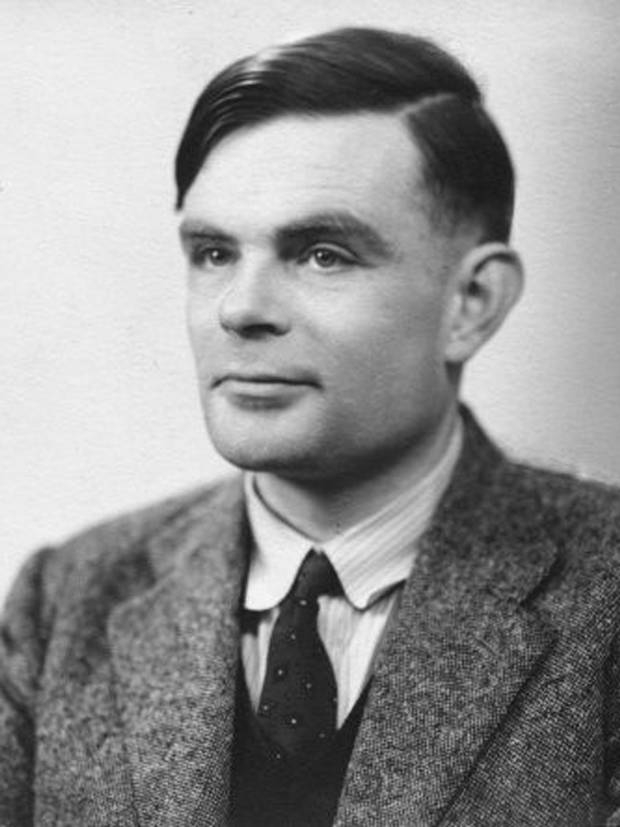
The other day I read an article in Scientific American by John Pavlus about the latest research on evolving computer development, and decided to put forth a final effort to unravel some of the mystery of these gadgets.  I was also motivated by the movie “The Imitation Game” which chronicled the invention of v3-turing-rxthe first computer by Alan Turing, and my own peripheral involvement in its further development only a few years later.  After completion of my internship in 1958, I joined the Navy as a general duty medical officer and was stationed at the Naval Proving Grounds in Dahlgren, Virginia.  It was located on the Potomac River at the mouth of Chesapeake Bay with a primary mission of testing the big guns used on battleships of that day.

Since the large guns of battleships were charged with hitting a target several miles away, the calculations to determine trajectory and other factors required precise mathematical calculations.  To that end IBM had constructed the NORC  (even then the feds were fond of acronyms) or Naval Ordinance Research Calculator.  A large two story brick building was built to house NORC, and it was powered by vacuum tubes very much in the manner of Turing’s machine.  People were amazed at the calculations that could be completed in a matter of seconds by this monster, which probably had 1/10 the power of my iPhone.

Obviously computers have come a long way since NORC.  I have heard much about “artificial intelligence,” and although I don’t know what that term means, it seems computers are getting smarter all the time.  What does it mean when a computer can win at Jeopardy, and the world’s best chess players are defeated by computers?   Much has been said about the supposed inability of computers to replace the human brain so I found it quite interesting when Mr. Pavlus reported that a group at IBM is at work to develop a chip “aimed to mimic cortical columns in the mammalian brain,” while researchers at Hewlett-Packard  are also hoping to design one which will function “more like a neuron.”  These chips are said to contain 41/2 and 5 billion transistors respectively.

I recall when transistor radios came on the market with a great deal of fanfare. Prior to that time the smallest radios were about the size of a picnic basket, and although I thought the idea of a radio which you could carry in your pocket was cool, I had no idea what a transistor was.  With the help of Mr. Wikipedia, I can now report that a transistor is a switch which can be turned off or on, and that a chip has lots of transistors and is attached to a printed circuit board.  The computer processes all that information by flipping those little switches, some smaller than a virus.  Now that I know all about computers, I am sure I will never call mine a bad name again.

Computers are a good example of the good, the  bad and the ugly.  They do wondrous things for us, but also invade our privacy, and pose newfound threats to our well being.  But for all man’s endeavors, no matter how spectacular, there seems to have always been a down side.

SPANKING: Discipline or Abuse?

117456135Introduction: When I prompted my dad to start this blog, we started a process where we kick around ideas for topics; if it’s an idea I really want him to address, I kickstart his process by sending him an email with my thoughts on a particular subject; then he writes his blog post (I tell him he has two things I don’t possess at this life stage: wisdom and time); and then I insert the article into the wordpress software. Below, is the email I sent dad about this week’s issue. His post follows.

April is National Child Abuse Prevention month. I think we should dedicate some blogs to that issue.

I can’t think of any other issue that evokes more polarization in the parenting world than spanking. While I’m in the middle on many issues, spanking isn’t one of them. In my opinion, spanking is lazy parenting. I was never spanked, however, my older brother and sister were. I remember the wooden paddle.

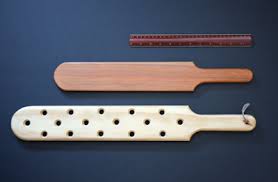
Interestingly, I had this idea that my parents stopped spanking because my dad went back to school to be a psychiatrist. I found out later that unbeknownst to my parents, my older sister hid the paddle, and my parents just didn’t bother spanking my other sister and me because they couldn’t find the paddle and decided it didn’t really work anyway. At least that’s how I remember it.

To me, spanking brings up a larger issue of rearing a child to have internal controls versus external controls. If I put myself in the mind of a four-year-old, spanking says, “If I’m bigger than you and you do something I think is bad, I can physically hurt you,” and then to add insult to injury, the four-year-old gets spanked for hitting his little brother when that little brother destroys his toy. The kid is just doing what he has learned: “I’m bigger than you. What you did was bad. I can physically hurt you, and humiliate you in the process.”

Discipline is about teaching, not punishment. The goal is to rear a child who has his own internal controls and does the right thing even when nobody is looking. I recall one of the many parenting conversations my late husband and I had about spanking. We vowed never to spank our children. He was spanked and said it taught him to learn how to be a good liar, be sneaky, and not get caught. He never gave a second thought to whether what he was doing was right or wrong because the goal was to get away with whatever he was doing.*

But I’m wondering what my dad thinks. Spanking? Thumbs up or thumbs down?

* P.S. When I talked to dad about this blog article, he mentioned that I didn’t give any examples of discipline that teaches children. So, I added some information at the end of the blog to address his point.

DISCIPLINE OR ABUSE by Eshrink

Maggie has asked me for my opinion on spanking. I find the issue a bit more complicated than she does.  Of course the first question which comes to mind is when does spanking become abuse.  Is it a matter of the amount of pain inflicted, both emotional and physical, or is the act itself never justified? This reminds me of the story of the of the man who when chastised for hitting his mule on the head with a club responded that he was not trying to hurt the mule, but only to get its attention.  Mules are notoriously stubborn, and there are some children who also possess that trait.  In such cases spanking will usually get their attention, but the question remains, is it the best and least damaging way to accomplish that goal.

Spanking in the good ole’ days

There has been a great deal of disagreement over the pros and cons of spanking during the past 50 or so years.  As I was growing up, there seemed to be a consensus that spanking was not only effective but necessary in order for children to distinguish right from wrong and learn to do that which was right, or as what we shrinks would call the development of a strong images8BL7CRUNsuper-ego.  The paddle was a prominent fixture in every school principal’s office and parents almost always assumed that it was used judicially.  I still recall vividly my only trip to the principal’s office, and the terror and humiliation I felt as he deliberately left me waiting in the outer office.  I was in the eighth grade and had avoided trouble until then by being “the teacher’s pet” according to my classmates.  I avoided “cracks” as spanking was referred to then, but Mr. Leckrone made it clear that he was not one to be messed with and that a return appearance to his office would result in unspecified but dastardly consequences.  I returned to my home room spankingvowing to never to talk in class again, but enjoying the notoriety as it allowed me to shed the goody two shoes identity that had plagued me until then.

Is spanking effective?

Fundamental to the controversy about paddling is the question as to the effectiveness of any kind of punishment in meeting our goal of producing self- disciplined, reasoned, confident, and caring individuals.  One lesson which must be learned in order to achieve this level of maturity is that behaviors have consequences.  Without this realization children are apt to lack judgement and make poor decisions throughout their lives.  I do not believe there is a one size fits all approach to teaching this concept, but the strategy used may vary depending on the personalities of both the parent and the child.  Among the most important factors in disciplining a child is consistency.  Children can hardly be expected to learn the lesson about consequences if a given transgression is treated differently from one time to the next.

My history with spanking

Punishments carried out in anger serve the parent’s needs rather than the child’s.  It goes without saying that when provoked with anger we are apt to be impulsive and exercise poor judgement; consequently it is a good idea to count to 10 before deciding on a response.   Now and then I think of an episode in which I flunked that particular test of patience, resulting in me feeling not only guilty but foolish.  My two grandsons were visiting and discovered a toy gun from my son’s childhood (No, my son has not shown any inclination to shoot anyone in spite of this early training).   My grandsons were barely more than toddlers, but were fascinated by the gun.  Their interest was probably fueled by the absence of toy guns in their lives as their parents did not believe it was a good idea to teach kids to shoot people; besides the game of playing cowboys and Indians, so popular in my childhood was no longer politically correct.

The boys were the same age and had always played together and seemed to enjoy each other’s company; however as you might expect the presence of two boys and only one desirable object was certain to result in conflict, and it did.  Initially there was a tussle, then one of the boys who shall remain forever nameless wrested the gun away and promptly hit his cousin on the head with it.  This was not a love tap, and could have done significant damage.  I was incensed, and promptly smacked him on the butt with my hand.   Later I would realize that I was angry with myself for not being adult enough to intervene before the situation got out of hand, and for violating my own rule about acting in anger.  Needless to say Grandpa’s overindulgence would reach a new high for the remainder of that weekend.

Yesterday I had the opportunity to ask my son if I had ever spanked him.  He said that I had but that it had been rare.  I find it very interesting that I have no memory of ever spanking him, while the previously mentioned episode is so firmly imbedded in this tired old brain.  I suspect that the answer is that I, the control freak, uncharacteristically lost control, and in such a state could have done serious harm to a little guy I loved.  As a psychiatrist I have seen many people with problems dealing with and controlling their anger.  It seems reasonable to me that for such people to engage in corporal punishment is dangerous and may account for many if not most cases of child abuse.  Unfortunately there is little that can be done about these parents until after the damage is done.  For some, this alone is enough justification to warrant a ban on any kind of physical punishment to children.

Does spanking damage children?

Certainly the most important issue in the spanking debate is the effect that it may have on children.  Research in the social sciences is notoriously difficult in that it is almost impossible to control all the variables when doing large scale population studies.  For example, an article at Slate.com cites sociologist Annette Lareau saying that research shows that “corporal punishment on average correlates with lower measures of cognitive ability, such as IQ,” but follows with the admission that “measures like IQ are confounded by many variables.” Consequently; one can find corroboration on almost any position one takes if they search hard enough.  Few statistics are available regarding the incidence of spanking.  An ABC poll showed that 65% of Americans approve of spanking and 50% of the parents said they have spanked their children. According to a Gallup poll 28% of American families spank their children. It is said that a majority of those who admit to spanking are conservative Christians, although I could find no evidence to confirm that premise.  Indeed one study found a higher incidence in non- Christian nations.  Many refer to the phrase “spare the rod and spoil the child” as a Biblical admonition, but it was first coined by Samuel Butler in a poem called Hudibras written in 1664.  The Biblical literalists who espouse spanking generally refer to several passages in proverbs in which beating your child is described as an act of love, just another reason for my not getting into the old testament.  Although I can’t picture Solomon as a sadist, I do have concerns that such passages may give license to those who are.

My experience as a psychiatrist and insights from patients about being spanked as children

During my many years as a psychodynamically oriented psychiatrist I have listened to literally hundreds of people tell the stories of their childhood.  It is dangerous to draw conclusions from such anecdotal information, especially when it may be colored by subjective perceptions.  Nevertheless; one would expect these perceptions to have some relevance.  As I reflect on the issue, it comes to mind that most had experienced some kind of physical punishment, usually spanking.  As you might expect my sample is skewed since many of these people had obviously suffered severe psychological damage due to extremely cruelty administered in the guise of discipline.

There were many who resented having been spanked, but more often identified overly strict parenting as their major complaint.  In other words it seemed not to be the spanking per se which disturbed them but rather it’s too frequent and injudicious use.  Of course there were those examples which may have crossed that line into abuse.  On the other hand there were significant numbers of patients who recalled almost fondly their experiences with the paddle.  Those folks seemed to interpret physical punishment as evidence that their parents cared about them, thus appearing to give some credence to the Solomon philosophy.

This same interpretation is also common among friends of my generation who are likely to be more critical of parents “who let their kids run wild” than of those who physically punish their children.  The phrase “that kid needs his little butt smacked “ is often heard among my contemporaries; although it is rarely recommended for their own grandchildren.  There is no doubt that society’s laissez faire attitude regarding such issues contributed to child abuse, and that mistreatment of children is still a major problem in many parts of the world and even here in this so called enlightened society.  It is true that many parents have abrogated their responsibilities toward their children, but it is also true that in our country while many children are overindulged many are neglected usually due to poverty.  Both groups need to learn discipline, but are denied, the first because of permissiveness and the second due to hopelessness.

The acceptance of discipline tactics changes with the times in which we live

Not so many generations ago ours was an agrarian society.  Families were generally much larger, and children were expected to work the land alongside the adult members of the family.  A sense of responsibility and strong work ethic were highly prized as the family’s wellbeing and at times even their survival was at stake.  Sending children to school represented a sacrifice as it took them away from work on the farm.  Summer months were the most labor intensive time for farmers thus began the practice of closing schools during the summer as we continue to this day.  I have no doubt that children were loved in those days, but I think it is safe to say they were rarely coddled.  It also seems clear that punishment was harsh when compared to present day standards.  Many of those disciplinary actions would in our time be considered abusive, while our ancestors would undoubtedly label them as methods to teach societal values and behaviors.

Those attitudes stand in marked contrast to those of our generation.  With fewer children in each family they are more likely to be overindulged and overprotected as parents have placed all their expectations in one or two baskets.  A dramatic example of this phenomenon exists in China where more than one child per family was prohibited.  This has resulted in an epidemic of childhood obesity which rivals that of the United States.  Some also feel that it has contributed to excessive narcissism among many of these kids.  I recently heard that the Chinese government has rescinded this anti-propagation law for fear that it will eventually result in a shortage of labor.

Now that children have little economic value, parenting has become even more of a vicarious activity than it has been in the past.  We want our children to “make us proud” which actually translates to allowing us to relive our past hopefully with better results.  In my own case, I am especially invested in my children and grandchildren’s athletic successes since I had tried out for every sport offered at my high school, but never made the team.  When one of the kids wins a game, some of my DNA was involved, and I find that very satisfying.  Nowhere is this phenomenon more evident than at a little league or biddy football game, where parents complain constantly about the officiating as if any perceived bad call is a personal affront.  The coach’s authority is often questioned and opposition players may be denigrated.  I am told that so called “trash talking” has become part of the game, and that deception strategies are welcomed.  Even the concept of sportsmanship appears to have evaporated.  It is my contention that teaching effectiveness is influenced more by what we do than by what we say.  In other words I believe that children tend to model their behaviors after those close to them even when those behaviors are objectionable (monkey see, monkey do).

Opinions about child rearing were influenced in the past century by Freudian ideas.  The emphasis on childhood traumas as the cause of most mental disorders was center to Freud’s theories; consequently parents, especially mothers, were to blame for causing a lifetime of problems for their children.  Mothers as primary nurturers assumed responsibility for their child’s successes and failures.  The “where did we go wrong” lament was frequently heard, and motherhood took a hit.  Alfred Adler, one of Freud’s disciples, emphasized what he called the inferiority complex which he felt had its origins in failures on the part of parents to enhance self-esteem.  This led to the position that criticism was to be avoided at all costs and that children should be always praised in order to protect their fragile egos.  Of course spanking by devotees to this philosophy would be a definite no no.

These ideas became institutionalized: teachers were taught to never be critical, and Mr. Rogers came along to tell kids how wonderful they were.  There were to be no losers for when there was a group activity in which there was competition, everyone would get a trophy.   Marshal Mcluhan commented that the so called TV generation was growing up feeling they should be entertained; however there has been some progress in that now kids spend hours interacting via video games rather than sitting motionless for hours at a time.  Still such things do little to nourish creativity.   Sixty years ago Dr. Hugh Misseldine, a child psychiatrist, delivered a lecture to my medical school class in which he stated that children who are overindulged grow up to be bored.

Have all these factors conspired to leave many of our children feeling entitled? Have we fostered over confidence setting them up for failure?  Have we impaired their judgement by not allowing them to suffer consequences?  Do we assume  responsibilities that should belong to them?  Last but by no means least do we really have as much power to affect our children’s development as we think we do?

I’m ready to render an opinion

Now, after that brief prelude I am ready to get around to answering Maggie’s question (she should know me well enough to not expect a simple answer to any question).   First I feel the need to address the paddle issue.  She may recall that I  manufactured that paddle with great fanfare, and hung it on a wall in the family room for all to see.  I don’t recall if I ever used it, but I do know that its primary purpose was intimidation.  That must have worked for I never had a need to use it on anyone after that.  I was aware that it had been hidden, and remember chuckling to myself about my oldest daughter Molly’s ingenuity.

A few years back I saw a patient who blamed her problems on a conflicted childhood which she described as chaotic.She reported that her father was very warm, loving and attentive except when he was drinking which was frequently.  When he came home drunk, the children would all look for some place to hide for he would become violent and abusive.  Her conflict centered around deciding which was the real person.  Was his behavior when sober an act or did he really love her.  This to my mind is the most important factor in answering the question.  I strongly believe that the most damaging thing which can happen to a child is perceived parental rejection.  The emphasis here is on the child’s perception as to whether he is loved even when punished.  As with Harlow’s wire cage monkeys children simply cannot mature without appropriate nurturing.  To feel unloved may be the most painful of all human experiences.

Since we cannot know how a child will interpret our motivations and since they tend to learn from and eventually mimic our behaviors, I lean rather strongly to the thumbs down answer.

Maggie’s addendum. In the introduction of dad’s post, I said I would answer my dad’s suggestion that I provide examples of discipline that I view as beneficial. Here goes…

There are several times as a child, I wished my parents would have spanked me instead of rendering consequences that seemed to last an eternity. One such time was when I mouthed off to my mom…I don’t remember exactly what I said or did, but she said, “I don’t want to hear another word. If I do, you’re going to be grounded for a week.” The challenge was on! I, of course, mouthed off in protest and she said, “That’s it, you are grounded for one week. Do you want to go for two?” Of course I did! This battle of the wills continued until I was up to four weeks of being grounded.

I sulked the entire weekend, and then started my campaign for goodness. I did my chores, I was pleasant, rubbed my mom’s back and feet before bed, asked how her day went…the whole enchilada. My friend Annette asked me to spend the night for a big sleepover the following week…mom and I had been getting along great and I had been the model daughter. I said, “Mom, Annette is having a sleepover Saturday. I’ve already done my chores and cleaned out my closet. Can I tell her I can come?”

Mom said she just needed to check the calendar. “Oh, honey you’re still grounded. Tell Annette you can spend the night three weeks from tomorrow,” she announced in her nicest mom voice. “I wish you would just spank me like normal parents,” I muttered under my breath as I stomped out of the room.

When Steve and I decided we would never spank our children, we had to have a strategy. The most valuable advice I acquired (other than the example of my parents) was a book called “Kids Are Worth It.” The main takeaways: identify your child’s currency at the time (it changes); be consistent; keep your word (follow-through); make them tell you not just what they did wrong but what they should do differently the next time (appropriate responses); embrace natural consequences; exhibit the behavior you want them to model; and make sure they know you love them.

The “currency” thing is key! My kids didn’t grow up in a “neighborhood” so grounding them like my parents did, wasn’t going to work. With Simon, there was a time when grounding him from the Playstation was a punishment worse than death, but he would have times when he wasn’t into gaming so I had to figure out what would make the biggest impact.

Another lesson: make sure it’s something you can control. During one stage, his phone was the currency that mattered. I took it away, but realized that I needed him to have a phone in order for me to reach him when I was at work since I had gotten rid of our landline. I gave him the “uncool” pay as you go phone. I soon learned my lesson: I can’t physically make him turn on the phone.

The last time he was grounded might have been even more of a punishment for me than him. I had given him permission to go to a concert with three of his friends. He had been looking forward to it for months. It was a big deal. He got mouthy and verbally abusive. I gave him the warning: he tested me. “Are you sure you want to do this?” I asked with a second warning. “F-you. I hate you. Everybody hates you.” Done. No concert. Grounded for the weekend. He kept it up. Grounded from everything: phone, computer, X-box…life. It was a long weekend since I had to stick to him like glue to enforce the punishment (good times…hanging out with an angry, sulking teenager). Stuck with each other for the entire weekend, we emerged with a better relationship even though I was exhausted. He seemed to develop a renewed respect for his mom who would do what she said (no matter how painful) and I was proud of myself for sticking to my guns.

I was fortunate Caroline’s personality has been less confrontational. She is introverted and her currency was books. I used to think to myself, “If I need to dole out punishment, what am I going to do? Ground her from reading?” Somehow that didn’t seem right. Fortunately, she hasn’t had to be grounded yet.

Two things from my dad’s article that are especially pertinent: methods of discipline have much to do with societal norms (in his day, it was common for kids to get spanked…almost a right of passage) but today it can make a child feel confused since peers don’t experience that same discipline; children crave and need consistency; and the fact that your child’s perception of events IS his/her reality. This last lesson my dad taught me has served me well. I often asked my children, “What do you think I meant?” It is amazing how they perceive what I have said in ways I never intended.

My all time proudest moment as a parent was when daughter Caroline sat down and started counting to 10 while taking deep breaths  when I told her she couldn’t have yet another cookie. “I am so frustrated right now. I just need to take a break for a minute,” she said–she had watched me do that through the years and pulled it out for a coping tactic.

The difficulty with parenting is that you never really know how you’re doing and won’t know for years to come. A kid isn’t going to say, “Good move, mom. I really learned my lesson with that punishment.” One thing I do know: nobody has ever given me a good reason as to the need to spank a child. I still contend it is lazy parenting.

The Great Science Conspiracy

Not so long ago, I was attending a Bible study session with a bunch of guys, (at my age one tends to become more interested in that afterlife thing) when I happened to mention the role of evolution in human development.  One of the members whom I considered to be quite intelligent, and especially well read when it came to biblical issues objected to my opinion.  He felt that The Theory of Evolution was an “insult to God.“ He was of course an adherent to the myth of creationism, and seemed little interested in my explanation of why I felt the opposite was true.  My mini-sermon about the awesome nature of a system so well organized and intertwined resulting in that miracle we call life should result in honor and praise of its designer, did little to impress him.   To his credit, he did not suggest that all was lost, and said he would pray for me.

His vow to pray for me was quite sincere, evidence that his belief was unassailable, and that he was concerned for me.  If I had indeed insulted God, then I would need prayer from somewhere.  I was hopeful that there might be some overlap so that his prayers could be applied to some of my more grievous sins. This is not to say that I have anything against prayer, for I have derived comfort when people have said they were praying for me.  The big question is which one of us was insulting God, or does he care which way we think it all happened?

Why How are we here?

This question as to how it all, including us humans, came to be has undoubtedly puzzled mankind ever since his brain had become sufficiently developed to contemplate such things. Primitive man must have been in awe of all that he witnessed in his environment.  He was totally immersed and dependent upon those miracles of life which we now often take for granted.  It is little wonder that he would look for plausible explanations for how he had come to be.  Since these questions were unfathomable, it is not surprising that he would look for a spiritual solution.  In recent centuries there has been considerable progress in answering the question as to how some of these things happened, but what or who initiated them remains as much a mystery as it was to our Stone Age ancestors.

Nevertheless, we have learned much about such issues during the past several centuries, but the rejection of scientific discoveries on religious grounds is not a new phenomenon.   In the past, scientists have faced not only derision, but even persecution for their pronouncements.  One famous example is Galileo, one of the most brilliant scientists of all time, who was twice convicted of heresy and spent the last few years of his life on house arrest.  Five hundred years later, there are still those who see scientists as Godless or even satanic in nature.  The truth is, according to a survey taken several years ago, it was determined that over half were believers.

Fortunately, we no longer put people in jail for their pursuit of truth, but there are some who reject outright those findings which they think conflict with their beliefs.  A good contemporary example is the insistence of some zealots that creationism be given equal time with evolution in school curricula.  This, in spite of overwhelming evidence proving that such an idea is false.  The question we must answer is: do we want to teach science, or should it be replaced by religious dogma as they do in the madrassas of the Middle East?

However, it is not only religious fundamentalists who are skeptical of science.  In the March issue of National Geographic magazine, it is said that “one third of Americans believe humans have existed in their present form since time began.”  The article continues to say that 60% do not believe that human activity is the cause of global warming, thus negating the opinions of 97 percent of climatologists worldwide.  The conflict between believers and naysayers tends to line up with their political views, further evidence that truth is no match for strongly held beliefs regardless of their origins.

The internet can be a source of a great deal of misinformation.  Many times I have challenged someone whom I feel has been misinformed, and ask them for evidence, and they have responded: “I saw it on the internet” which implied that it must true.  Of course conspiracy theories abound on the internet and the scientific community is not immune.

The Vaccine Conspiracy

Since I am a physician, I tend to note the anti-science rants which concern the field of medicine. The myth that immunizations are the cause of autism is one of those issues that appears to have been widely propagated on the internet.  One prominent example is a website called VaxTruth.org.  After reading some of their literature, I strongly suggest that title is inappropriate as I found little there that was truthful.  This is an issue that has caused serious harm and has the potential to affect the population as a whole.  I find it difficult to understand how such an organization could achieve not for profit status.

The Measles

Recently there have been sporadic outbreaks of measles in communities where well meaning parents refused to have their children vaccinated.  Measles is probably the most communicable disease known to man.  It is communicable five days before the appearance of a rash.  When I first started practicing medicine measles was a fact of life, and it was expected that all children would become infected.  If one child developed the rash, you could expect that everyone in his family or classroom, who had not already had the disease, would be sick in one to three weeks.  It was extremely rare for anyone to reach adulthood without having experienced the illness, but after recovery they had lifelong immunity.

It is not difficult to find information on the internet written by opponents of vaccination.  They tend to minimize the seriousness of measles, and suggest the recommendations to vaccinate are largely due to vested financial interests on the part of physicians and drug companies.  The truth is that the vaccination business is not very lucrative, and the complications of measles can be very serious, especially for children under five and young adults.  The Center for Disease Control reports the incidence of ear infections, which can lead to hearing impairment to be one in ten, pneumonia one in twenty, and encephalitis one in one thousand.  There also exists the possibility of the development of subacute sclerosing panencephalitis, a very serious brain disease, which may develop seven to ten years after recovery from measles.

Polio

I am old enough to recall days when my parents were terrified that I or my brother might develop the illness that had left President Roosevelt crippled.  I also remember seeing a newsreel at the movies which showed a room full of people in so 1280px-Iron_lungs

called iron lungs. Polio patients were entombed in these large cylindrical structures with only their heads protruding.  The paralysis usually occurred in the lower body, but could ascent until breathing was impaired in the more serious cases.  I heard that FDR contracted the disease after swimming.  After watching that news reel, I lost all interest in swimming for that year.

SalkIn 1955, a breakthrough occurred in the treatment of this previously incurable disease when a vaccine developed by Dr. Jonas Salk was made available.  Prior to that time there were between 13,000 and 58,000 cases of polio reported annually in the United States.  In 1952, a record year, there were 3,145 deaths and untold survivors with residual disabilities.  If that weren’t enough, a condition called post polio syndrome with muscle weakness and pain could reappear years after the original onslaught.  The Salk vaccine virtually eliminated polio in the United States and throughout much of the world.  There are still pockets at risk, the most recent in the U.S. was in 1979 when there was an outbreak among an Amish population in the Midwest who had refused the vaccine on religious grounds.  Needless to say, Dr. Salk became an instant hero.  He refused to patent the vaccine as he wanted to keep the price down in order that it could be available to as many people as possible.  You might think this would give the Vaxtruth and likeminded people pause to reconsider their theory that this vaccination business was simply a con game to extort money from the masses. However, it’s been my experience that believers rarely allow facts to get in the way of a good conspiracy.

There appears to be general agreement among epidemiologists that what is called “herd immunity” is an important factor in preventing major epidemics.  When the percentage of those vaccinated reaches a critical mass, the risk for the entire population is lessened. Of course, the anti-vaccination groups vehemently deny the validity of the concept of herd immunity or community immunity as it is sometimes called.  This disbelief appears to have been a factor in the measles epidemic in southern California a while back where a group of parents became convinced that vaccinations were dangerous.   All 50 states require immunizations to enter schools, but 48 allow religious exceptions, and 19 make exceptions on philosophical grounds which would seem to make those laws toothless.

The phrase “an ounce of prevention is worth a pound of cure” is one I heard many times in my childhood, and is all one should need to justify immunizations.  The development of vaccines is one of the major factors contributing to the lengthening of our lifespans, and must rank among the greatest achievements of mankind.  I read somewhere that an Egyptian mummy was found to have probably died of smallpox, and some historians think that a smallpox epidemic in the ranks of Roman soldiers was a major contributor to the country’s demise.  Indigenous populations throughout the world have been virtually destroyed by its ravages.  Jenner’s research in 1796 resulted in a means to vaccinate against this dread disease, and now it has been virtually eradicated from the face of the earth.

Diphtheria

Many years ago, I accompanied my Grandmother to the village graveyard, and was surprised to see a small marker in the family plot with a name inscribed that I had never heard before.  At my prodding she told me of how he had died of diphtheria as she held him in her arms.  She talked of her feelings of helplessness as she heard the “death rattle” and finally that last desperate gasp.  She was a strong woman and went on to focus on the rest of her family.  Sadly this had not been the case with Mary Todd Lincoln whose son had died in the same way, for it is said she was never able to resolve her grief.

In 1920 one year prior to the introduction of diphtheria toxoid there were over 15,000 diphtheria deaths reported in the United States. It was referred to as the “plague for children.” There have been no reports of diphtheria in the US since 1975 when there was a minor outbreak in Seattle.  Similar statistics could be found for other diseases, such as whooping cough and tetanus.  Can there be any doubt about the effectiveness of these vaccines, or will the conspiracy theorists insist these numbers are also fabricated? One could go on with a list of reasons to promote and even require immunizations for the populace, but I am sure there will be others who prefer that we go back to those good old days of one hundred years ago when life was shorter and more painful.

As is well described in that National Geographic article, The Age of Discontent, there is now rampant skepticism of many things scientific.  In previous blogs, I have also expressed concern over the relationships between the pharmaceutical industry and medical science.  I believe that it is possible for studies to be contaminated by poor study design and for researchers to thus being used to promote a particular product with too little focus on the common good.  I also have some concerns over the dependency of Universities on corporate funding for research as our politicians cut back on academic budgets.

In spite of the occasional intrusion of financial or political interests which have on occasion blemished scientific endeavors, one only needs to look around in his own small part of the world to appreciate the benefits that have accrued to mankind by those who have committed their lives to the scientific method in search of truth.  They explore the wonders of our universe and even things we cannot see or hear.  New questions usually arise from every one answered, and we begin to understand how little we know.  It has always seemed to me that such knowledge should confirm religious beliefs rather than threaten them.

Bending My Brain

However it is not only the Biblical literalists who question scientific findings.  Many reasonable people are reluctant to embrace some discoveries.  First of all, there never has been a time when we have been deluged with such massive amounts of information, some of which is difficult to understand, and some so fantastic that it strains credibility.  For example whenever I read something supposedly written for lay people about astrophysics, I come away with my head spinning. In addition, I was taught that the atom was the smallest particle of which all matter was made.  Now I read about all kinds of particles which reside in the atom and the forces that hold it all together.  On reading further, I am told that some of these particles are not matter but some other form of stuff, while others theorize that particles are actually strings.  At this point I often give up and accept that either I am stupid or this stuff is confusing.

Now I am no “Bill Nye the science guy”, but I have had some background in many of the sciences, and remained interested in them all of my life.  It would seem logical that if I can’t understand what these guys/girls are talking about, that Joe Sixpack would probably walk away from it convinced that it was a bunch of double talk, it had no relevance to him, and that scientists are all weird.

Media in Need of Education Regarding Science and How the Process of Discovery Works.

The inconsistencies delivered to the public by the news media also contributes to a general mistrust of the scientific community.  The explosion of data in recent years has led to the birth of fulltime positions as science reporters.  These people not only look to interview those investigators who are doing work the reporters deem interesting, they also peruse various scientific journals in order to get the jump on their competitors.  Therein lies a significant problem: many of these studies may be flawed, and subject to revision or outright rejection.

The scientific method was first adopted 500 years ago, and has changed little.  In its simplest form it involves formulating an hypothesis or theory then setting about to prove or disprove it by whatever means is appropriate.  This may be done by experimentation or other means of developing evidence for or against the hypothesis.  In most studies there is much opportunity for error not only in data collection, but study design, interpretation, outside influences, and even the unconscious biases of the investigator.  Therefore; most all important studies are subjected to intense review and usually are not accepted as gospel until their studies have been replicated by others.  The validity of the study conclusions are highly dependent upon these checks and balances, and there is often a great deal of back and forth as these scientists are just as competitive as any athlete.

With this in mind it is always wise not to endorse any scientific conclusions until the dust settles and there has been time for some study of the study. Indeed, this is how science is supposed to work!  However, the media is apt to report the results of a study before the process of checks and balances (replication) is actually finished.  Subsequently, it may be determined that the previous conclusions were wrong and the opposite of what was previously reported is true.  Therefore, one day the media reports caffeine will kill you. Next month, you hear the same reporter tell you caffeine is good for the brain and prevents dementia.

It is little wonder that Mrs. Sixpack loses faith in these “experts” on whom she depends, to tell her what is good for her kids, and Joe thinks this global warming thing is a joke. Is it surprising that they would cling to their previously held beliefs and give more credence to a politician than someone who has devoted his entire life to study of a particular subject?

The more we learn, the more wondrous the world becomes.

There also seems to be a great deal of misunderstanding as to how this science stuff is done.  Most discoveries are the result of painstaking efforts carried out over considerable lengths of times, sometimes years or even decades.  There are few “eureka moments” as most discoveries occur incrementally.  In my opinion the pursuit of knowledge is a noble endeavor, and curiosity is part of the human condition.  The sciences have provided a method to satisfy that need, and in the process have not only enhanced our quality of life, but left us in awe of the magnitude and complexity of our environment.  The more we learn, the more wondrous it becomes.  Of course we humans have not always used that knowledge sensibly, and may even have used it to put our very existence at risk, but that is another story for another time.

Rebuttal to NY Times Article “Medicating Women’s Feelings”

Note from Maggie, Dr. Smith’s daughter and proud editor of eshrinkblog.com

The minister (pastor, reverend, preacher…I never know the correct title) sent my dad an op-ed piece from the New York Times and asked him what he thought of it. To me, it sounds like they are both very well-read people and enjoy intellectual conversations about issues. Below is my dad’s response. For my part, I see why my dad is so baffled by Dr. Holland’s article. I think what she is saying is that the system is set up to reward male-dominated traits, and there is value in many of the traits females have as a part of their biology. But she doesn’t explain it very well. Instead, she seems to be saying, “Suck it up and appreciate your depressive state. These anti-depressants are just making you like a zombie.” As a person who suffered from post-partum depression after my second child, Prozac was a lifesaver…for me and my husband and children.

Here is the article:

Medicating Women’s Feelings

WOMEN are moody. By evolutionary design, we are hard-wired to be sensitive to our environments, empathic to our children’s needs and intuitive of our partners’ intentions. This is basic to our survival and that of our offspring. Some research suggests that women are often better at articulating their feelings than men because as the female brain develops, more capacity is reserved for language, memory, hearing and observing emotions in others.

These are observations rooted in biology, not intended to mesh with any kind of pro- or anti-feminist ideology. But they do have social implications. Women’s emotionality is a sign of health, not disease; it is a source of power. But we are under constant pressure to restrain our emotional lives. We have been taught to apologize for our tears, to suppress our anger and to fear being called hysterical.

The pharmaceutical industry plays on that fear, targeting women in a barrage of advertising on daytime talk shows and in magazines. More Americans are on psychiatric medications than ever before, and in my experience they are staying on them far longer than was ever intended. Sales of antidepressants and antianxiety meds have been booming in the past two decades, and they’ve recently been outpaced by an antipsychotic, Abilify, that is the No. 1 seller among all drugs in the United States, not just psychiatric ones.

As a psychiatrist practicing for 20 years, I must tell you, this is insane.

At least one in four women in America now takes a psychiatric medication, compared with one in seven men. Women are nearly twice as likely to receive a diagnosis of depression or anxiety disorder than men are. For many women, these drugs greatly improve their lives. But for others they aren’t necessary. The increase in prescriptions for psychiatric medications, often by doctors in other specialties, is creating a new normal, encouraging more women to seek chemical assistance. Whether a woman needs these drugs should be a medical decision, not a response to peer pressure and consumerism.

The new, medicated normal is at odds with women’s dynamic biology; brain and body chemicals are meant to be in flux. To simplify things, think of serotonin as the “it’s all good” brain chemical. Too high and you don’t care much about anything; too low and everything seems like a problem to be fixed.

In the days leading up to menstruation, when emotional sensitivity is heightened, women may feel less insulated, more irritable or dissatisfied. I tell my patients that the thoughts and feelings that come up during this phase are genuine, and perhaps it’s best to re-evaluate what they put up with the rest of the month, when their hormone and neurotransmitter levels are more likely programmed to prompt them to be accommodating to others’ demands and needs.

The most common antidepressants, which are also used to treat anxiety, are selective serotonin reuptake inhibitors (S.S.R.I.s) that enhance serotonin transmission. S.S.R.I.s keep things “all good.” But too good is no good. More serotonin might lengthen your short fuse and quell your fears, but it also helps to numb you, physically and emotionally. These medicines frequently leave women less interested in sex. S.S.R.I.s tend to blunt negative feelings more than they boost positive ones. On S.S.R.I.s, you probably won’t be skipping around with a grin; it’s just that you stay more rational and less emotional. Some people on S.S.R.I.s have also reported less of many other human traits: empathy, irritation, sadness, erotic dreaming, creativity, anger, expression of their feelings, mourning and worry.

Obviously, there are situations where psychiatric medications are called for. The problem is too many genuinely ill people remain untreated, mostly because of socioeconomic factors. People who don’t really need these drugs are trying to medicate a normal reaction to an unnatural set of stressors: lives without nearly enough sleep, sunshine, nutrients, movement and eye contact, which is crucial to us as social primates.

If the serotonin levels of women are constantly, artificially high, they are at risk of losing their emotional sensitivity with its natural fluctuations, and modeling a more masculine, static hormonal balance. This emotional blunting encourages women to take on behaviors that are typically approved by men: appearing to be invulnerable, for instance, a stance that might help women move up in male-dominated businesses. Primate studies show that giving an S.S.R.I. can augment social dominance behaviors, elevating an animal’s status in the hierarchy.

But at what cost? I had a patient who called me from her office in tears, saying she needed to increase her antidepressant dosage because she couldn’t be seen crying at work. After dissecting why she was upset — her boss had betrayed and humiliated her in front of her staff — we decided that what was needed was calm confrontation, not more medication.

Medical chart reviews consistently show that doctors are more likely to give women psychiatric medications than men, especially women between the ages of 35 and 64. For some women in that age group the symptoms of perimenopause can sound a lot like depression, and tears are common. Crying isn’t just about sadness. When we are scared, or frustrated, when we see injustice, when we are deeply touched by the poignancy of humanity, we cry. And some women cry more easily than others. It doesn’t mean we’re weak or out of control. At higher doses, S.S.R.I.s make it difficult to cry. They can also promote apathy and indifference. Change comes from the discomfort and awareness that something is wrong; we know what’s right only when we feel it. If medicated means complacent, it helps no one.

When we are overmedicated, our emotions become synthetic. For personal growth, for a satisfying marriage and for a more peaceful world, what we need is more empathy, compassion, receptivity, emotionality and vulnerability, not less.

We need to stop labeling our sadness and anxiety as uncomfortable symptoms, and to appreciate them as a healthy, adaptive part of our biology.


My dad’s response to the article above

Dear Dennis,                                                                                                                                               March 9, 2015

Thank you for sharing the New York Times Op Ed.  Although there are many points in which I agree, I do fear that the opinions expressed may have the power to cause as much harm as the side effects of the psychotropic medications which Dr. Holland feels are overused.   My concern is that her essay may contribute to the stigma already attached to the treatment of mental illness or emotional problems in general.  Although Dr. Holland does make some valid points, I believe that some of her analyses are inaccurate.   She bases her expertise on having practiced psychiatry for 20 years.  Lest you think it audacious of me to challenge her, I trumpet the fact that I had more than twice that many years as a psychiatrist and prior to that another 10 years practicing general medicine.   In the latter capacity, I found myself frustrated by my helplessness to deal with the emotional suffering of many of my patients.   With this in mind I returned for a residency in psychiatry.

The first paragraph of Dr. Hollands’s piece lists qualities which she presents as gender specific, with which I do agree in general.  She then describes these qualities as a “source of power” and continues by asserting that women are  “under constant pressure to restrain our emotional lives” while denying a pro-feminist ideology.   I fancy myself as a firm advocate of equal rights for women having been well indoctrinated by three assertive daughters, and a wife who has extricated herself from the helpless, dependent role which she had been taught.   As I have stated in a previous blog post, I believe that women will eventually achieve equality or even superiority.  In general, I feel this would be a good thing, although I must confess I do occasionally have some nightmares of that Stepford  Wives  thing, for I realize that paybacks are hell.

In the next paragraph she bashes the drug companies for “playing on fear.” Those of you who have read my previous blogs would agree that I am no big fan of the pharmaceutical industry, and I believe that promotion of prescription drugs to the lay public is not helpful, but then neither is the endless promotion of alcohol on TV.  I have long felt the cost of new medications outlandish, but that is another story.   In their defense I must admit that the tools available for treating mental illness although not nearly perfect are amazing considering what was available to us 60 years ago—even 30 years ago.  She uses the example of Abilify as the inappropriate use of a medication.  She does not seem to consider that it may be used so much because it is effective.  Although it was originally developed as an antipsychotic, it has been found to be efficacious when given in small doses to augment the effect of antidepressants.

She presents further evidence of a stoned female population by noting that 1 in 4 women are taking a psychiatric drug compared to 1 in 7 men.  This would seem to indicate that men are under medicated and women are about right for the INH study shows a prevalence of mental illness of 26.3% of the adult population. The disparity may also have something to do with the fact that women are not burdened by the macho thing and the qualities in women, which the doctor extolled in her opening paragraph, allow them to be more likely to seek help.  Could these same disparities in diagnoses between men and women also have to do with the sensitivity and other valued traits in women?  It does not seem illogical that they might have an increased susceptibility to depression and anxiety disorders as is the case in many  types of illness.  After all “men are from Mars and women from Venus.”

Dr. Holland insists that women are designed to “be in flux” and such things as premenstrual syndrome with its despondency, irritability, and anger are simply part of the normal female physiology and apparently is something that shouldn’t be tampered with.

She should be reminded that biologically premenstrual syndrome (PMS) was not a problem for primitive women, because they avoided the problem by being constantly pregnant.  Modern women have rejected that option, and menopausal symptoms likewise were rarely a problem since few lived to be as old as 40.   When these facts are considered one could safely conclude that treatment of these problems is not in violation of natural law.  On the contrary I have seen many women through the years who have been severely impaired and spend sometimes half of each month miserable.  Then there is the guilt that follows when they later realize the effect their behavior has had on their family, friends and coworkers.   I would dispute her statement that menopausal symptoms can ” sound a lot like depression”, and say it not only sounds like but is depression.   If it quacks like a duck, etc.

Perhaps it is with her discussion about SSRI’s that I wonder if I really am on a different planet.  I vividly recall the first time I prescribed Prozac, which was the first SSRI.  The patient was a very unhappy young man who had suffered  a social anxiety disorder with depression since the 6th grade.  He had lived in almost total isolation, had never dated,  and worked in a warehouse on the night shift in order to have minimal contact with other people.  After a few visits he appeared to be a bit more comfortable with me, but shuddered at the idea of branching out socially.  After a couple of weeks there was a remarkable change.  He had started out by making conversation with the check out girl at the grocery, and reported he was no longer avoiding acquaintances as he had in the past, but more importantly  he arrived with a broad smile.  He denied any depressive symptoms, and the changes in his persona were so remarkable that I wondered if he had been into something illicit.  I was skeptical this might be a  placebo effect, but the changes persisted and the last time I saw him he had quit his night job, and enrolled in a university to pursue an engineering degree.

At this point I was sold on Prozac, but my joy was short lived when I found that it did not always work as advertised.  It did however offer many advantages over other antidepressants which were available at the time including fewer side effects , less sedation, and non lethality at even huge doses, an important feature when dealing with depression.   There is a significant group who will experience some sexual dysfunction, but most of my patients say that is a price they are willing to pay.  I do not recall noting the zombie like effects that she describes with SSRI’s.  As a matter of fact, my patients usually are more animated and expressive.  Dr. Holland notes that SSRI’s may dampen what she calls ”human traits” among which are irritation, sadness, anger,  mourning and worry.  I don’t know about her patients, but mine would not mind giving up those human traits.

She also lists as side effects that SSRI’s are apt to result in one becoming “more rational and less emotional.”  It is difficult for me to understand how these traits could be labeled as negative effects; therefore undesirable. We are led to believe that emotional stability will make women more masculine with the capacity for leadership, which again we are to assume is a negative.  Her response to patients who complain about the emotional instability associated with the  premenstrual period could be likened  to such macho statements as  “suck it up, play through the pain, stop whining  etc.” consequently I am confused as to exactly what behaviors she thinks are appropriate.

The most puzzling of all to me is the last statement in the article wherein she states “we need to stop labeling our sadness and anxiety as uncomfortable symptoms and to appreciate them as a healthy , adaptive part of our biology.”  I see nothing healthy about depression and anxiety, but only pain.  Nor do I see any virtue in needless suffering.  As a physician, I have always seen as my goal the alleviation of suffering, and nowhere in life is the suffering more extreme than in those afflicted with mental disorders despite the cause.

LOSING A FRIEND

Lilly has lymphoblastic leukemia.  It looks as if she will not be with us much longer.  We will certainly miss her.  She has always been loyal to a fault, and her love for the family is obvious as she is not one to hide her feelings.  As a matter of fact she likes people with few exceptions, and is never happier than when there is company.  She likes being with the family, is always sad to see us leave and gloriously happy when we return.  She is very protective, and I am sure she would give her life to prevent any of her family from suffering at the hands of others.  She likes to please and feels ashamed on the rare occasions that she has violated our trust.  In other words, she is a supplier of that rare phenomenon called unconditional love.  Is it any wonder that I count her among my very best of friends?

lilly

Lilly

I am sure that by now you have surmised that Lilly is not a person, for it would be extremely rare for any human being to be that virtuous.  Yes, Lilly is as the saying goes “just a dog” (a phrase that always makes me angry).  To my mind, that is no more appropriate than describing a member of my own species as “just a human.”

It is difficult for me to imagine a better companion than a dog.  If you don’t believe this, just observe a therapy dog and see eyes light up among the demented in a nursing home or the psychotic in a psychiatric unit.  A better example occurred during a therapy session with one of my patients several years ago.

She had recently gone through her third divorce, and was quite depressed.  She confessed that she was not good at choosing men, but had difficulty with loneliness when not involved with one.  It had been a hard day for me, and without much forethought, I sarcastically suggested she should get a dog, because they are good companions, and loyal to boot.  At her next visit, she arrived beaming and thanking me for the wonderful advice.  She had gone to the animal shelter, purchased a dog who she was convinced adored her, and said she was happier than she had been in years.  I never saw her again.

The History of Relationship with Dogs

Archeologists have found evidence of the dog- human connection in almost all cultures studied going back to the Paleolithic era (archeologese for stone age, I can use terms like that now that I have completed my archeology course).  One discovery in Siberia suggests that dogs had been domesticated as long as 33,000 years ago.  That man has long had a personal relationship with dogs is evidenced by the discovery of dogs entombed alongside humans in many cultures including Peru, Egypt, and Rome.  In one case such a dog was found with a bone in his mouth, apparently so that he would have sustenance in the afterlife.  Scenarios such as these indicate that the ancients were very likely as fond of their dogs as are we.

DNA has confirmed that all dogs have the wolf as a common ancestor regardless of size shape or form.  Indeed, no other species exists in such variety.  It has always intrigued me that that the chihuahua and the mastiff in spite of their vast differences seem to realize they are both dogs.  For hundreds, maybe even thousands of years humans have done genetic engineering the old fashioned way, by selective breeding.

Delaney at lake ready to jump in

Delaney getting ready to jump in the lake during our 2011 annual family vacation in Tennessee.

Delaney


The relatively new field of epigenetics may help explain why some breeds seem instinctively more disposed to certain activities than others.  For example Lilly will show no interest when a ball is thrown while her cousin (a Chesapeake Bay Retriever) will chase it all day, and cheerfully jump intoa freezing lake to retrieve it even though she has had no training and was not with her mother long enough to learn to mimic her behaviors.


What was the genesis of the dog/human relationship?

There is some disagreement as to how dogs came to be domesticated.  One researcher with only partial tongue in cheek suggested that dogs may have domesticated us instead of the other way around.  There seems to be little doubt that we needed dogs more than they needed us, but they must have realized early on that a partnership with these strange animals who walked on two legs would offer them some advantages.  However; in my opinion, we humans got the best end of the deal by far.  For a few paltry scraps of food and the privilege of sleeping close to the fire we gained much more than companionship.  Their contributions were essential to our survival and some have posited that without dogs, homo-sapiens might have become extinct in the manner of the Neanderthals.

The fact that the talents of the two species were complementary undoubtedly contributed to the longevity of the relationship.  Our large brain with its superior ability to plan and reason along with our upright stance and manual dexterity were qualities lacking in dogs.  Dogs on the other hand like most mammals could run much faster and for greater distances than humans.  Their special senses were vastly superior to ours. Their remarkably acute sense of smell was and continues to be a major asset, and has saved countless lives through the years.  It has been enlisted in searches for people who are lost and for those buried in earthquakes and avalanches etc. Their built in GPS systems could also be lifesaving.   Dogs’ noses continue to be our most effective tool in finding explosives and caches of drugs.

These same qualities were undoubtedly also found to be very useful to prehistoric man.  The fact that dogs were pack animals probably predisposed them to develop a sense of loyalty to their masters, and to be subservient to the human whom the dog saw as the pack leader.  In short, we were made for each other.

mummified dogs dogs egyptian tombs

It probably all began a few thousand years ago when some hunter-gatherer tossed a bone which he had finished to one of the less shy of the wolf pack who was hanging around the campsite.  This particular wolf, we will call him Ralph, would not have been averse to a handout, and must have thought this certainly beat his usual mode of obtaining nourishment which was hazardous to say the least, and also quite tiring.  It was not as if Ralph was lazy or cowardly, but since he was a little bit smarter than the rest of the pack members he was able to recognize a good deal when he saw it.

wolfRalph was reared in a well organized pack and was early on taught to respect authority; consequently he would soon learn who was the leader of this pack of two legged creatures.  It was not long until he realized that pleasing him would result in a more copious supply of bones and other goodies.  He learned that people were very picky about their food, and threw meat away after it had ripened.  This brought all manner of scavenging critters who would take Ralph’s cache given the opportunity, and he found that he must be on constant guard to protect it.  His exceptional sense of smell and hearing allowed him to become aware of the approach of threats long before his new human friends could, and he could sound the alarm with his bark.  If they persisted in their approach the curling of his lip to show off those long canine teeth well adapted to ripping off large chunks of flesh along with a menacing growl were enough to discourage most.

It would not take long for the people to recognize the value of this behavior and Ralph would be encouraged to sleep at the mouth of their cave, and would soon become a highly valued sentinel and protector.   Ralph found himself spending more and more time with his adopted family and was becoming less involved with his pack.   As his relationship with humans deepened it became obvious that Ralph’s hunting and tracking skills could be of great value in the group’s life and death struggle to avoid starvation.  He joined in their hunts, proved his value, and found hunting with his new found family was much more efficient than with his fellow wolves.   Ralph was beginning to feel as if he was a member of the family rather than an uninvited guest. He was a passionate young wolf and it was not surprising that he would return to the cave one day with a family of his own.

The pups would bond almost immediately to their human hosts.  Succeeding generations would lose sight of their wolfly heritage and be totally assimilated into the human culture.  Their appearance would change and they would look less like wolves.  Taxonomists now agree that these changes were sufficient to label Ralph’s descendants as a new species which were called canines. They would prove to be capable of learning new skills, and delight in the approval of their masters upon learning them.  As subsequent generations of hunter-gatherers transitioned to agriculture, dogs would guard the crops from marauders, both animal and human.  With the domestication of other animals they learned to herd and protect them from animals of prey including wolves.

Specialization

As time went on the training of dogs and selective breeding designed to produce certain physical or behavioral characteristics became much more sophisticated.  Over the millennia Ralph’s descendants became less recognizable, and more diverse.  Hunting dogs became more specialized.  The hound breeds were  trackers, and varied in size, and conformation depending on the game to be pursued.  The retrievers would as their name implies find downed game and return it to their master with some of them specially equipped for swimming when the hunt was for birds shot over water.  Pointers would use their nose to find birds and point in their direction while standing motionless until the master directed him to flush them out.  Some packs learned to pursue large carnivorous animals, corner and attack them until the boss man arrived employing the same tactics used by their ancestor wolves. dachsund Eventually the age of specialization would invade the dog kingdom.  One such example was the dachshund who was developed to have a long slender body, and short legs which allowed him to gain entrance into  a badger’s burrow, and chase him out, no mean feat as badgers were tough cookies.

Some large breeds were developed as guard dogs, others as beasts of burden.  There were the sled dogs of the arctic whose feats are legendary, and I recall as a child a large German Shepard who worked in a coal mine near our home.   Such mines were called dog mines because the ceiling was too low for a mule or even a donkey and the coal cars were pulled out by a dog.  The miners would spend much of the work day on their knees. German Shepherd laying on the green grass I have vivid memories of Mr. Davis with his dog by his side going past our house and up the hill to his mine every morning, then back home in the evening.  I felt sorry for that dog, but he seemed contented with his life at least showed no resistance towards going to work.

Perhaps the most loyal and dedicated of all are those dogs who are trained to serve the disabled.  To me of these the so called seeing-eye dogs are the most remarkable not only for their skill and remarkable intelligence, but for their loyalty and dedication.  They are never distracted from their duty, and their loyalty is absolute.  I see them as a canine version of the members of a monastic order in which the member has given up all worldly pleasures in order to serve.

I think it is safe to say that most people like dogs; although there are some who do not, usually due to a bad experience or to some phobic reaction.  As a matter of fact of the approximately 400 known breeds of dogs throughout the world probably most are valued for their companionship.  Some simply offer comfort as in the case of the Australian aborigines who shunned clothing and depended on dogs to keep them warm on cold nights, the severity of which was gauged by how many dogs were needed as in the band moniker “Three Dog Night.”

There are said to be some cultures in which dogs are used as food, and for most of us that practice is right up there with cannibalism on the abhorrence scale.   Some people criticize the American Kennel Club and its members for the excessive inbreeding used to enhance certain features.  They feel this policy has resulted in the propagation of certain diseases and structural abnormalities due to the known effect of inbreeding on recessive genetic conditions.

Our Life with Canines

maddie

We inherited Maddie when her owners dropped her off at one of our friends’ kennels and never came back to retrieve her. We gave her to eldest daughter Molly as a Christmas gift, but that partnership didn’t work out and she ended up to be “our best dog ever.”

We have enjoyed ten different dogs of various breeds and mixes, not including a few litters of puppies during our marriage, and I suppose I could tell hundreds of dog stories.  I recently commented that I thought Lilly was probably the best dog we ever had, but Barb reminded me that I have said that about every dog as they were ending their lives. Lilly was a birthday gift from my children shortly after the death of our springer spaniel Maddie.  In the midst of our grief we had decided we would not get another dog, but the kids insisted that Lilly would keep us young.  Although well intentioned, that promise would not be realized and their grand plan was a miserable failure in that regard, for I feel I have aged at least ten years since we took Lilly into our home four and one half years ago.  Lilly was a rescue dog, and as part of the sell job we were fed a story about her having been found in a cornfield with a litter of dead puppies.In spite of our initial reticence and the con job, Lilly has turned out to be a joy for us.


This is Fletcher (2 dogs before Lilly). Fletcher was some kind of a basset hound/beagle mix. She was found in the median on I-270 in Columbus

She has given us thousands of laughs and her affection is boundless.  Lilly’s adoption was complicated by some bazaar situations, which as the saying goes were stranger than fiction.  I shan’t relate them here, but those of you who know us have heard the story.  Ninety nine percent of the time Lilly’s behavior was exemplary, but she demonstrated a violent temper on two occasions.   The first was when she was left with a house and dog sitter while we were away on vacation.  The sitter left her overnight, and Lilly must have felt she was abandoned for she took her anger out on a leather couch ripping it apart.  This was our first indication of her good taste as she chose to unleash her fury on the most expensive piece of furniture in the house.


old pictures grover with me pete and trudy

This is Grover. He is one of the rare dogs we had from the time he was a puppy. He flunked out of obedience school as it was suggested he take private lessons. We loved him anyway.

Now, I am sure that Lilly would flunk the Mcnaughten rule as her ability to distinguish between right and wrong is undoubtedly solely determined by her family’s judgments.  She consequently never shows any signs of remorse or shame unless her violations are discovered, but this type response is certainly not unique to dogs (witness recent revelations about some politicians).  Likewise there are never any signs of lingering guilt, and I suspect her behaviors are only limited by what she doesn’t think she can get away with.

Lincoln

Lincoln (Trudy and Jim’s dog)

The second behavioral crisis occurred during one of the family’s annual vacations.  We had chosen to rent a house which was pet friendly, and we all brought our dogs.  This proved to be a problem for although the kids and grandkids seemed to enjoy each other’s company, Lilly and Maggie’s dog, Delaney were not getting along.  The two had some unresolved issues from a previous visit, and clearly did not like each other.  True to her heritage (did I mention that she is a pit bull?) Lilly  decided to settle the issue by attacking Delainey.  This proved to be a formidable task as Delney is a very large and strong Chesapeake Bay retriever.  In the process of breaking up the fight son-in-law Jim sustained a large gash on his forearm requiring a visit to the local ER.

old pictures xmas picture granville with rachel

Rachael. She was our Doberman from a broken home (her owners were getting a divorce). Loyal, protective, and loving. During the 70s, her breed got a bad wrap…sort of like pit bulls now (see a trend?)

Pit Bulls such as Lilly face a great deal of discrimination.  They are seen by many as the homicidal maniacs of the dog world.  There is some value to this perception in that Lilly’s presence in out front yard is probably a much more effective deterrent to would be intruders than the small sign on our front door warning that we have a burglar alarm.  The down side has to do with Lilly’s perceptions.  Lilly is a very friendly dog, and a kind word with a pat on the head will encourage her to get to know you better.  A few sniffs and she will remember your scent and welcome you on subsequent visits. Her world is interpreted by her sense of smell.

On the other hand if you are fearful, and many are, she will know it from the odor of the pheromones your body secretes.  Of course these smells are undetectable to us mere humans much as we are unable to hear the high frequency sounds of the silent dog whistles which are audible to all dogs.  Although limited in her ability to communicate, she is not stupid, and must reason that if he is afraid he must have done something bad or is planning something bad.  We have instructed her to never launch any full-fledged frontal assaults on people without our order, but she has on a few occasions nipped at some heels.  Lilly has shown herself to be a good judge of character, and I suspect that some of those folks deserved to be encouraged to move on.

Since beginning to write this note a few days ago, Lilly has been referred to the oncology department of a hoity toity veterinary clinic. That visit brought that good news bad news thing into play.  The bad news is that Lilly’s leukemia is a lymphoblastic type with a very poor prognosis.  The other bad news is that the treatment if we choose to pursue it is ridiculously expensive, and even more bad news is that Barb felt we must do all we can even  though the chances of remission are slim.  In the interest of full disclosure, I must confess that I want to blame the decision on her in order to spare myself the embarrassment of admitting that I was spending all that money for “just a dog”.  Oh well, bankruptcy lawyers must make a living too.

Now comes the good news.  Lilly is eating as if to fend off starvation, her head is up and that sad look is gone.  Although not up to full speed she is much stronger and even brought her toy to me once.  This in no way signals a cure, and the remission may be short-lived.  Meanwhile, we will do for her as we would for any member of the family.

lilly from emma

Lilly

Happy Birthday George Washington: Let’s Celebrate “Old School”

This oral history lesson is from a retired multi-talented colleague older even than me.  He was a member of the so called “greatest generation” and served in World War II. He points out in this poignant little story that in those days kids were in school during the presidential holidays, and the time was used for a history lesson rather than as a paid time off for teachers and a day for the kids to hang out at the mall or play video games.  I know that story about little George and the cherry tree is probably a myth, but I wonder if a greater focus on our heritage had something to do with the development of that exalted generation.  I hope to offer more biased speculation on the subject in a later blog.  Meanwhile, thanks Chuck.  We love you too.

Feb 16 2015

From Charles Cerney, M.D.

Dear friends,

Back in 1932, things in our country weren’t going all that well.  My Dad had lost his job in the bank, we weren’t going hungry but things just were kind of bleak.  One thing we had though was respect for ourselves and our country.  That was before we started lumping things like birthdays. We celebrated birthdays on people’s birthday like George Washington   In our little backwater hamlet in  central Nebraska, school was in session on the 12th, 14th and 22nd

On the 12th we spent some time with Mr. Lincoln, his life and accomplishments: On the 14th we drew hearts and pasted up some little cards. The 22nd that year  was the 200th birthday of George Washington.  A special year and there was an all school affair  celebrating his life.  The second grade was assigned the dance of the minuet and had been practicing.   Even with the depression in full force, mothers had been at their sewing machines.  The dance troupe performed the Minuet to piano accompaniment I seem to recall “In A Country Garden.”  There was about a full day of remembrance as all grades and their parents attended. Then we processed down to the local photographic studio to document the event  In the front row. I think I am the only one of the guys still living. Perhaps two of the girls are still functioning at my last count.

I thought you might be interested in what went on during this period back in days beyond recall.

clip_image004[2]

My Selfie today is sans Hat, but cum  wig, for my contribution to the memory of our first president.

Love

Chuck

The secret to a happy marriage

HOW TO AVOID ALIMONY

Following the publication of my most recent blog in honor of Valentine’s day, my daughter/editor proposed a question which has been asked of me previously.  I am asked to divulge the secret to a long happy marriage.  Of course those terms are not necessarily synonymous, and my own marriage has certainly not always been happy; although, I would guess that it would register above average on the happiness meter.  The most encouraging thing for me is that it seems to get better as time goes by.

Marriage and Divorce in the “Good Ole Days”

In my day, lengthy marriages were the rule and divorce uncommon.  Divorced people were apt to be stigmatized. The women were referred to as “grass widows.” Men were often assumed to be philanderers.  In those times, most wives became stay-at-home mothers (housewives) who had been conditioned and trained to be just that.  Those few who had chosen a career were expected to give up their jobs as soon as they became pregnant.  Daycare centers were few and far between.  Consequently, a woman abandoned by her husband faced insurmountable obstacles to becoming self- supporting.

Men likewise faced financial hardship sufficient for them to eschew divorce.  This was during the days of alimony before the days of no-fault divorce, and adultery was the most common charge leveled by the complainant.  Awards could be punitive.  Divorces were often nasty, long, drawn out, and expensive.  Reputations suffered as the family’s dirty linen was made public.  At times, courtrooms were filled with spectators who had attended in hopes of hearing some salacious gossip.

Thus there were many pragmatic reasons to stay married and undoubtedly many men and women felt trapped in their marriages (quite a few of whom ended up in my office); however, there were also many more who were quite content with their marital relationships.  All of this raises the interesting question as to the ratio of happy versus unhappy relationships, both in those old days and now.  It could be argued that my contemporaries stayed together because they were stuck with each other or could it be that since the alternative was so distasteful that they were more diligent in finding ways to be compatible?

Although the divorce rate in the U.S. has been reported to be as high as 50%, there are some encouraging signs.  During the past decade this number has gone down some, and there appears to be a significant decline in the rate when the couples are married later in life.  As a matter of fact, there appears to be an inverse relationship between divorce and age beginning in the thirties.  Presumably this would indicate that maturity and/or life experiences might be an asset to a happy marriage.  That was not true for me as I was married at 22, and was as green, naïve and inexperienced as they come; although, I thought I was really cool.

Infidelity

As you might expect, infidelity is a frequent cause of marital discord.  I don’t believe this is only due to changing of societal sexual mores.  In my experience most problems of this sort occur in the workplace, which should not be surprising since women are now frequently side by side with men.  They may share in their accomplishments and failures much as happens in marriage, and may spend more time with a coworker than with a spouse.  Likewise, the coworker is likely to be more understanding of work stresses.  Those who work closely together are apt to see each other at their best, but may arrive home after a hard day tired and grumpy.   In addition the development of effective means of birth control lessened the risk of sexual liaisons.  Needless to say, fooling around can be a real downer for a marriage, and is not recommended.

Is an unhappy marriage better than divorce?

None of this should be construed to mean that I am unalterably opposed to divorce.  It can be very dangerous to live in a dysfunctional family environment.  The U.S Bureau of Justice reports that 6.5% of all murders in the US. are committed by spouses.  Obviously, family relationships are important factors that influence children in hundreds of ways, not only when witness to violent behaviors, but how they view those relationships affects their ability to express feelings, develop self-esteem, have healthy relationships and functional marriages of their own.

Although I have quarrels with some of Freud’s writings, I believe that he was right on with the concept of identification.  In simple terms the concept is basically “monkey see monkey do” and we often end up unconsciously adopting characteristics of others: usually our parents.  One of my former patients was a perfect example of this phenomenon.  This very sophisticated lady whom I had seen occasionally throughout the years had a great deal of animus toward her mother.  During one visit, she was discussing problems related to her daughter, and suddenly announced: “I have become my Mother,” an insight of which she had been blissfully unaware until that moment.  Many of us will have a similar experience and will end up unconsciously mimicking characteristics we found abhorrent in one of our parents.

All this brings to the fore a problem which has been vexing to me during my entire career.  Although I have rarely recommended divorce, I have always been troubled by the question of which is the more damaging to a child, divorce or growing up in a dysfunctional family.  The patients who focused on family as a cause for their problems seemed evenly split.  Some were angry that their parents had divorced while an equal number blamed them for staying together, so maybe it is one of those damned if you do damned if you don’t situations.

So, what’s the secret to a long, happy marriage?

I realize that up to now I have written little to answer Maggie’s question about how to stay happily married.   It is a simple question that deserves a complex answer.  The melding of two personalities into a functioning unit requires more than lust; although, that can certainly be helpful in the early stages.   In my early days as an academic, I was placed in charge of a family and couple’s therapy clinic where we made use of communications and systems theory in our treatment plans.  We have all had times when our messages have been misinterpreted, for example, the recipient thought we were being sarcastic (the words did not fit the music).  In other words, the tone or nonverbal message was inconsistent with the verbiage, a situation we called sending roses and feces in the same box.  This is only one example of the myriad ways in which communications can become garbled and result in a great deal of frustration.

Another characteristic of couples caught up in these systems is that they both are unaware of their part in the problem. It is as if they are swallowed up in their communications system and cannot see beyond its borders.  The therapist’s job is to become a meta communicator, that is to communicate to each of them about their communication system so that each can see the part they play in their problems.

The person who plays the part of meta communicator is not necessarily a therapist.  Barb and I have had therapy both together and separately, but the most insightful revelation for me came from one of my students who after a party said, “I can’t believe how you treat your wife.”   Initially, I thought: “Who, me?  The great communicator, insightful couple’s therapist, and kind considerate husband? The audacity of this pip-squeak!”

Then, I thought more about that observation and began to see our relationship in different terms.  With awareness, I was able to put forth some effort to improve our relationship, which was in need of some improvement at that time.  But old habits are hard to break and even after all these years I still relapse from time to time.

Of course people always bring their own unique personality characteristics to the relationship along with their needs, expectations (often unrealistic), and dreams.  In our case Barb and I probably fit into what I categorize as a complementary relationship.  Opposites often attract, and in our case (in addition to that swivel) Barb seemed to fill the void of my shyness with her outgoing personality, and sensitivity while I came across as an in charge, stoic person.  She must have felt that I could look after things and provide stability.

What turns you on is what will turn you off

In my experience the qualities that attract couples to each other are the same ones they will come to complain about after a few years.  True to form I found that her emotional responses eventually became irritating to me and she began to complain that she felt ignored and put down by my apparent lack of feelings.  She hungered for conversation, but after a day listening to people and talking to people, I wanted solitude.

We eventually worked that out by scheduling 30 minutes after dinner to talk.  I learned to listen, and she found she didn’t need that much time after all, mostly just needed to be appreciated which I learned to do.  She likewise has learned totolerate my  foibles and we now roll along with only minor skirmishes.  I know she will be there for me and she knows I will do likewise for her.

As you have undoubtedly noticed I have no secrets for success in this marriage business.  I do have some hints that you could just as easily have learned from your Grandmother as follows:

  • Be patient Rome wasn’t the only thing not built in a day.
  • Listen, I mean with both ears.
  • Sex may lessen the sting, but is not enough to solve the problem.
  • When you think you can’t stand him/her see if you can’t find a little bit of something good.  Nobody is all bad.
  • Don’t be sticky, you both need time away from each other occasionally.
  • Trust, paranoia will tank your marriage, if your mate is screwing around there will be plenty of time to shoot him/her later.
  • If you don’t “feel the love” mutual respect may well resurrect it.
  • If there is abuse, get the hell out.
  • Remember it often takes work to make it work, but when it succeeds it is well worth the effort.
  • If things still don’t click, find a professional who sees couples. Individual therapy is not likely to be very helpful.  Dancing lessons without a partner don’t work very well.