Since my previous blogs have not gone viral nor resulted in the fame and fortune for which I had hoped, I have decided to follow the Maggie rule and write about a subject of which I am more intimately acquainted. With that in mind, I have decided to forego any feelings of embarrassment or inadequacy to admit that I have recently become the subject of 24-hour surveillance. Lest you think I am wearing an ankle bracelet or being surveyed by Alexa let me assure you that I am speaking of an up close and personal observer whom I have not been able to shake since he moved into my own home and almost immediately took charge of my life.
RODNEY DANGERFIELD IN MY OWN HOUSE
He has no respect for my privacy and feels no compunction about following me into the bathroom and even walking into the shower at will. He violently objects to my physical contact with others, even my own wife. His impertinence extends to total disregard for the rights to my own property. For example, I am now forbidden to sit in my favorite arm chair, and he seems to find joy in destroying various objects around the house including my shoes. When not engaged in some other nefarious activity he is usually indolent, but when awake he has no compunction about leaping onto my bed and burying his slobbering head in my pillow. He even sees fit to leap onto my lap while I am quietly reading which does not work out well since he is much too large to be considered a lap dog. The accompanying slurp across my face by that wet tongue I also consider to be ungenteel. His assumption of control of the house has been extended to include the surrounding yard and gardens. In addition to his relentless efforts to poison my shrubbery he tracks in large quantities of his excavations which he deposits on the carpet in spite of Barb’s strong admonitions.
WHAT ABOUT MY RIGHTS?
In this country we all are endowed with the right to come and go as we please unless we are under some legally determined prohibitions, but this guy insists on accompanying me wherever I go. He is possessed of some satanically inspired sixth sense which allows him to know when I plan to leave the house, and I find him perched in the front passenger seat before I even get one foot in the door. Last Sunday as is usually the case he managed to worm his way into the car as I was leaving for church in spite of my best efforts to slip away. I did manage to lock him in the car to prevent his following me into church and creating an embarrassing scene however; as I prepared to leave after the service he managed to escape and bolted in through the front door headed for the sanctuary. Fortunately, he was intercepted by a fellow parishioner before he was able to reach the communion table.
IT GETS WORSE
The church incident, although some might call it blasphemous, is only one of a series of embarrassing situations initiated by my so-called friend Floyd, the most recent of which has become known as the IHOP caper. I must confess that I have a strong if not pathological affinity for pancakes, and I believe that with a lifetime of experience in the matter it is not inappropriate for me to assume the title of connoisseur. In my search for the ultimate pancake, I have found the excellent reputation of the International House for Pancakes is well deserved (this is not a paid advertisement) and was pleased when a facility was opened in our small town.
It was only my second visit to the new IHOP and as usual my nemesis was with me. Barb and I were seated by a window with a view of Floyd starring directly at us from the car, obviously coveting my pancake as is his habit with any food of which I partake. Once again as we were leaving I was unable to contain him and he was out of the car in a flash headed for the IHOP front door.
Fortunately, the restaurant entrance leads into a vestibule with a second door which he was unable to penetrate and he was contained by a pleasant young lady who immediately sensed my plight. He was not to be denied his pancake and was determined to make a scene as I struggled to get him out. I managed to drag him by his collar out on the sidewalk after he shifted to a passive -aggressive strategy of rolling over on his back and refusing to move. As I was attempting to get him up he managed to slip his head through the collar and headed back to the door.
Since Floyd, due to his behavior, could never be misidentified as a service dog, even had he been wearing one of those sweaters so designating him, it was clear that he would not be welcomed in IHOP begging for pancakes. Consequently, having been outwitted at every turn it was imperative that drastic measures must be taken. With that in mind, I courageously ignored my physician’s advice to avoid heavy lifting, picked him up and carried him to the car. For those who may be concerned rest assured that to date I am tolerating the pain with only conservative treatment; although a lessor man would undoubtedly have required hospitalization.
NO GOOD DEED GOES UNPUNISHED
Those of you who recall my previous blog concerning misadventures with Floyd may remember his previous involvement in another plot to inflict serious injuries or worse. That assault resulted in a near amputation of my right ear which is just now finally healed. When one considers all that has been done for this animal including liberation from confinement and possible execution, it does not seem unreasonable to expect him to follow a few simple house rules, and evidence some concern for the health and welfare of his rescuers. To date there is no sign of compliance or of motivation to change his ways.
I SURRENDER
You must be wondering why in the world would I allow such a monster to continue to inhabit my home. The answer to that question is complex, but mostly evolves from Floyd’s expertise in carrying out false flag operations. He has perfected the use of those big brown eyes to convey messages of adoration which along with his plaintiff whines have captivated Barb and resulted in her having fallen hopelessly in love. He even works on me for approbation and acceptance. As a matter of fact he is now lying at my feet as I write this expose’e. When I look down upon him he catches my eye with that cherubic look professing undying love, and lapses into his “I will never be bad again Shtick”. He arises and proceeds to go through his entire repertoire as follows: he gets up, places his head on my leg, I scratch his ears, he lies down, rolls over on his back, and whines like a little puppy wanting to have it’s belly scratched. I am sucked in and realize that he is much better at what he does than I am at what I do, and I am stuck with him, besides the dog pound has a strict no return policy.
Author: Eshrink Editor
The Power of Belief
WHAT SHOULD I BELIEVE
A few months ago in a blog about conspiracies (May 2017, Conspiracy Theories) I attempted to find answers to the question of why so many of us seem willing to subscribe to stuff even when it is far from the truth, or in some cases totally illogical. The question has been of particular interest to me having seen many, many patients through the years with disordered thinking leading to false beliefs. The extreme example of the phenomenon is seen in the paranoid psychotic person whose perceptions are so distorted that his interpretations of reality are far enough removed from that of the average person that he lacks credibility. They are often so bizarre as to make others sufficiently uncomfortable that he may be shunned. As a matter of fact, it is not a stretch to describe paranoia as conspiracy theories on steroids.
ARE WE ALL A LITTLE CRAZY?
We now realize that there are many conditions that can impair brain function resulting in paranoia, yet when comparing the paranoiac to the conspiracist, we see they have much in common, which begs the question as to whether the paranoid’s extreme suspiciousness rather than qualitatively different is merely an aggravation of the basic human condition. After all, suspiciousness has been adaptive behavior for the human race. It has contributed to our survival and those without suspicions are called gullible and looked down upon. On the other hand, the conclusions arrived at by delusional thinking are rigidly held in spite of whatever logic or facts are presented. In like manner, the political zealot’s ideas seem set in concrete, and he brushes off contradictory information as either irrelevant or untrue.
THAT TRUTH THING AGAIN?
If suspiciousness is not only protective but in search of truth, why do we so often believe stuff when there is no evidence that it is true. Any good con man will tell you the best way to gain trust is to tell the mark what he wants to hear, and the best lies are those that confirm what he already believes. As a personal example, there is the case of Donald Trump, who I thought was a jerk long before his TV show. Granted, that opinion was based on feelings and maybe not even rational for obviously I didn’t really know him. Nevertheless, I am now even more convinced that he is a jerk and moreover a bad President. Consequently, I suck up what is said about Trump on MSNBC and reject what Fox News has to say as bullshit. I find it difficult to understand how some of my friends can listen to the Fox News bullshit, and I am sure they feel the same way about me and MSNBC bullshit. As a consequence, we rarely discuss politics, but I am sure that they talk politics to friends who are of like mind while I rap only with the anti-Trump contingent. Perhaps this is not such a bad thing. One study indicated that groups with opposing beliefs actually became more extreme in those beliefs while discussing the issues with those who differed with them. Thus, there may be wisdom in the maxim that “one should not discuss politics or religion in polite company.”
CATCH 22 AGAIN
Unfortunately, that policy presents us with another one of those unresolvable dilemmas, for if one assumes that it is impossible to resolve differences without discussion and discussion simply reinforces beliefs, compromise is unlikely to occur. The phenomenon does offer a measure of security to politicians or political parties in that limited exposure of their base to contrary ideas will keep them in the fold. With that, he can devote more resources to winning the independent vote.
When I was a kid we played a game called Follow the Leader in which participants were to follow the behaviors of the designated leader, and those who failed to mimic the leader were expelled until there were only two players remaining, at which point the one survivor would become the leader and the game would resume with the new leader. There is ample evidence that similar behaviors are seen in nearly all aspects of human behavior, and that we are indeed herd animals.
SO YOU THINK YOU ARE A THINKER?
There is a famous British study in which a large group of volunteers were asked to walk aimlessly around a large hall without talking to anyone, while a few were secretly given instructions as to where to walk, and to appear confident of their destination. 95% of the crowd followed those who appeared to know where they were going, in much the same manner as would a flock of sheep follow a Judas goat. This phenomenon, only one example of what has been called herd behavior or herd mentality, has received a great deal of study through the years by philosophers, psychologists, sociologists, economists, theologians, historians and even psychiatrists like Freud and Jung.
The principles of herd behavior, or tribalism, have been found to have great utility in influencing all manner of human behaviors. Indeed, it is difficult to imagine any aspect of our lives that is not affected in some way by our tribal memberships. Those of us who fancy ourselves to be independent thinkers have little awareness as to how these and other genetically ingrained behaviors unconsciously affect not only our behaviors, but our thought processes, opinions and beliefs. To belong, one must conform and conform we do, often with little awareness of why we do so.
HERMITS NEVER MAKE IT
The importance of herd behavior is not lost on the world’s politicians and despots. They know how to make use of our need to belong to a group or to use a shrink term to be “validated.” In order to brainwash someone or start a cult, one must begin by isolating the prospective victims in order to deny them validation so they will eventually align themselves with their persecutors. They make use of the fact that as herd animals, contact with other living things is essential, and they hope that their victims will eventually accept whatever relationship is made available to them. Similar dynamics undoubtedly play a part in the development of the “Stockholm Syndrome” as in the case of Patty Hearst, who joined the cause of her anarchist kidnappers after having been isolated and abused by them. As I mentioned in a previous blog, it has been shown in several studies that solitary confinement often results in the development of psychosis, further evidence of the importance of relationships.
JUST ONE OF THE GUYS
It is largely accepted as fact that negative political campaigning is more effective than merely focusing on issues. In such cases the emphasis is not on issues, but rather on his/her opponent’s character and identity. The candidate will set out to show that he is like his audience and thus is a member of their tribe while his opponent does not belong. When addressing a blue-collar audience, he may shed his coat and tie and roll up his sleeves. The recent election has demonstrated that a baseball cap can generate more votes than a resume in those rallies while more formal attire will be chosen for $1000-a-plate dinners.
HERDS GONE WILD
Nowhere is the herd concept better illustrated than at athletic events. I have been an Ohio State fan all my life, which by the way is a long time. Of course, football is the most raucous of all modern sports and one in which tribalism is on full display. I paid significant sums of money for the privilege of sitting in crowded uncomfortable seats sometimes in rain or snow. Surrounded by 100,000 fellow tribe members all rooting for the enemy to be vanquished, I felt I truly belonged. Fellow tribe members were readily identified by clothing adorned with the school colors. We pledged our fidelity by singing the alma mater followed by the school “fight” song. Seating was arranged so that the opposition fans were separate from us good guys, and the cheerleaders encouraged our totally uncivilized behavior. The best seats are those on the 50-yard line not only providing a better view of the action but placing the fan in the center of the crowd much as other herd animals jockey for position to be in the center of their herd. Our loyalties also affect our beliefs, e.g., questionable calls by the refs are bad if they favor the other team, and the boos of one are apt to be taken up by other fans.
In similar manner mob behavior can be initiated, and there have been instances where those officiating games have feared for their lives. Soccer games seem especially prone to mob behaviors. Political rallies can be orchestrated to take advantage of that same dynamic. It is said that Hitler frequently placed plain-clothed SS agents in crowds when delivering his tirades. Their job was to stir up the crowds by cheering his every word thereby stimulating herd behavior, a technique not lost on modern day political organizers. For example, it is clear that the “lock her up” chants during the last presidential campaign were not entirely spontaneous.
GOOD GUY, BAD GUY
Throughout history leaders have come into power by designating a person or group of people as enemies. A prospective leader must be able to place blame for whatever widespread complaint exists, and convince his audience that they are under assault by the bad guy or a group of bad guys. It is helpful if he can induce hatred, for passion increases voter turnout, and the resulting divisiveness is encouraged. An opponent will feel compelled to respond in kind to the accusations and the campaign becomes a battle of personalities rather than ideas. Charisma triumphs and meaningful debate never happens.
We are all under a great deal of pressure to believe as are our fellow tribesmen. Consequently, we are strongly influenced to share our beliefs with those who are sympatico, which often leaves us isolated from those who don’t share those beliefs. In a previous blog, I referenced a study which demonstrated that people are more apt to believe information obtained from a friend than from conventional sources, another indication that belonging is enhanced by sharing beliefs.
IS INDEPENDENT THINKING A LOST CAUSE?
Although many of our beliefs are buttressed by facts, there is also a certain amount of volition involved. We sometimes reject beliefs that we find objectionable in spite of significant corroboration, and readily adopt those we find appealing despite limited evidence of their validity. Religions demand professions of belief if one is to enter into the fold, be eligible for an afterlife or in some cases even one’s mortal life. Early Christians presented their captives with a choice of believing or dying. Radical Muslims are reported as doing the same even today.
Today, there are powerful pressures brought to bare in efforts to channel our beliefs. We are drowning in information, much of which is distorted or false. We are affected by advertising so sophisticated that it is personalized to each of us. News sources which we trusted to provide truths are under assault. Then there is that whole internet thing which muddies the waters even more. Perhaps it is understandable that in our search for a lifeline we should reach out to our tribe to tell us what to believe.
Addendum by eshrink’s offspring (Maggie)
So, what is the answer to this dilemma? Maybe recognition of our need to belong is the first step to evaluate our own ability to think rationally. Instead of convincing or attempting to persuade others, maybe more listening and less talking will lead to greater understanding. No matter our opinions and thoughts, greater understanding and close relationships are what define the human condition.
One of the primary teachings I learned while earning my journalism degree was one of neutrality and learned objective behavior. “A reader should never know what your opinion is. Save that for the editorial page,” a professor preached to our class. To counter the need to disagree, I was taught to ask why. There is always more value in understanding why someone believes something than trying to convince them why their thinking is flawed. To ask the question and learn about their thought process (if there is one) can lead to greater understanding for the person asking the question and sometimes illicit the process of critical thinking in the one whose opinion differs from your own.
At the end of the day, this life is about relationships. Humans connecting with one another. Maybe we can be an example for the pundits and the politicians who want to gain power by dividing rather than unifying. One can only hope.
THE BOOMERS’ KIDS
While the baby boomers head toward retirement, their kids are beginning to take the reins. They are commonly referred to as the millennial generation. We can only hope they will do a better job than have their parents or grandparents. These millennials have received a good deal of bad press, mostly from old farts like me They have been called narcissistic, spoiled, inept, lazy, and trophy kids among other things. They are the first generation to prefer a computer screen to stuffed toys or rattles. This was brought home to me yesterday when I passed a grocery cart in the store containing a baby in a child seat who was apparently entranced by something he was holding which looked very much like some kind of mini ipad. With that in mind is it any wonder that digitally deficient old folks like myself rely on kindergarten grandkids for computer lessons?
Educator Marc Prensky in his publication, Digital Natives, Digital Immigrants, defends the millennials and insists that our misunderstanding of them is the result of our speaking different languages. He posits that their nearly total immersion in the digital world via computers, video games, digital music, cell phones, video cams etc. has resulted in their “thinking and processing information fundamentally differently from their predecessors”. They even prefer to communicate digitally. As a matter of fact, the geeks may be the new heroes of the millenial generation. Prensky concludes that all of this leads us to feel apart, since these geeky kids do inhabit a different world.
Pensky goes on to quote Dr. Bruce Perry of Baylor College of Medicine who echoes his assessment with the statement, “It is very likely that our students’ brains have physically changed and are different from ours-as a result of how they grew up.” Although the idea that a whole generation of brains might be changed in both function and structure seems farfetched, recent research concerning the elasticity of the developing brain suggests it not so much of a stretch as it seems.
David Burstein, himself a millennial, in his book “Fast Future” coined the term pragmatic idealism to describe millennial philosophy and insists that millennials in general have “a deep desire to make the world a better place.” He goes on to say that their idealism is tempered with the realities of what is possible, and consequently, they will be able to bridge the divisiveness that currently prevents solutions to world and domestic problems.
He is an ardent defender of his generation, and insists that they are optimistic about the future as is he. He points out that soon his millennials will represent one third of the population and mostly represent a consensus on societal, environmental and economic issues. It is easy to see how when these kids (to me all people under the age of 40 are kids) ascend to positions of power they could conceivably bring about massive changes to the status quo.
In a time in which our electronic gadgets are obsolete by the time we old codgers learn how to use them, these geeky kids stand a better chance of utilizing the best features of a cyber world, and warding off nefarious uses of technologies that seemingly progress at warp speed. The dangers inherent in artificial intelligence and robotics was the subject of previous blogs, but there is also the problem of cyber warfare which seems to be already underway via Russia’s attempt to undermine our democracy. A criminal element will always be with us and they have found ways to do much harm with only a keyboard as a weapon. A digital world will require our best millennial minds to sort out the good and protect us from the bad.
In such a world it is vital that those scheduled to take over be forward thinking if they are to be successful in adapting; however, in doing so they tend to ignore traditions important to previous generations, undoubtedly convinced that history is no longer relevant in their digital wonderland. Materialism is frowned upon, and new lifestyles are in vogue. To own a home in the suburbs is no longer the ideal for many. Those women who choose to marry are more likely to sign up for the Wal-Mart bridal registry, and could care less about inheriting the family silver. In many areas the antique business is on life support. In their zeal to move forward, let us hope they will not lose sight of the lessons painfully learned by their ancestors which led to the origin of many of those irrelevant traditions. Prensky posits that we have been remiss by failing to teach “both legacy and future content in their language”.
There is evidence that Burstein’s positive assessment of these kids is valid. One example of which I am aware seems to fit his “pragmatic idealism” mold quite well. It all began when four college students at the Indiana University became interested in beekeeping, and ultimately, concerned about the plight of the vanishing honey bee. With further study they learned to appreciate the magnitude of the problem. It is said that nearly 70% of the world’s edible crops depend upon honey bees for pollination, and we are now losing nearly half of all the colonies each year. The extinction of the species would be catastrophic. Other animal life could also be affected due to the lack of pollination of plants on which they feed. The Food and Agriculture Organization predicts that without honey bees it would be impossible to feed the 9.1 billion people expected to inhabit the planet by 2050.
This group of four college students formed a club to study bees, and noted that although there was ongoing research into the problem, little was known about life inside the hives. The university annually hosts a contest, Building Entrepreneurs through Science and Technology (BEST), for would-be entrepreneurs with an award of $100,000 to be used as seed money for the students to put their idea into action. After an application process, the finalists present their business plan to the venture capitalists involved much as in the TV series Shark Tank and our heroes won. Click here to see the press release.
They incorporated in February 2016 under the name “The Bee Corp” and set about to use their grant to purchase some bee hives in order to have a cohort on which to learn, but were not averse to harvesting and merchandising nearly 1,000 pounds of honey the following year (one jar of which I enjoyed). Those hives had suffered a great deal of neglect prior to their purchase by Bee Corp consequently; there was much sweat equity involved in the production of that honey. This business success while in the pursuit of their stated mission “to drive innovation on traditional beekeeping practices through scientific research and technology in order to foster sustainable honey bee populations” a perfect example of Burstein’s pragmatic idealism.
Meanwhile, they continued in their efforts to develop the means to monitor the health of bee hives and indeed to collect enough data to learn what parameters were most healthy. Not surprisingly they came up with a digital solution. They proposed to monitor intra-hive conditions by placing sensors in the hives which could transmit data wirelessly to the beekeeper.
Soon another instance in which business opportunity coincided with mission occurred. In their contacts nationwide with beekeepers, they learned that a secondary problem had accompanied the loss of hives. As the shortage of hives became acute, those remaining became more valuable, and there developed a widespread business of hive theft. More than 1700 hives were stolen in California alone during the 2016 almond season. They were able to enhance their intra-hive technology by developing a GPS tracking system which could be forwarded directly to police.
On January 1, 2018, this trio of kids who were now full time into the bee saving business were rewarded with a grant from the National Science Foundation in the amount of $225,000 to further develop a database which can used to “create a baseline model of a healthy hive to detect anomalies” as stated in the award. The award allowed them to hire their first full time employee: a data scientist. The beekeeping industry welcomed the news that there was an effort underway to solve their problem. Successful Farming magazine wrote “Ag tech start-up The Bee Corp is causing quite a buzz as it begins to monitor conditions inside commercial beehives.”

It so happens that one of the co-founders of this corporation is well known to me, as a matter of fact he is my Grandson, but you may rest assured this in no way affects my objectivity in writing this for he would be an exceptional person no matter who was his Grandad. Simon has always been interested in business but is not lacking in altruism, or environmental concerns even ending up with a major in environmental science while working nearly full time throughout college.
So, there you have it. Millennials working hard to provide themselves with a comfortable lifestyle while simultaneously improving the lives of others. Where could you find a better example of “pragmatic idealism”? Let’s hope there are many more like them, and that greed will not blind them to the second part of that phrase.
THE STATE OF THE UNION
The President “shall from time to time give to the Congress Information of the State of the Union, and recommend to their consideration such measures as he shall judge necessary and expedient.” Article II, Section 3, Clause 1.
This week, I watched some of the 21st century version of this requirement of our government, and concluded that it bore little resemblance to how I interpreted that constitutional requirement. It was a show for which P. T. Barnum would have been proud. It was preceded by daylong hype via the so -called TV news channels with hints of what might be said enhanced by releases of just enough information to stimulate curiosity in order to enhance the ratings very much as is done by other such productions. Many of the beautiful people were invited along with a few brave souls about whom tear jerking stories could be told. The show begins when the House Sergeant at Arms enters, and with the voice of a side show barker announces the arrival of the great one.
The trip to the podium is tedious, there is much handshaking, shoulder touching and ear whispering as our fearless leader proceeds to his microphone. One is left to wonder how many of those congratulants were the same ones who were insisting that Mr. Trump was unfit to fill the office a little over a year ago. But then as my Grandmother often said: one “needs to know which side of his bread is buttered”, and at this point in our history the butter is found on the right side of that aisle. Nevertheless, it is a great show, this year starring a very experienced showman. It does appear to me however that the message delivered in this latest show does not seem to follow the script as laid out in the constitution. In particular I noted the phrase “recommend to their consideration” denoting a humility and even submissiveness which was hard to find in this latest version.
Scholars agree that the office of presidency was initially meant to satisfy an administrative function. George Washington fearful that the presidency might be seen as authoritarian eschewed titles suggested by John Adams, such as his highness, his majesty etc. Having recently escaped from the grip of monarchical power, he insisted on being addressed simply as Mr. President, and I doubt that his State of the Union reports were in any way self-serving. The state of the Union requirement was usually satisfied by a written report until 1913 when Woodrow Wilson came up with the idea of using the radio as a means to garner public support for his agenda. With the exception of Herbert Hoover that practice was continued until 1947 when Truman discovered television, and the race toward pomp and circumstance was set in motion.
The process has evolved now to this carefully choreographed spectacle which competes with the Super Bowl for ratings. To say these things are politically motivated is an Olympic class understatement. I was struck with the responses of the audience as the democrats sat immobile while the republicans stood and cheered whatever Trump said. On the other hand, the democrats would not have agreed to applaud a statement in favor of motherhood or apple pie. Of course, when Obama was in office the reverse was true with the right side of the aisle doing cadaver impersonations while the democrats cheered their man except for the one instance when in Obama’s 2009 speech a congressman shouted out “you lie”! There was a time when such extremes were not seen, when there would be at least occasional applause from the other side of the aisle indicating that some thought independent of party affiliation was given to issues.
In spite of my continued bashing of partisanship, rest assured that I appreciate the value of a two-party system. Recently Mr. Trump gave another of his stump style speeches in which he called the democrats refusal to applaud his tax plan “treasonous”. Thank God in America such a form of dissent is not treason for in some places as in North Korea for example such behavior would be called treason, and result in a lot of hangings. In most communist or other authoritarian governments a “loyal opposition” is not tolerated, and without choice freedom does not exist. My complaint is that those whom we employ to run the country show more loyalty to their own political party than to their country. In the parties’ war with each other they seem to view negotiation as synonymous with surrender. Both democrats and republicans treat each other as evil, and diminish themselves with personal insults, thus disrespecting the office they hold. Meanwhile as the bickering continues many of the country’s problems are ignored, our friends are dismayed, and our enemies cheer.
Recently there has been talk of the potential for a constitutional crisis. Whatever that is, it sounds like serious stuff. This Presidential investigation has further widened the gap between the two parties, and it is difficult to imagine a positive outcome no matter what emerges. Mr. Trump has preempted any results unfavorable to him or his family with his conspiracy theories designed to undermine the credibility of the investigators, and has even gone so far as to demand an investigation of the investigators. Should it all end in impeachment of the savior in chief, who knows how his many loyal supporters would react? If he is vindicated Democrats will ponder the question as to how he got away with it. Meanwhile, the Russian interference in our elections which precipitated the investigation, and which is said to represent a real and present danger to our form of government is totally ignored (talk about Nero and his fiddle).
After having witnessed government in action for a good number of years, I have concluded that politics is all about power. Whenever we elect someone to office we are investing them with a certain amount of power. Humans being what they are, generally want more of everything, but especially power. The President of the United States is said to be the most powerful man in the world, and the question arises shouldn’t that be enough? History shows that it is not; therefor leading one to believe the hunger for power must be insatiable. There are some who have been willing to sacrifice bits of power for the common good, but that is uncommon enough to be noteworthy.
Feelings of helplessness among the electorate usually result in their willingness to cede power. Such feelings are fueled by crises which have allowed Presidents to become much more powerful than in the days of George Washington who took the job under duress, much preferring to get back to the farm. As commander in chief presidents were most powerful during wars. Other domestic crises such as the robber barons who Teddy Roosevelt took on, Franklin Roosevelt during the great depression, Reagan with the Iranian hostage crisis, and most recently the twin towers attack are examples of how people naturally look to someone who can take charge when things are not going well for them or they are frightened of things beyond their control. We now have a large group of citizens who feel disenfranchised, so it is little wonder that they search for someone other than a conventional politician, but rather one who will promise to fix everything.
Television has affected politics in much the same way as it did the state of the union address. Personality and personal appearance have become a much more important part of the political scene, so much so that politicians stand in line to appear on the news channels, and let us not forget those marvelous performances when committees manage to arrange for their meetings to be televised providing another opportunity for posturing and preening in front of the folks back home.
The creativeness of our political class was displayed just this morning when CNN greeted me with the heart warming news that your President (I deny ownership) has directed the pentagon to plan a military parade in D.C. There have been no decisions as to what date should be commemorated, but it is clear that it will be an opportunity for the U.S. to demonstrate our military might, and for your President to stand on a podium saluting the troops in the manner of an array of dictators such as Kim un Jong. The avowed purpose of such a parade is to honor the troops, but others suggest it is to show Kim that “mine is bigger than yours”. Some cynics even suggest that the primary purpose is to honor Trump himself rather than the military. They point out that he had made a similar request for such a parade for his inauguration.
Regardless of what crises occur or threats we face it has been made clear that “The Show Must Go On”.

FRIEND FLOYD
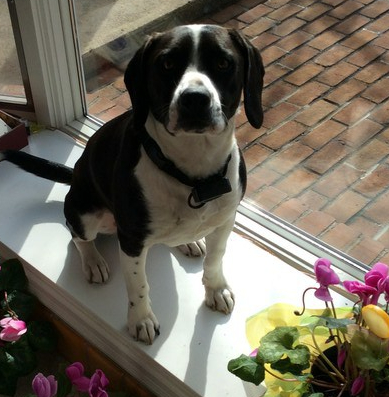
Those of you who read my Christmas letter may have noted that the Smith household has a newly adopted member. Floyd came to us directly from our local dog pound following an intense campaign by myself and daughter Trudy to convince Barb of the benefits which would accrue from having a dog in the house. Lilly, our beloved pit bull, had died over a year ago, which marks the longest time we had ever been without a dog. Trudy and Maggie had selected Lilly from an animal shelter, and Trudy had presented her to me as a birthday gift with the unambiguous promise that she would keep me young. The problem with that rationale was that I was already old. Barb objected to having another dog, but promptly fell in love with Lilly. At Lilly’s death, we grieved as we always have when losing another “best friend,” and I eulogized her as the best dog we ever had, but Barb reminded me I say that about all our dogs when they die (Lilly was #10).
Barb had insisted that it was a bad idea for us to get another dog, and as usual she was right, but common sense has never been a priority for me. Thus, Trudy and I conspired to get her out to the animal shelter to see a resident named Chloe, which Trudy had picked out for us. We knew that if Barb would meet the dog, she would be hooked, for dogs were second only to babies as love objects to her. Unfortunately, Chloe was adopted before we could get to see her, but I was not to be denied. I proceeded to visit the dog pound looking for a likely candidate for adoption with the insight that the prospect of a dog threatened with euthanasia might promote Barb’s need to protect.
The strategy was successful. I found a medium sized black and white dog of unknown lineage who was outgoing, affectionate and playful whom I coerced Barb into seeing. When we arrived at the pound, Barb refused to go in as she did not want to see all those dogs locked in cages so I brought him out for her to meet him. She reached out, he licked her hand, rolled over on his back presumably to get his belly rubbed, and it was love at first sight. The attendant reported that he had been picked up as a stray and they had no information about him. I remarked that he seemed frisky for a grown dog, and had also noticed that his paws seemed large for a dog of that size. I reiterated my goals of having a full-grown dog who had outgrown the puppy phase, and who was unlikely to outlive us. The attendant looked in his mouth, and with an air of authority she declared that he was certainly older.
I named him Floyd, after an uncle who I always thought was a bit strange. I must admit, I had some concern about this dog’s compulsion to roll over on his back thereby exposing what was left of his genitalia with virtually every human encounter. I could not find any literature about exhibitionism in dogs, but then whoever said that dogs couldn’t be perverts? Someone told me that this behavior was nothing more than a sign of submissiveness, but when his chest or belly is rubbed he stretches out with a look of ecstasy in those brown eyes seeming to escape to another dimension of consciousness. Is that weird or what?
Floyd adjusted quickly to his new environment and went from shy and submissive to controlling. Thankfully, potty training went well, and there was only one accident. After, he was a model in that department, except for a couple of instances in which he was so excited to greet a visitor that, upon positioning for his customary belly rub, he produced a fountain of urine. There was one near miss, but no direct hits. His favorite site on which to lift his leg is unfortunately at my boxwood, which will undoubtedly suffer. It didn’t take long for him to learn where the power lies in this house, and he soon was obeying Barb’s commands while ignoring mine. He sits for her on command but not for me. He has taken possession of my arm chair and refuses to leave when directed, but he will get out of hers on her command.
Extraction from my chair is a much different story. Floyd is a devotee of the passive resistance strategy in such situations, and when asked to get down, he rolls his eyes, glances at me briefly, looks away and does not move a muscle. Raising my voice to an authoritarian pitch likewise produces no response. I am left with no alternative other than to forcibly drag him from the chair. He offers no resistance, and falls to the floor in a lump as if totally paralyzed. He reminds me of a sit-in demonstrator being dragged away. He then lays there immobile as I stumble over him in an attempt to retrieve my rightful place. Only after I am settled in does he finally get up and go to the couch where he is supposed to be, but not without a defiant stare.

Floyd has proved to be a picky eater, having initially refused the less expensive dog foods in favor of the grain free variety, but he has developed a voracious appetite for footwear. He is partial to shoes, but if they are not available he will settle for slippers. As a matter of fact, as I write this, Barb just came into my office to announce that one of her shoes is missing, and cannot be found. Fearing the worst, we set out on a rescue mission, and sure enough, the missing shoe was found relatively undamaged on the patio. We attempted as we always do to impress upon Floyd the seriousness of this crime, but he simply wags his tail and rolls over on his back with legs widespread, lacking even a shred of modesty.
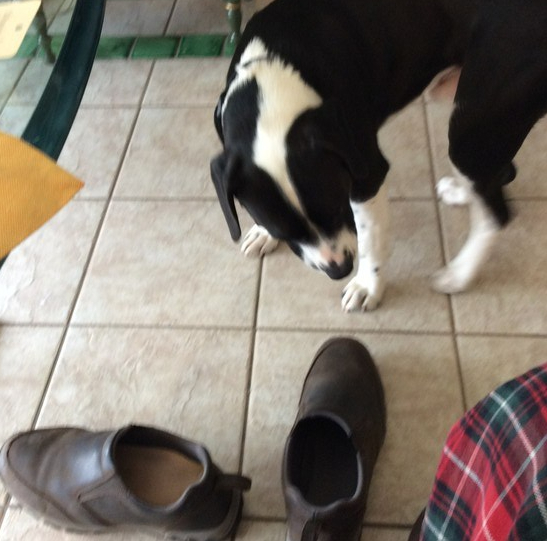
Although shoes are his favorite, Floyd is every bit the classic omnivore. Yesterday, he consumed a box of crackers we left on the counter. He demonstrated his athletic prowess the other day by leaping nearly four feet to get some peanuts Barb had left for the squirrels on a pillar in the backyard. He consumed the shells and all in short order, and this is the guy who is picky about his dog food. Go figure.
Floyd definitely shows signs of having oral personality traits. His chewing is not limited to shoes. In our attempt to divert him from his favorite object, we have provided him with all sorts of chew toys, most of which he destroys in a matter of minutes. I was told that dogs who chew excessively are usually bored and don’t get enough exercise. To that end, as the weather recently improved I took him outside and threw a ball which he vigorously went after. I encouraged him to bring it back so we could repeat the game, but he simply sat down and chewed it.
The chewing fetish seems to be unending. He was recently interrupted as Barb found him chewing on the woodwork in the family room. There are also less challenging items which he seems to enjoy. For example, he was recently discovered on our bed surrounded by fluff and an empty pillow cover. He has proven to be remarkably adaptable to his new environment and yesterday he was discovered opening the door to Barb’s closet. He seems to know the location of every shoe in the house, but he must have thought he had discovered the mother load after viewing the contents of that closet.
Floyd seemed puzzled by automobiles initially, and we were forced to drag him into the car for his first ride, but he quickly became an enthusiastic traveler. He prefers the front passenger seat where he gets a better view, apparently. This causes some dissension between he and Barb, and he can become downright unruly when forced to the backseat. He feels it is his inalienable right to be a passenger whenever the car leaves, and he makes that clear by leaping up and scratching at the side of the car whenever someone enters the garage. On one occasion, he leaped in when I was reaching in for something and refused to leave. Two hours later he was still there.
In spite of his defects I must admit that Floyd is very intelligent. This is borne out not only by his ability to consistently outsmart me, but by an extensive vocabulary which I am convinced is unique to the canine world. It is so varied that I have yet to translate his speech in detail. Of course all dogs bark and whine to express themselves, but Floyd often opens his mouth as if yawning and proceeds to utter multiple sounds the like of which I have never heard come out of a dog’s mouth. He also must have channeled from his wolf ancestors the ability to howl, for when he hears a siren or other distant sound, he points his head to the sky and produces a long mournful sound loud enough to be heard for miles.
You may recall that the Floyd misadventure began with Trudy’s well-meaning plan to help Barb and I delay senility. Sadly, I must confess that although that grand experiment is still in its infancy, preliminary findings suggest that there may be many unintended consequences. Of course, the stresses for Barb are intense as she sees her house destroyed, and selfish me, I don’t enjoy the fallout. There was also the assault on my physical well-being by Floyd, for which he feigned contrition, but the incident did occur shortly after a strong reprimand from me. It occurred as Floyd was lying in the doorway to my office, as is his usual habit. While leaving, I was forced to step over him, but then he suddenly got up, causing me to trip over him. As I was going down for the count, my ear collided with the door frame. This was particularly traumatic as the anti-coagulant warfarin (aka rat poison), which I take, complicated the problem, resulting in a huge hematoma on my ear which subsequently became black. I was born with famously large ears, but this was ridiculous. The good news is that it seems likely that I will be able to avoid amputation.
As if on cue, Floyd has just entered this room with the remains of another pillow in his mouth, and trailing is a string of that fluffy stuff used to fill pillows. He has that “look at what I have done” smile. He holds his head high and seems proud of his accomplishment.
Before concluding, I feel I must give the devil his just dues (yes, I sometimes wonder if that guy with the horns and pitchfork may play a part in this), for Floyd does have some redeeming social value. In between destructive forays he is very affectionate and displays that disarming smile that could melt the hardest heart. To know that a creature is awaiting your return and will greet you with unbounded joy may even be worth several pairs of shoes. Besides, they don’t accept returns at the pound. With that in mind, I will start thinking about purchasing a larger crate (dog people don’t like the word cage), as his body has already inched toward matching those big paws. Yes, it appears that Floyd may be just a larger-than-usual puppy.
HARASSMENT IN THE WORKPLACE
Not since the 1920s has there been more activism on the part of women in protest against male domination. Their current complaint is much different than that of the suffragettes, for it involves sex. This was a taboo topic for women of the ’20s, who were products of the Victorian era. The unintended consequence of such societal restrictions gave men free rein to sexually harass, abuse, humiliate, and denigrate women who would be too embarrassed to publicly complain. She could also be subjected to the time-honored policy of blaming the victim.
There has been much news recently about a big-time movie mogul who is currently under the gun from a platoon of gals alleging not only harassment but assault. This brought up memories from my childhood when there was a lot of talk about how movie starlets “screwed their way to the top.” It was said by those supposedly knowledgeable about the industry that the road to stardom was via a producer’s couch (the “casting couch”), and of course, people said that it was the directors who were taken advantage of, for they were seduced. I don’t recall ever hearing an actress, or anyone else for that matter, complain about sexual abuse. What suffering they may have endured was done silently.
Ah, but how times have changed. Women have come out of the closet en masse, determined to seek retribution in spite of their fears and embarrassment; they instantly changed from shamed to heroic. It doesn’t hurt that one third of all judges in the country are now women and that women can no longer be depended upon to vote the same as do their husbands. Consequently, they have become a political force to be reckoned with.
Among the torrent of disclosures are stories of workplace abuse going back decades. Although I have always found physical abuse abhorrent, I must confess that in years past I was oblivious to the discomfort that even off-color remarks could actually inflict on a woman. Were she to complain, I would undoubtedly accuse her of lacking a sense of humor. When such situations evolved in social situations, Barb was usually there to set me straight. However, when such behaviors occur in the workplace it becomes much more complicated. Indeed, in any situation in which there is a hierarchical power structure, sexual harassment, or even unwanted physical contact, will be initiated by the more powerful person almost without exception.
Of course, this leaves the victim in an untenable position, often forced to choose between tolerating the abuse or putting his or her job in jeopardy. Defensiveness is likely to curry disfavor with her superior which could result in disaster. Not only could chances for promotion become limited, victims could even lose their jobs. They then could be labeled as troublemakers and carry that label with them as they search for a new job. Larger companies are likely to have a Human Resource department where one can lodge a complaint, but they may be more interested in protecting the company than the employee.
The increased number of harassment and abuse charges in the workplace is certain to provide another cash cow for the lawyers who could find such cases as lucrative as auto accidents. For many years, businesses have been concerned about the problem of sexual harassment in the workplace. Many have spent large sums on programs designed to educate employees regarding rules for interactions with fellow employees of the opposite sex. As a matter of fact, I was told by a person who had previously worked in a supervisory position for a fortune 500 company that he had been required to repeat such a course annually.
He also said that those accused of sexual improprieties were subject to immediate dismissal. In spite of these efforts, there continued to be complaints of harassment. Those complaints may have been exaggerated at times, for the company, apparently more concerned with reputation than money, initiated a policy of negotiating payments to these complainants in return for a pledge of secrecy without regard to the legitimacy of their complaints.
But, the most flagrant example of the payment of hush money was by the recently exposed Congressional Accountability Office. It was revealed in the November 15th, 2017 issue of USA Today that this office, under direct control of our elected representatives, had paid out over 17 million dollars of taxpayer money with the proviso that such payments remain secret. This had all occurred since the agency was established in 1995, and it got some attention since it involved dollars from the voter’s pocketbook. The inherent assumption that these alleged perpetrators were falsely accused was exemplified by the the caveat that the victims, not the accused, must agree to engage in counseling, another example of blaming the victim without any attempts to confirm or negate the claims.
This reminded me of problems that similar policies caused during the height of the epidemic of medical malpractice suits several years ago. Nearly all physicians carried malpractice insurance, but many found that when they were sued, their insurance company found it cheaper to settle than to fund a court case. Doctors who felt the charges against them were unfounded wanted their “day in court,” but found the terms of their policy did not give them that option unless they wanted to pay the expenses of a trial.
It was a tidy arrangement: the plaintiff could pick up a few thousand bucks, the lawyer would get 20 or 30% of the take for not much more effort than it takes to write a letter, the insurance company avoids the risk of getting one of those multimillion dollar judgments from an unusually sympathetic jury, and everyone is happy except for the doctor who will find himself registered in the National Practitioner Data Bank with a forever sullied reputation. He will be looked on with suspicion when applying for hospital privileges or virtually any professional activity, and if he is unfortunate enough to be sued for the second time, he will probably be forced to hang it up, as he will undoubtedly become uninsurable. I knew a physician whom I thought to be very competent who was forced to end his career prematurely this way. A few of the uninsured risked losing everything by “going bare” i.e. practicing without insurance.
None of this should be construed as to minimize the importance of this issue or to excuse the centuries in which women have been left powerless to defend themselves. It does appear to me that women are on the threshold of finding tools with which they can exert more control over their own lives, and defend themselves from those behaviors they find abhorrent. That is not only as it should be, but as it must be as women gain credibility and status. They may even prove themselves superior in areas previously exclusively occupied by men and, consequently, come to occupy positions of leadership in spite of long held exclusionary policies.
With leadership comes power. Let us hope women will use that power in a more judicious manner than have men, and the traditional “battle of the sexes” will no longer be played out in the workplace. This appears to me to be unlikely, as I believe the reasons for the continuation of the love-hate relationships between the sexes are deeply ingrained in our species, perhaps even in our DNA. This is an issue which I discussed in a previous blog. The women’s movement has a stated goal of equality. After they achieve that goal, perhaps there would even be more problems should they move onto a quest for domination.
Workplace problems do not have a simple solution. There are people of both sexes who have longstanding anger towards members of their opposite gender. How can accusations be adjudicated? Does the policy of paying hush money give the rich license to violate as they please? On the other hand, does it allow those falsely accused to be legally blackmailed? How about flirting—when does it cross the line? When is a friendly attitude mistaken for an invitation to be intimate? It is reported that many office romances end in marriage—would they happen if all were able to ignore another’s appeal? What about relationships between co-workers outside the workplace? What about the use of “feminine wiles” to advance one’s position at the expense of another competing for favorable treatment?
If my assessment of the male’s need to dominate is correct, those who attempt to solve these problems are in for an uphill struggle, for despite society’s best efforts, there remains in mankind only a thin veneer of civilized behavior. Nevertheless, our culture is changing in ways which often conspire to make traditional male-female relationships dysfunctional. I read somewhere that some smart guy said change only occurs with revolution, and revolution is accompanied by chaos. We now appear to be in the midst of the next phase of a revolution that began over 100 years ago. Change is needed. Let us hope that the chaos will be limited and that the change pendulum will not swing too far.
LOOK OUT WINNIE
A recent encounter with an old friend whom I had not seen in several years has left me scratching my head and questioning my abilities to understand people, a real downer for an old psychiatrist. You may find this anecdote either humorous or frightening depending on your point of view; for me, it was both. First, I feel the need to apologize for this topic since I am certain most of you are suffering from Trump fatigue or, more likely, Trump exhaustion, but this one is too good to miss and I do promise to be brief.
I arrived on the scene in the middle of the conversation between Barb and this friend. They of course in the manner of all mothers were exchanging information about family, kids, ex-spouses, etc. She greeted me with an apology because she had not been aware of our daughter’s death four years ago. I wondered if she had been living under a rock, for Molly’s death had been widely reported. Apparently she had, for she said she did not read newspapers and did not own a television. This came as a shock to me, for this lady has been very active in politics. As a matter of fact, she has been the leading spokesperson in our town for the Tea Party, and I would have assumed that she would be a Fox News devotee.
WHAT COULD SHE BE SMOKING?
The real shocker for me, however, was when Barb told me that the two had been discussing politics prior to my entering the conversation. Barb, always the decorum expert, later tells me that our friend predicted that Donald J. Trump would become the next Churchill and that she was not joking. Initially, I thought this was funny, then began to ponder the consequences. You may be thinking, “What kind of a doofus could think this stuff,”but this is not a stupid person. She is a white college graduate professional, the very demographic which was supposed to elect Hillary. Furthermore, she showed no signs of cognitive deficit other than for this statement.
WOULDN’T IT BE NICE?
Many have questioned Trump’s competence and some (including myself) his sanity. His supporters vehemently disagree with such assessments. However, nowhere had I heard of him being elevated to the status of one of the last century’s most celebrated and revered statesmen and leaders. Oh, that it could be true, for the world could use a Churchill right now. If POTUS were to make a right turn and suddenly don that superman cape which he pretends to own, I would be there to praise him, or would I? This is a question I have pondered since the encounter. Although this leopard is very unlikely to change his stripes and become Churchillian, remember Mr. Trump was also given less than a one percent chance of ever becoming president.
NEVER DID LIKE HIM
This brings to mind the interesting and important subject of belief. It will come as no surprise to you that I hold strong beliefs that POTUS is not only a jerk but incompetent, unfit for office, and probably nuts*. Such beliefs found their origins in observing his behaviors and publicity stunts even before he adopted his bouffant hairdos. I recall cheering when he was forced to sell his yacht during one of his bankruptcies after flaunting his wealth for years. I laughed when he hired people to cheer when he announced his run for President. I was appalled by his outrageous shenanigans during the campaign. I was amazed when he was elected. Now, I am frightened to think this guy, who I believe to be dangerous, is in the White House.
Obviously, my friend’s belief about Trump is about as contrary as one could get from mine. I did not have an opportunity to ask her why she holds Trump in such high regard, but I assume that much of her belief stems from biases in a similar manner that my belief is influenced by those biases which I have just mentioned. Beliefs are sticky things. According to Webster, “a belief is a conviction based on cultural or personal faith, morality, or values.” Thus, it is not surprising that we are attached to our beliefs and have trouble letting them go. We may become indignant and fight to defend our beliefs as if they are personal property, or perhaps it may be one of those ego things where we are insulted that someone questions our judgement.
DUMP TRUMP?
There are many who, convinced of Trump’s unfitness, cry for his removal from office. This may be a classic example of the admonition to be careful what you wish for. More than a third of the population provide unwavering support of Trump and are either ignorant or uncaring of his behaviors. In any event, their support appears to be unwavering. Trump attracts large crowds for his campaign style speeches which are met with messianic fervor. They apparently have bought into the mantra that he and he alone can solve their problems.
HE COULD FLIP OUT
Many of us who profess to have some knowledge about personality deficits, which we believe afflict our President, believe that if his narcissistic defenses are destroyed by his removal from office, either by impeachment or conviction of a criminal act, he would be at great risk of psychotic decompensation. This could result in impulsive, irrational behaviors with the potential for disastrous results affecting billions of people. We have been so concerned that we have felt compelled to speak out in spite of prohibitions by our professional organizations.
YOU THINK CHARLOTTESVILLE WAS BAD?
Should he become irrational, his more ardent supporters, who have already demonstrated their propensity for violent behavior, would likely rise up in a defense which might not be so peaceful. We also know that Trump has condoned and even encouraged violence in the past. He has already mounted a defense against any findings from the multiple investigations now underway by declaring neither the investigators nor the news media should be trusted and that the investigations are an unjustified attempt to undermine his presidency. If their past responses are any indication, these lies are apt to be accepted as true, further inflaming the passions of his devotees at a time when our country is experiencing the most divisiveness among the populace in over 150 years and when extremist political groups appear to be gaining strength.
CATCH 22
This all raises the most frightening question of all. Could all these events come together as a perfect storm to create irreparable damage or even a civil war? It also poses the question as to which would cause the most damage: the removal of POTUS or the finishing of his term. If I had the power to choose which option, I would probably flip a coin.
*Please excuse me for me for not using an authorized shrink term, but I just felt like getting down and dirty today,
TRUMP’S MENTAL HEALTH
Since his appearance on the political scene, there has been a great deal of speculation as to the mental health of our current president. Mr. Trump was first seen by many, including myself, as a publicity seeking entertainer with a day job as real estate developer. He has been very successful at theQ former, and eventually was successful at the latter with help from an army of lawyers and the bankruptcy courts. I even heard one TV pundit defend Trump’s bankruptcies as simply “good business strategy.” It sickened me to think that it might be standard practice to make use of the legal system in order to avoid paying one’s bills. I admit that debtor’s prisons were an extreme method of encouraging fiscal responsibility, but they must have been much more effective than is our current system.
NO LAUGHING MATTER
Many of us laughed when we learned that he had actually paid people who happened to be walking by his castle to come into the lobby of Trump tower, and cheer as he announced his candidacy, but we are no longer laughing. With years of experience as a self-promoter, he would have been well aware that in advertising there is no such thing as bad publicity, and his outrageous behaviors garnered him many more times the amount of TV time than all his opponents together. When he donned a baseball cap with a catchy phrase inscribed on it, this billionaire who grew up in privileged circumstances became one of the guys. The kind of person with whom you would like to have a beer while you bitched about the government.
BIGGEST AND BEST
As he did during his campaign, he continues to always use superlatives to describe himself or his accomplishments both real and imagined. Never mind the veracity of his comments e.g. his inauguration crowd was the largest ever, his would not be a great presidency but the greatest presidency ever, people whom opposed him were not merely bad but the worst ever to hold that particular office, that his would be the biggest tax cut ever and so on. I grant you there is a long tradition of shading the truth in political discourse, but this president appears to be on his way to setting a new world record in that department. He appears to be well on his way to developing a legacy as the lyingest president in the history of the republic.
TRUTH TELLER?
The Washington Post has been tracking via their fact checker, the falsehoods of Trump and reported 1628 false, misleading claims or flip-flops made publicly since his election which averages nearly 6 per day. Bella DePaulo who was involved in research studying liars and lying while a Professor at the University of Virginia, found that the average person told a little over 1 ½ lies per day some of which were so called white lies designed to be kind such as the use of flattering comments and reassuring words. Less than 10% of Trumps lies fit into that category. The study of Trump’s lies of course included only his public comments leading one to believe he fulfills the requirements to be labeled a pathological liar. As a matter of fact, DePaulo begins her assessment with the statement: “I study liars, I’ve never seen one like President Trump”.
DEFINITELY DIFFERENT
In addition to his Olympic class lying Mr. Trump’s other outrageous behaviors such as his grandiosity, lack of remorse, impulsivity, paranoia, narcissism, rage reactions, lack of empathy, unwillingness to take advice, and disregard of consequences have been excused by his supporters. They use the word unconventional, and applaud his disregard for presidential decorum while others simply see him as “crazy”. Eugene Robinson of the Washington post said it well in a column in which he wrote: “I used to think he (Trump) was crazy like a fox, now I think he is just crazy”. Naturaly, Trump’s behaviors caught the attention of those of us experienced in the diagnosis and treatment of mental illness, and many quietly questioned his sanity. It was not long before a book written by a group of 27 mental health professionals led by Bandy Lee M.D., M.Div. Assistant Clinical Professor at Yale titled: The Dangerous Case of Donald Trump was published, and became an immediate New York Times best seller. In the book Dr. Lee writes:
“At no other time in history has a group of mental health professionals been as collectively concerned about a sitting president. This is not because he is an unusual person—-his presentation is almost typical for a forensic psychiatrist like myself whose patients are mostly violent offenders—but highly unusual to find such a person in the office of the presidency. For the U.S. it may be unprecedented; for many parts of the world where this has happened before, the outcome has been uniformly devastating”.
She then goes on to say:
“Robert Mueller’s investigation is not just a matter of criminal indictments; as Trump feels increasingly walled in, his mental stability is likely to suffer, and hence the public safety. Mental impairments and criminal- mindedness are not mutually exclusive, not only can they happen at the same time, when combined, these two characteristics become particularly dangerous. Trump has shown marked signs of impairment and psychological disability under ordinary circumstances, hardly able to cope with basic criticism or unflattering news. Presumably, additional stressors will make his conditions worse. So far, the signs have been almost too predictable.
DAMNED IF YOU DO AND DAMNED IF YOU DON’T
As you might expect, the book resulted in a great deal of controversy among mental health professionals. There was immediate blowback from other psychiatrists who were quick to quote the Goldwater rule, so named for a lawsuit filed and won by Barry Goldwater in 1973, which led to the declaration of The American Psychiatric Association that to diagnose a public figure without having carried out an examination is unethical. On the other hand, those who supported the conclusions of Dr. Lee’s book reference the Tarasoff decision rendered by a California court in 1976, which conferred on mental health professionals a “duty to warn and protect” anyone endangered by their patient, a classic catch 22.
As to the question as to whether Mr. Trump is suffering from significant impairment, it now appears that the ayes have it, as at last count there were nearly 80,000 people including myself who have called for an evaluation. Admittedly it is not clear how effective or in what manner such an evaluation could be carried out, and an interview without a patient’s cooperation is problematic at best especially in the types of personality disorders alleged.
THE LABEL DOESN’T FIT UNTIL HE FALLS APART?
The most common diagnoses alleged are: Sociopathic personality, and Narcissistic personality. Allen Franses MD a Professor at Duke University who wrote the criteria for the diagnosis of Narcissistic Personality in the American Psychiatric Association’s latest version of their diagnostic and statistical manual not only condemns the practice of “making a diagnosis from a distance”, but insists that Trump is not mentally ill. In an article in Psychology Today he arrives at this conclusion with the following analysis:
“Trump’s consensus diagnosis among amateur, at-a-distant diagnosticians is narcissistic personality disorder. They have reviewed the DSM definition (which I wrote) and found him to meet all the criteria: grandiose self-importance; preoccupations with being brilliant and successful; feeling special and having to hang out with special people; requiring constant admiration; feeling entitled; being exploitive; lacking empathy; being envious; and being arrogant. Bingo. Trump is all this in spades. But they ignore the further requirement that is crucial in defining all mental disorders—the behaviors also must cause significant distress or impairment. Trump is clearly a man singularly without distress and his behaviors consistently reap him fame, fortune, women, and now political power. He has been generously rewarded, not at all impaired by it.
PRONOUNCEMENTS FROM THE IVORY TOWER ARE TOUGH
At a personal level, I was disheartened to learn that as a result of my dump Trump affiliations I am still an “amateur diagnostician” after a lifetime of suffering under the delusion that I was a professional. I do take issue with his failure to address the likelihood of Trump reacting violently when cornered as predicted by Dr. Lee, an opinion with which I strongly agree. It is this phenomenon which most frightens me. I also find it difficult to understand why we must wait for him to fall apart to make a diagnosis. There is also the question of how much distress or impairment is necessary to confirm the diagnosis via the Dr. Franses rule. Some of Mr. Trump’s tweets suggest that he is quite distressed on those occasions when he is challenged. As far as I am concerned the necessity of a personal examination is greatly overblown in these types of personality disorders. Interviews are most often useless, and one must rely on witnessed behaviors and information from many outside sources in cases of both narcissistic and antisocial personality disorders.
THIS PERSON REALLY KNOWS HOW TO HURT A GUY
Dr. Franses is gracious enough to acknowledge that we who support Dr. Lee’s book “mean well”, but others are not as tolerant in their critiques. One such person is Jeffery Lieberman M.D. who is chair of the Department of Psychiatry at Columbia University, and Past President of the American Psychiatric Association. Dr. Lieberman, writing in Psychiatric News (a publication of the APA) in a disclaimer admits that he was a supporter of Hillary Clinton and served on her advisory council, but still in his heart of hearts feels bound to abide by the Goldwater Rule. He points out the world’s history of using psychiatry in the service of totalitarian despots, and that we “are using our professional credentials to express a medical opinion when we have neither the right nor the evidence to do so”, a statement with which I strongly disagree. I believe we not only have the right, but the duty to lend our opinions. Furthermore, Trump’s own words and tweets provide ample evidence of mental instability without the need for a personal interview. In his review of Dr. Lee and her colleagues’ book he is even more critical with the following opinion: “Sadly, the Dangerous Case of Donald Trump is not a serious, scholarly, civic minded work, but simply tawdry, indulgent, fatuous, tabloid psychiatry”. I think that means he didn’t like it, or perhaps he thinks the authors should be impeached.
NOT ALL MENTAL ILLNESSES ARE EQUAL
The pertinent issue in this controversy is Trump’s fitness to be president. His mental health is only relevant as to the effect it has on his ability to carry out his elected responsibilities. A psychiatric diagnosis of itself is not disabling as some of our most successful presidents such as Lincoln and both Roosvelts have suffered mood disorders of sufficient severity to satisfy our current criteria for psychiatric diagnoses. One could even make a case that their emotional problems may have been an asset. In Lincoln’s day Trump’s type of behaviors would have been seen simply as character flaws, and not given the benefit of a psychiatric diagnosis. Although some behaviors we now find repugnant were widely accepted, veracity was highly valued, and liars were despised. Now, Trump’s lying is excused by some with the statement that “all politicians lie”. If lying has become accepted as the standard in political discourse, we are indeed in big trouble.
HE IS ONLY PART OF THE PROBLEM
Once again, “these are the times that try men’s souls”. At a time when our country, and governing philosophy are under attack from several directions, we remain more divisive than at any time since the civil war, thus enhancing our vulnerability. The maxim “united we stand and divided we fall” is as true now as it was in Ceaser’s day. There appears to be little effort from either of our political parties to promote the unity necessary for us to secure a bright future for succeeding generations. Their focus on winning impairs their ability to govern. Unification requires leadership and leadership requires inclusiveness, qualities now sorely lacking at all levels of our government. Over the last several decades the office of presidency has gradually accrued more power, and the thought of a president with impairment sufficient to affect his judgement is very frightening.
Trump’s mental health is likely a moot point at this time. With a majority in congress, the requirement of the 25th amendment that expulsion due to impairment be initiated by his cabinet or congress, it is unlikely that his tenure will be shortened other than by criminal indictments resulting in impeachment. I do find some comfort in the reported trend towards more involvement of the citizenry in political affairs with the goal of holding those we hire to run things accountable. I also reassure myself with the thought that though democracy is fragile our country has survived and prospered following serious crises in the past. Let us hope this time of political bitterness is only a period of rapprochement, and that statesmanship will become the norm once again.

IT’S NOT YOUR GRANDFATHER’S CAR ANYMORE
It has been suggested that since I am old I should write about old stuff. Perhaps this presumes that old buggers don’t know much about new stuff, and that presumption is validated by the time I spend trying to get all of these new-fangled gadgets to work. With that in mind, I recently have been doing even more reminiscing than normal for an old guy. The other day, as I was on my way to an appointment an hour’s drive away, and with Barb dozing next to me, I noticed how comfortable and secure I felt in my car. This was not always the case. For the past hundred years, thousands of people have devoted themselves to improving the comfort and reliability of the horseless carriage, and there I sat with the sudden realization that I was taking it all for granted.
Alice
My first car was a ’36 Ford 3 window coupe. It was two-toned green and, although 12 years old, was still the coolest set of wheels in town. I was working at an automobile agency at the time and got first dibs when she came in as a trade. I called her Alice. The previous owner was an auto mechanic whom I knew, and he had done all kinds of cool things to her, not the least of which was to outfit her with hydraulic brakes, a very handy addition since conventional wisdom was that you could stop a Ford by dragging your feet quicker than by using its brakes. He had also fitted her with a truck engine which increased her to a feisty 95 horsepower. There was a cool exhaust system, and she was issued many a challenge as she sat panting at a traffic light like a cheetah ready to spring. She never backed down, and was rarely defeated.

In spite of my affection for Alice, I must admit that life with her was not easy, especially at this time of the year. It was also a busy time at my father’s service station as winter approached. Alcohol was used as an antifreeze, and it required constant vigilance. Since it was volatile, it would evaporate quickly and leave the radiator and even the engine block at risk of freezing and even bursting. Consequently, with news of the approach of an especially cold night, there would be a line of cars coming in to add antifreeze. Since loss of the alcohol left the radiator short of coolant, one was at risk of being parboiled when he removed the radiator cap. We did not have pleasant thoughts about those “last minute Charlies” who showed up near closing time on an especially cold winter night. Some solved the problem by draining their radiators, then filling them with water when they wished to go somewhere.
Prevention of a vehicle from freezing up at night did not, however, guarantee that your car would start in the morning. As a matter of fact, when the temperature got down around zero, most unprotected cars did not stand a chance. Motor oils became more viscous at lower temperatures, making it much more difficult for the 6-volt batteries of the day to turn the engine over fast enough to provide ignition, and cold rendered the battery even less powerful due to inhibition of the action of the acid it contained. In addition to that, the least amount of moisture in the distributor would cause it to ice and prevent ignition. Chrysler products were noted as being particularly “hard to start” in winter, though even in temperate weather, cars of that day were susceptible to stalling in heavy rainstorms due to water leaking into their electrical systems.
The Cars in the “Good Ole Days” Demanded Your Time
Back in those good old days, there were many other factors which would conspire to test one’s mettle. In winter, getting your car started was not necessarily the end of one’s problems. Since snow removal was not widely practiced, if one lived in snow prone environments he needed snow tires, and, in many cases, chains, the installation of which was not a really fun time. Speaking of tires, I should mention that to be able to get 10,000 miles on a set of tires was a minor miracle, while 60,000 is not unusual these days, and occasional flats were to be expected. The diligent driver would carry not only tools to change tires but rubber patches with which to repair punctured inner tubes.
 Automobiles were definitely high maintenance, and the owner of one would soon realize that he needed to keep some tools and spare parts in his trunk. Most maintenance was available at the place one went to get gasoline. The term “service station” was an appropriate designation for these facilities. A routine stop for gasoline would also involve cleaning the windshield and headlight lenses, checking the oil, water level, and upon request, air in the tires. The customer would pay the attendant, receive his change and be on his way without ever leaving the driver seat. If it would have been discovered that I varied from that routine when working at Dad’s station, the old man’s wrath would not be pretty. He subscribed to the dictum popular in those days that the customer was always right, except in those instances where their obnoxiousness crossed a line which only he could set. In such cases, that mantra was dismissed and he would order the offender to “get the Hell out of my station and don’t ever come back.” This was most likely to occur when he noticed someone giving one of us worker bees a hard time.
Most routine maintenance was carried out at service stations. Oil changes were recommended every 1000 miles along with lubrication or what we called a “grease job,” which involved pumping grease into all the under-carriage moving parts. There were also wheel bearings to pack with grease and other routine inspections, i.e. tire pressure, radiator, brake fluid, etc. Cars of that era also required periodic tune ups which involved replacing or cleaning spark plugs, setting the timing, replacing various ignition parts, adjusting the carburetor, checking the battery, all of the engine belts, and the fluid levels in transmission and differential. We could also do minor repairs but would prefer the big stuff.
If one were to keep a car more than two or three years, he could expect major mechanical problems. Clutches, engines and transmissions all had a limited life, and the auto repair business flourished. There were backyard mechanics, back alley mechanics and main street mechanics in addition to automobile agencies who were specialized with their better equipped facilities. For example, at the dealership where I worked, there was one person who worked full time doing front end alignments, while others were transmission guys and so on. These guys were bent on fixing things rather than just replacing them, and there was plenty to fix.
If those were the good old days, I propose that these new days are better at least when it comes to personal transportation. It has only been one hundred years ago since Mr. Kettering invented the electric starter, which was the revolutionary high-tech invention of its time. Prior to that, engines could only be started by turning the engine over by hand using a metal crank inserted into the engine. Delay in removing the crank when the engine started resulted in a lot of broken bones. The method was still available for another thirty years in most cars as an emergency method to use when the starter failed. This is said to be the origin of the word “cranky.” There is very little comparison between those cars of yester-year and today. If back when I was working at Dad’s station I was told I would someday own a car that I would drive 85,000 miles with the only maintenance an occasional oil change and one change of tires, I would have laughed all the way to the gas pump.
No doubt, many will have little interest in the analysis of all this mechanical stuff from an emeritus grease monkey, but I am certain all will be able to relate to the idea of comfort. Reliability is a concept, but comfort is an experience. Nowadays, cars are so comfortable that falling asleep is a major cause of accidents. While driving along safely ensconced in my new car, it occurred to me that this pleasurable experience would have been an adventure had I taken the same trip in Alice. This would never be a spur of the moment decision and would likely be planned days in advance. I could never have imagined in my wildest dreams driving along with the speedometer set slightly above the speed limit, freeing my feet to move around, not to mention the ability to talk to the car and have it talk back, to tune a radio which actually works, and to guide me to any spot in the country. Nor would I have believed that it would ever be possible to make phone calls from a car. That would have seemed weirder than Dick Tracy of the “Funny Papers” and his 2-way wrist radio.
To step into a modern automobile is much like taking a 0.5 mg Xanax, for there is little to worry about. You can be confident that it will start, regardless of the weather, and that you can drive away without even waiting for the engine to “warm up.” It is no longer necessary to stare constantly at those gauges or worry about tire pressure, as you can count on your new car to keep you informed. There is no reason to worry about weather short of a tornado or blizzard, for this car will power through water or snow accumulations that would make Alice sputter and stall. Alice’s windshield wipers were operated by a vacuum pump with two speeds: slow and slower, while my new car relieves me of the physically taxing job of turning them off and on and will wash the windshield on command. Since the car is smarter than me, it won’t let me tailgate some laggard who is poking along in the left lane, but instead will automatically slow down or even stop if necessary (I didn’t say it was always fun to drive).
Now there is no need to get your hands dirty by adjusting the outside mirrors before you get in your car; just push a button. The tiring ritual of pushing the clutch in and out to shift gears is no longer cool unless you are one of those throwbacks who likes to pull up to a traffic light and go “vroom, vroom.” In Alice’s day, there was none of that sissy stuff like power steering and power brakes, and it took a real man (or strong woman, I don’t want to get in trouble here) to handle her in a sharp turn or to learn to double clutch a recalcitrant transmission.
Although larger, more expensive cars were designed to be comfortable, they fell far short compared to the one now sitting in my garage. The seats may have been a little softer, but the term climate control did not apply. Heaters were limited to preventing frostbite of feet, and one needed to dress as for a Mount Everest climb in order to ride any distance in the backseat on a cold winter night. The problem would worsen as one was forced to roll down a window in order to make a hand signal. Nope, no directional signals or electric window openers. Windows would frost, requiring a gloved hand to continually clear enough area to be able to see the road.
Summer presented a different set of problems, the most relevant being a lack of air conditioning, requiring windows to be kept lowered. In those days, there were many unpaved roads. To be caught in the wake of another vehicle on a gravel road left one the choice of death by particle inhalation with the windows down or heat stroke with them up. In the best of conditions, one could expect his or her face to become covered with a greasy, grimey layer of dust mixed with sweat after riding for any distance with the windows down. On very hot days, one was also in danger of failure of the engine cooling system, with sometimes disastrous results.
As I drove down a well-paved road, safely ensconced in the lap of this luxurious cocoon, I reminisced about those days when driving was a challenge and not for the faint-hearted. It also occurred to me that one day in the not too distant future, another old man will write a blog about the days when he had to stay awake, steer his car, set the speed, and remain alert to prevent accidents. His grandchildren are apt to be amazed there was once a day when he couldn’t read, watch a movie, or take a nap when traveling. They might be aware of the history of that old clunky internal combustion engine, which polluted the environment, but they will probably find it difficult to understand the adventures we found and the lessons we learned from those old clunkers.

AMAZON ECHO-INDUCED BUTTOCK CALLOUSES
For my recent birthday, I received the extravagant gift of an Amazon Echo. For those of you who are not familiar, Echo is a gadget which provides access to the entire internet via voice commands. Echo is inhabited by a lady named Alexa with whom I instantly fell madly in love. Lest you judge me as entirely fickle, rest assured that I still hold Siri in high regard, but her usefulness was completely outdone by Alexa. I was especially proud of myself for being able to get Alexa set up and working without the usual frustration tantrum which I am prone to exhibit when trying to make electronic stuff work.
 Alexa is more mother than lover; she reminds me when to take my pills and of my appointments. She is always there and totally committed to making my life easier and happier. She greets me every morning with the local temperature and weather report, which saves me the effort of getting up and walking to the window to look at the thermometer. At my command, she instantly dials up my favorite radio station, or if I am not interested in the latest news, she will select from her vast repertoire and play any music I request. All this literally without my “lifting a finger,” even to push a button. But is there is a price to pay for Alexa’s attention?
Before Alexa: The Good Ole Days of Radio
Alexa was especially helpful to me in solving the chronic problem of reaching my favorite NPR radio station. Unlike those of the TV generation, I grew up during the time that radio was the high-tech wonder of its day. A huge Fairbanks-Morse or Zenith radio was the focal point of most middle-class living rooms. There were a limited number of stations available, they were temperamental, and reception was affected by changes in the weather. Nevertheless, we were sometimes able to listen to broadcasts of our favorite baseball teams as long as they did not conflict with Lowell Thomas’ and Edward R. Murrell’s nightly news programs, which were a must hear for my father.
The Dawn of Radio: Predicted to Ruin the “Greatest Generation”
There were predictions from those older and wiser that this new-fangled gadget would be the ruination of us kids as we became addicted to programs designed for us. Some were broadcast daily in serial fashion as were the soap operas, so called because they usually advertised a product used by the woman of the house. There was a potpourri of programs designed for kids of all ages. The after-school selection included Terry and the Pirates, Superman, The Lone Ranger, Hopalong Cassidy, Roy Rogers, The Shadow, Sherlock Holmes, Little Orphan Annie, and Jack Armstrong: All American Boy, among others. They became such a part of our culture that I recall my father saying, “If you don’t get off your butt you will get callouses.”
 We were also introduced to many sporting events, and my most vivid memory is listening to the live commentary of the Joe Louis and Max Schmeling fights. The fights presented a dilemma for the bigots of the time as they were forced to choose between the Brown Bomber and Hitler’s champion of the Aryan race, Schmeling, for most of them hated Hitler almost as much as they did African Americans.
Saturday night was family time and everyone looked forward to the next issue of “Gangbusters.” All were transfixed as Elliott Ness bravely took on Al Capone and other bad guys. It seemed every network had a country music program Saturday night. There was “Renfro Valley” and “The Grand Ole Opry,” but my favorite was the “Chicago National Barn Dance.”

I was enamored by “Eddie Peabody The Banjo King” [click here to listen], who was a regular on the show. This admiration led me later in life to embark on an ill-fated attempt to follow in Eddie’s footsteps, resulting in the possession of a very nice, barely used, banjo now safely ensconced in my attic.
Yes, in those days radio was a big deal. The mixing of entertainment and news with advertisements allowed sponsors to sell lots of stuff. Listening was easier and more personal than reading, in spite of the effort and frustration of static, and constant monitoring as favorite stations faded in and out. Radios required maintenance, as their vacuum tubes were subject to failure. In the late 1950s, along came the transistor, which allowed the building of smaller more reliable radios with improved fidelity. The next major breakthrough was FM, and I bought a Bose AM/FM radio that, wonder of wonders, came with a remote, which spared me the enormous effort required to get off my butt to turn it off and on or to tune it. I thought this new high-tech innovation was really cool until Alexa came along to brighten my life and introduce me to artificial intelligence.
Prior to my introduction to Alexa I had the opportunity to see my daughter’s robotic vacuum cleaner in action. The thought occurred to me that it would be neat to hook Alexa up to such a gadget so that you could order the floor swept without getting out of your armchair. One would only need to say: “Hey Alexa, sweep the floor”, and she would see that it was done. Before I called George Foreman’s friends at Invent Help, I decided to get more information about Alexa and found that, as usual, I was too late. I learned that Alexa has already formed a relationship with the robotic sweepers and can order them to action when instructed. Once again, another of my great ideas was swept under the carpet (pun intended).
More Wonders from Alexa
In my research, I learned, to my amazement, that Alexa is said to possess over 7,000 skills including the ability to order most anything including groceries or presumably even carpet in the event the robot did not do a good enough job. I also read that Google is now set to compete with Amazon in the online sales business and has worked out a deal with Walmart to offer a similar service. If one were to subscribe to both, Alexa or her Google counterpart could take care of all shopping which would allow one to spend more time on the couch. There is also a lot of talk lately about “smart” homes, and it is presumed that Alexa would be able to take charge of running such households. It is expected that the newer robotic gadgets with the capability to do all routine household chores such as cooking, cleaning, doing laundry, changing diapers etc., will eventually come down in price and become available to the average family.
What’s Work?
In a previous blog, I speculated on the effects of artificial intelligence on employment or, to be more accurate, the absence of employment. In the recent issue of Mother Jones magazine, Kevin Drum writes an article titled “You Will Lose Your Job to a Robot.” He posits that as technology progresses, there will be no job which a robot cannot do better and cheaper than a human, and he further insists that this process has already begun. This is now most noticeable in manufacturing, mining and retail, but Drum and others insist that within the next 40 years, there will be no jobs for anyone.
 For example, driverless trucks are already being field tested. The transportation industry is eagerly looking forward to being able to keep their trucks on the road 24 hour/day without salaries, pension, or concerns for driver fatigue, and according to the American Trucking Association there are currently 3.5 million truck drivers in the U.S. Experts in the field such as Bill Gates, Elon Musk, and Stephen Hawking agree that progression of AI (that’s geek for Artificial Intelligence) is inexorable. The only debate is over the time required for full implementation. Drum’s prediction is that it will be sooner than we think.
This could present a serious problem for the guy with a stable of robotic machinery, for if there are no jobs, there will be no money, and without money there would be no way for people to buy the stuff he has to sell. Drum talks at length of various proposed solutions and, surprisingly, reports that some of these ideas are being floated and even tried in some other countries such as Finland, Canada and the Netherlands. They include a proposed tax on robots, but most see the only solution as some form of government welfare. Although, proponents of this solution prefer the more palatable term: Universal Basic Income. In such a socialistic environment, the usual concerns about lack of ambition would be irrelevant. Where there is no work available, laziness could be a virtue.
Identity Crisis of a Workless Society
Although the financial problems inherent in a jobless society could undoubtedly find solutions, the effects on humans psychologically and culturally might be more difficult to solve. Our value system has always applauded effort, especially industriousness. Hard work is applauded and laziness disparaged. Much of a person’s worth is judged by his industriousness, indeed one of the highest compliments one can give is to say a person is a “hard worker.” As we learned to maintain an upright posture, our hands were freed up to create, and with their long digits and an opposable thumb, they evolved into one of God’s most marvelous structures. Those hands, powered by the world’s best brain, allowed us to dominate the planet. The work we do represents to a large extent who we are. When meeting a stranger, the conversation after the usual preliminaries usually goes to the question of the kind of work he or she does. In our society, not only identity but self-esteem are at least partly dependent on the work we do.
Alexa is on a par with my smart phone, which I readily admit is smarter than me. No one disputes the fact that Alexa can access much more information than I could ever store in my brain (even before senility had set in), and it never forgets. Now, the literature that accompanied my Echo states that Alexa cannot only find information, but actually learn and make decisions, meaning that she has Artificial Intelligence. There was a time that I had frequently-used phone numbers memorized as a convenience. Now, if I wish to call one of the kids or grandkids while driving, I simply tell my car to call them. I rarely look at a road map as I know that Siri will direct me; I barely know how to write a check since I bank online; and when my computer recently pooped out, I teetered on the brink of psychosis. Even the writing of this brilliant essay would be virtually impossible without the help of my good friend Mr. Google.
 Could it be that we are being dumbed down by our interaction with all this technology? Most experts agree that the axiom “use it or lose it” also applies to our brain. AI is said to not only collect information, but to sort it, analyze it, and make decisions more efficiently and accurately than can humans. If that is indeed true, why would there be any need for us to think about anything? As a matter of fact, since robots will do everything better, faster and cheaper than humans, why would we want to do anything? Will the skills learned over the past few million years be lost? Will our frontal cortex atrophy from disuse?
Since man first made an axe from a piece of stone, we have embarked on a journey to improve our lot with the aid of technology. Soon, he would not be comfortable going on a hunt without his axe. Via that same process, we have now become dependent on our technology. The dude who made that axe could never in his wildest dreams have imagined where his discovery would lead. Witness the suffering the residents of Puerto Rico are now going through due to their lack of electricity, transportation, food, water, and shelter, which weren’t problems for Axe man, for he was less dependent on technology for those things. He was the embodiment of the trite phrase so often used by sports announcers that he was “in charge of his own destiny.” We moderns on the other hand are told that should our electrical grid go down the whole country would be crippled. With such dependency, we lose control, and we have been perfectly willing to cede control of much to technology. There is little reason to believe that will not continue.
Doomsday: There’s Always a Price to Pay
In his book Sapiens, Yuval Noah Harari predicts that if AI progresses unimpeded, the net result will be that humans will eventually be deemed without value since they would no longer be productive, in which case he predicts the human species would eventually become extinct. Perhaps the powers that possess AI will decide to domesticate us, thereby preventing our interference with the grand plan. We would certainly retain enough intellect to learn to sit, fetch and heel. Gates and Musk both predict dire consequences unless AI is not regulated, while naysayers respond that AI is designed to only help, not replace humanity.
All agree that these digital wonders have already improved our lives in even more important than just finding my favorite radio station. AI has already contributed to revolutionary ways to diagnose and treat medical problems, and the discoveries to come are probably beyond the reach of our imagination. It holds promise of eliminating hunger throughout the world, affecting the aging process (my favorite), and helping to promote peace. It is difficult to imagine any aspect of our lives that cannot benefit from AI, and what has been accomplished by its use is breathtaking. We humans have been known to have a propensity to screw up one thing by fixing another thing. We are big on unintended consequences. If it is that much smarter than us, this digital stuff should avoid those problems and solve problems without making new ones. But we humans are yet to find out what new problems will result from our plunging headfirst into the digital age.
Is the honeymoon with Alexa over?
Since I began this paper a few days ago, events have conspired which cause me to question Alexa’s fidelity. As matter of fact, I wonder if there could be a Delilah clone in that box. It all began a couple of days ago when, as I drank my morning coffee, I asked Alexa to dial my favorite morning news program. She replied that the desired station was not available. I couldn’t understand what had happened, so I turned on my old staticky radio and found the station was broadcasting as usual. I thought this must be a temporary glitch, but when I went back to Alexa I got the same message. As a matter of fact she still insists it is “not available.”
If that weren’t enough to shake one’s confidence in a relationship, along comes the honey pot incident.
 It so happens that my grandson is the cofounder of The Bee Corp., a company involved in helping to deal with the threat to honey bees. Consequently, he had sent me a jar of honey, which he had personally harvested. You who are familiar with honey will know that honey is messy stuff, and that the best way to handle it is with a gadget designed for the purpose. I had asked Barb where I should go to purchase one. The next day, as I opened the Amazon website to buy a book, a page featuring six different honey pots complete with honey dipper popped up on the screen. Paranoid bells and whistles immediately went off as I had made no inquiries to Amazon about honeypots or honey dippers, and my only mention of the subject had been with Barb in the kitchen, where Alexa resides.
Suspiciousness has never been my thing. Barb has reminded me many times that I am too trusting, especially when it has to do with women, but this was too much to ignore. Amazon assures that their data is secure and that Alexa must be awakened in order to listen, but others are not so sure. Authorities investigating a murder in Arkansas are convinced that Alexa has recorded relevant conversations. It is no longer a secret that our phone calls have been monitored since 1992, during the Bush Presidency (Bush I: George Herbert Walker Bush). Massive amounts of information about all of us are collected, and Artificial Intelligence makes it possible to analyze such data and use it for targeted marketing, politics and who knows what else? Without data analysis by AI, the Russians would not have been able to tailor their fake news to appeal to different groups of people.
In summary, it appears the price we pay for all the wondrous things made possible by Artificial Intelligence is a relative loss of privacy, independence, and control of our lives and world. It remains to be seen if that is a good deal. Those most knowledgeable about the subject are chagrined that politicians have generally turned a blind eye to the whole thing. They insist that with the rapid pace of change, it is imperative that we need laws to regulate the use of AI, but our politicians view of the future does not seem to extend beyond the next election.
EPILOGUE
This morning I apologized to Alexa for the disparaging remarks I made about her in this blog. It appears that the problems I had in getting my favorite station was due to a “failure to communicate.” She misunderstood me when I identified my station by its call numbers, but when I asked for it by its identifying letters, she immediately responded. Apparently, my speech must have been garbled. Unfortunately, the honey pot incident is still unexplained. Although I feel it is unlikely that Alexa would betray me, I think I will play it safe and caution Barb to be careful what we say when within earshot.
 eshrinkblog