BOYS AND THEIR TOYS

Last night, I saw a commercial hawking Jaguar automobiles. The spectacular hood ornament of an attacking jaguar was missing, and I was sad.

jaguar
It suddenly occurred to me that this must mark the end of a venerable tradition. Many years ago, I happened upon a mechanic who was installing a new clutch in a jaguar roadster. In order to do that, he found it necessary to remove the entire engine and part of the frame. He was very frustrated. He said British autos, especially Jaguars, were temperamental, prone to mechanical problems, difficult to work on, and in general all “pieces of shit.” But, oh the character in those “pieces of shit.” To settle into that bucket seat mere inches off the ground, look down that long hood and to hear and feel that power is something that must be experienced to be understood.
BORING
Now, it is virtually impossible to distinguish one car from another. It was not only the hood ornament which identified it, but each car was the product of a designer who wasn’t limited to producing a car which had a profile like every other make. I suspect those charged with the responsibility of marketing today’s cookie cutter cars are aware of this, for I notice that most ads on TV focus on close ups or interior views.
Of course, I understand that current model shapes have evolved in order to produce more aerodynamic and efficient vehicles, and I appreciate the current models for their comfort, reliability, and conveniences. However, I still yearn for the day when a 10 year old kid could identify the make and model year of a car from a quarter mile away, and loyalty to a particular brand could result in heated discussions as to their respective virtues. This was a time when the advent of a new model year was a big event, and the changes from the previous year were a carefully guarded secret. When the big day came, the new version would be unveiled with all the fanfare of a newly discovered Rembrandt.
LOVE: BLESSING OR CURSE?
You may have suspected by now that I was a car guy in my younger days. I worked on cars and learned to overhaul engines and such, but my fascination with sports cars, especially British ones, was born when one day Dr. McCormick pulled in to my father’s service station and asked me to fill up his brand new bright red MG. It was love at first sight.

mgtd

After all these years, I am still not certain how much this had to do with my deciding I wanted to be a doctor. I am certain that all the usual altruistic motivations were involved in that decision; however, I vividly recall thinking that if that is what doctors get to drive, I want to be a doctor.
What I did not understand at the time was that doctors are not always capable of indulging in frivolous purchases. This is especially true when additions to the family are occurring in rapid succession, and one finds it difficult to fit six people into a two seated sports car. But finally, in the early seventies, against all odds, I was able to buy a Sunbeam Alpine which, although not an MG, was a reasonable facsimile. I did love that car, even though it did not have much zip, but one of my daughters finished it off by smashing the front end against another car, which she insisted was parked in the wrong place. Following an appropriate period of mourning, I was able to move on and convince myself that a family man needed to have a more conventional vehicle. Despite my resolve to continue on the straight and narrow, that lust was reactivated whenever I saw a person go by in a vintage British roadster. At such times I felt a longing for that feeling of the wind in my hair, an open sky above and feeling as one with my steed.

sunbeam

FORGIVE ME MY WEAKNESS
It has been said that addicts may be subject to relapse at any time and must be constantly alert to triggers that may overcome their resolve. Although my charming, always supportive wife was an enabler, I bear total responsibility for spending my children’s inheritance in an impulsive, irresponsible, episode of poor judgement. It all began innocently enough when Barb and I stopped to look at a battered MG-A parked in a field with a “For Sale” sign on the windshield.
Unfortunately, I mentioned this to my friend Tim, who is a very serious car guy with a penchant for hot rods and corvettes, and he responded by taking me to see Andy of Andy’s Auto Service. I was overwhelmed upon walking into Andy’s shop to find six MGs in one room of his shop, four more in another garage, and several more in varying stages of disrepair in the surrounding yard. Andy obviously shared my love for MGs, so we bonded immediately. A major part of his business is in restoring old MGs to their original glory, and I was impressed with the quality of his work. He estimates he has had nearly fifty MGs during his lifetime.
After inspecting one of his most recently restored cars, I was hopelessly hooked and devoid of reason. He just happened to have a car ready to be restored, and he told me he could have it ready in time for me to drive it before the snow flies. If Grandma was correct when she said “once a man  twice a boy,” I decided to do my best to enjoy my second childhood, and we closed the deal.  Andy had installed a V8 engine in the car he showed me, but I opted to keep the original four banger in mine. I had retained sufficient sanity to recognize that it might be dangerous for an old man to attempt handling a car with that many horses under the hood
The car that would be restored for me was said to be of low mileage, and indeed the odometer in the dashboard, which had been removed and was lying on the floor, showed 24,000 miles. This might not seem like many miles for a 36 year old automobile, but I comforted myself with the thought that sometimes a car may really be driven by a little old lady, who only used it to drive to church on Sunday.
One of my naysayer friends suggested I might not be able to get in and out of a small car like that, making obvious reference to my elongated body and age related debility. I convinced myself this would not be a problem, as I had no problem with ingress and egress when the top was down and rationalized that since this was a priceless work of art, I would never want to expose it to the elements; consequently, I would have no need to ever have the top up. This is what my new baby will look like (I hope). If you see me on the road, wave.

mgb

MOVIE MADNESS

Last evening Barb and I went to see the latest Bourne movie. Sometime ago we came to an agreement after extensive negotiations that we would alternate between squishy romance flics and those of a more manly character. I managed to convince her it was my turn to choose; although neither of us could really remember which type we had last attended (mild cognitive impairment can sometimes be useful). When it comes to movies I have always been a sex and violence kind of guy, and although the Bourne flic had plenty of violence, it was sorely lacking in any prurient themes.
Nowadays, one is forced to suffer through what seems like endless advertisements before the movie begins. I can accept the previews of coming attractions, but when they begin to promote Coca Cola, cars, or vacation trips I feel as if I could become as violent as Jason Bourne. It is my pet peeve, well not actually my pet one since I have many other peeves of equal value, but the idea that I must pay good money to watch advertisements leaves me so cranked up that I may miss the first few scenes of the main attraction. In this case it was 23 minutes from the time the lights went out until the actual movie began. That experience may well have biased my opinion about the movie as I muttered to myself about the injustice of it all through the first few scenes.

NOT A SISKEL AND EBERT
Far be it for me to pretend to be a movie critic, but I do have opinions which I am always ready to share with anyone who will listen. As an enthusiastic fan of cinematic violence, even I felt the level of such in this movie was overkill both literally and figuratively. I lost track of the number of deaths at eight, and that was barely half way through the thing. There was the obligatory motorcycle race through the city as our hero’s bike went flying through the air, going up and down stairs, under trucks, and over cars. Then there was also the automobile chase with a new twist in which one car struck another and then went flying through the air landing on its front end. Of course as tradition insists the chase must go down a one way street in the wrong direction, and after too many near misses ends up in a huge explosion from which our hero miraculously escapes (explosions seem to be big in today’s movies). It has been said that familiarity breeds contempt, and these themes have definitely been overused, and when you know what is going to happen suspense is lacking.

FIRST IMPRESSION
This was not the case when I saw my first action movie which was actually my first movie going experience of any kind. It was “Mutiny on The Bounty” not to be confused with the 1962 remake. I was about 5 years old and saw it with my uncle. I don’t remember a lot about it but do remember the awe that I felt, and that I was instantly hooked on movies. I was also introduced to cashews, and experienced air conditioning for the first time. On top of it all I got to spend an afternoon with my uncle who was my hero.
In spite of the lingering effects of the great depression, the moving picture industry was thriving at that time. The addition of sound to the films was only a few years old, and the ability to project colored pictures on the screen was already happening on a limited basis. Some are of the opinion that the poverty experienced by a vast majority of the populace was a boon to the industry, that for a few pennies one could escape from the misery of hopelessness for a few hours, to where happy ever after themes abounded. There was also the bonus of warmth in the winter and relief from scorching heat of summer (theaters were virtually the only places in town that were air conditioned).
We now have movies which provoke every conceivable emotion. There are scary movies, and those which make us feel sad, angry, excited, aroused, shocked, happy, or repulsed with permutations of all those and more. Directors recognized even in the days of silent films that background music could intensify those emotions, and such a strategy continues to this day, but the in house piano player has been replaced by orchestras.
There were many who predicted that television would mark the end of movie theaters; however a living room couldn’t compete with the experience of sitting in a darkened theater surrounded by a group of people all of like mind and raptly attentive to that huge screen. It is almost as if we become one with the actors as evidenced by the shifting in our seats as we unconsciously mimic our favorite character’s body language. Our cares will be put on hold for a couple of hours and we can allow ourselves to be mesmerized and taken to another place or time. Our only concern will be about our supply of popcorn.

WE HAD IT ALL
In the very small Midwestern town in which I grew up there were five movie theaters. There was the Weller (built and named for the local pottery tycoon),the Liberty, Imperial, Quimby, and Grand. It seemed that the Weller and Liberty theaters showed most of the first run movies, while the Imperial specialized in westerns, and the Quimby which was much less elegant was relegated to B movies or reruns. The Grand was misnamed for it only seated 200 and had seen better days. Whatever grandeur it had possessed in earlier days was sadly missing, and I had never been inside. All the movie houses had been designed with the capability to produce stage plays and concerts, some even predating the movie craze. In some ways that tradition continued as musicals were very popular in my day.
The crown jewel movie house in town was the Liberty. The interior was like an Italian opera house with columns, frescos and gilding everywhere. There was an enormous organ which would ascend out of the orchestra pit and often there would be a “singalong” with the words projected on the screen and instructions to “follow the bouncing ball” as a ball directed the audience to the words. Surprisingly most of the audience would join in and I imagine that it helped to enhance moods in preparation for the main feature.

NO SMUT ALLOWED
The format for movies in those days was much different. The show ran continuously and one could enter in the middle if he chose, and stay as long as he wanted, Some would actually stay to see a movie two or more times to take advantage of the air conditioning. Movies were heavily censored by the Motion Picture Association of America. A kiss was the most explicit sexual content one would see, and scenes requiring couples in bed were always filmed with them in twin beds. Of course nudity and profanity were expressly forbidden. When Clark Gable in Gone with the Wind uttered the phrase, “frankly my dear I don’t give a damn”, audiences all over the country let out collective gasps.

IT’S THE ENTERTAINMENT STUPID
Content of those movies of yesteryear were as they are today sometimes lacking in content, but were not attempts to sell anything other than upcoming features. They began with previews of coming attractions, followed by a so called newsreel, which was mostly human interest stories, until WWII when they functioned as propaganda always with patriotic themes. That was followed by a cartoon such as Bugs Bunny, Roadrunner, Popeye or Mr. Macgoo. Then with great fanfare the main feature would begin. Some theaters would also show a short serial with invitations to return the following week to see what happened to the hero, undoubtedly taking a leaf from the radio soap operas which were very popular at the time.  There were also occasional “double features” when you could see two movies for the price of one.
Movie stars were almost deified, and young people by the thousands flocked to Hollywood in hopes of being discovered.

INFLATION SURE BUT THIS IS REDICULOUS                                                                                                                                                              Movies were affordable in those days. Matinees were ten cents for kids and twenty five for adults. I recall when in later years paying one dollar for admission, I thought this surely would be the death of the moving picture industry. The era was not always pleasant for some however. It would be years later before I noticed that the black kids I knew always sat in the balcony, and not by choice. We learned much about the terrible racism in the south, but we did not talk much about what was going on in our town. We were northerners and so felt we could never be guilty of racial prejudice.

Thus it is that although I have fond memories of those days, they were not without some downsides. The theaters have all been demolished, my favorite one (the Liberty) is now a bank parking lot. We saw the Jason Bourne movie at the movie-plex located in the mall at the edge of town. The seats are great and there are never any interruptions while the projectionist splices a broken tape. All in all it is very functional, but when it comes to character forget it. Well, at least it doesn’t have a balcony.

ODE TO STUFF

ODE TO STUFF
There was a time back when I was a kid that I desperately wanted a new bicycle. I had inherited a hand me down bike from my brother which was a wreck. It was so bad that I couldn’t even use it on my paper route, and I was convinced that alone should justify a new one. In spite of all that I did not get another bike, and I never got over it. I was envious of all my friends with their shiny new bikes with basket in front, carrier in back, horns, lights, and some even with whitewall tires. That same feeling occurs yet today when a Porsche 911 zooms past me (I never got one of those either).
That bikeless childhood I hold responsible for my lifelong quest for stuff, a small portion for which I actually had some pressing need. I have been rather successful in my quest for I now find we have a mountain of stuff. This does create some problems as the few things we need are frequently buried somewhere amidst all that stuff. In order to counter that problem we always look for a special place for important things, and promptly forget the location of that special place. The result is that we never lose anything unless it is important.

CONFESSION IS GOOD FOR THE SOUL
My addiction to stuff is little different from other types. This desire to procure stuff is fueled by the expectation that its possession will make me joyful (what Freud called the pleasure principal); however I soon learned that whatever good feeling results will be transient. Of course this explanation is not some wondrous insight, but such understanding did little to affect my need to accumulate more stuff until a few years ago when I realized that stuff was not like money as in the more the better, but at some point it became a liability rather than an asset.
With this understanding of my problem, I decided to go cold turkey, and vowed to cease and desist from accruing any more stuff unless in dire need. In spite of my best efforts, I must confess that I have relapsed on several occasions and succumbed to those same old primal urges to possess more stuff. To my credit, after a brief period of remorse I have always been able to renew my pledge, and now have been free of frivolous purchases for over six months. Barb may question that statement for she is aware that I recently ordered a soap dish for the shower from Amazon for $3.24, but I defend that purchase as a definite need to prevent me from using a bar of soap as a mini skateboard.
Unfortunately the accumulation of stuff is only part of the problem. After one is in recovery one must cope with the problem of undoing what has been done, by finding a way to dispose of the clutter. Recently, my otherwise charming wife defied me by agreeing to partner with a friend to have a garage sale. She did this without consultation and in clear violation of a solemn vow we had made more than thirty years ago to never ever have another garage sale. Since her commitment had already been made, as an all around good guy who is aware of who does the most cooking here, and in the name of marital harmony , I threw myself into the fray. The upside to this debacle was that it forced us to dig into that mountain and decide of what we could rid ourselves.

TOIL AND TROUBLE
As the saying goes this is the point at which the rubber hits the road. Decisions prove to be more difficult and the resolve to disinfect is tested to the fullest. There is the pull of sentiment connected to useless items, the “one of the kids might be able to use this” rationalization, and the infamous always fatal “I might need this later” betrayal. Barb and I collaborated on the mission to ready ourselves for the grand opening and were able to counter many of each other’s objections to letting go of particular items, and in the end the garage was wall to wall stuff.
The sale as expected was not a rousing success, but Barb had an opportunity to socialize with a variety of potential customers which allowed me to hide from the operation. We had been able to dispose of some stuff, but by the quantity left behind it did not appear we had made a great deal of progress. The idea of finding holes in which to stick the left over merchandise was anathema so we were able to find a charitable organization who mercifully agreed to pick up all the left overs.

IT’S NOT ALL MY FAULT
There are outside influences that encourage our collection of stuff. Advertisers have long known about that pleasure principal thing Freud talked about; however television added a new dimension. Everything from kitchen gadgets to condominiums were shown by the beautiful people and the inference was that you too could have a happier and easier life with the help of this latest tool, furnishing, item of clothing, or automobile etc.
Our economy is based on consumerism. Its health is measured by the Gross National Product i.e. the total amount of goods and services produced by a country in a year, and of course there is a direct correlation between production and consumption. Consequently; shopping to buy more stuff is the patriotic thing to do. As a matter of fact that is what our president asked us to do in the aftermath of nine eleven.
Our younger generation consume without accumulating a lot of stuff. They generally are not as interested in Grandma’s silver as were previous generations. Brides often prefer to be registered at Walmart for their gifts. They preside over the “throw-away society”, and are more interested in function and cost rather than form.

THINK OF THE MONEY I COULD HAVE SAVED
The latest iteration of this philosophy are the minimalists whose gospel is that possessions take up time and effort that could be used in other pursuits more meaningful as in relationships and other activities which will promote a calmer and happier life. They posit that materialism is largely an ego thing (catching up with the Joneses). More extreme is the “tiny house movement” where houses are built usually with less than six hundred square feet of floor space. Such a house would certainly solve the problem of too much stuff.
Although these guys may be a bit extreme, I can appreciate their ideas every time I open a closet, go to my basement, or even worse open the door to my attic. Where were they when I needed them?

SEQUEL TO A BAD DAY

SEQUEL TO A ‘BAD DAY”
My last blog ended on a plea for human engagement, and I am pleased to announce that such may still exist in some quarters. After waiting a few days for the lost check I had written about to appear, I decided to stop payment and write a check the old fashioned way. With some trepidation I called the 800 number for my bank expecting once again to deal with a robot, and go through the usual litany necessary in order to speak to a person. I was prepared to hear about the importance of my call, how busy people were in helping other clients, and to listen to those disgusting sounds masquerading as music.
STRESS MANAGEMENT
My secret weapon against the assault on my sanity was the speaker button on my phone. I had learned that by engaging the speaker I could do something useful, and ignore the crap emanating from the phone while waiting for that person to whom I am so important to talk to me. I had also prepared myself psychologically for the travails to come by attempting to convince myself that in the grand scheme of things this was not a momentous event, and not nearly as important as my blood pressure.
IT JUST SLIPPED OUT
It is true that on a couple of occasions in the past, I have lost my cool during similar situations, and once had that person to whom I was so important hang up on me, allegedly because I swore at him. I felt similar conflict was nearly inevitable, as I was determined not to pay the $35.00 stop payment fee, and was expecting a debate over who was to blame for the lost check . With that in mind I vowed to be assertive, but not hostile, and felt I was ready.
ALL THAT WORK FOR NOTHING
In spite of all the conditioning in preparation for the ordeal, I found myself totally unprepared for what was to come when a sweet and charming voice answered on the first ring and announced: “I am Elsie, How can I help you”? In my most serious voice, I explained to her my problem and my frustration, and girded myself for the inevitable conflict over the stop payment fee. She replied that she was sorry about my problem and I found myself thinking she really did sound sorry. She then asked me to wait a few moments while she looked up my account.
While doing so she inquired as to the weather in our town (it turned out that she was in another state), and then asked me about my weekend (this was Monday morning), and when I enquired about hers she told me she had taken her son to the park and they had played the Pokeman game. I had been wondering what that fad was all about, so she explained it to me in detail. After our little chat she told me that she had stopped payment and wished me a “good day” saying it in a manner suggesting she really meant it.
OH YE OF LITTLE FAITH
Oh, by the way I forgot to ask her about the stop payment fee. When I talked with Barb about it, she said she thought I had been seduced, and I replied I surely hoped so. After all at my age I rarely experience seduction even as a con game. Nevertheless, I did have some doubts as to the veracity of the experience, and checked my bank account to find that no stop payment fee had been leveled. But even if it had I doubt that it would have changed my perceptions of Elsie for she reminded me so much of my daughters, and the qualities of kindness, and caring for others that they exhibit.
ADVANTAGE: HUMANS
In my opinion, what the world needs is more Elsies and fewer robots. I am aware that such a strategy is not very cost effective, and that a digital brain offers some advantages over the God given type, but when it comes to human interaction people relate better with people than do machines. I also know that Elsie did more yesterday to cement a lasting relationship between me and my bank than all the mailings, emails, and print ads to which I had been exposed over the yearsI had been a customer.

A Bad Day

The beginning of a bad day wasn’t so bad…

Yesterday was a bad day relatively speaking. In truth, at my age, any day that I wake up is a good day. This one began without incident, and breakfast was enjoyable in spite of the minor incident of me spilling my milk. I managed to complete the chore of watering Barb’s flowers with a minimum of accompanying profanity when the hose would get tangled or I would trip over it. But from there it was all downhill.


Actually, the problems experienced on this particular day had their origins in a decision I had made several years ago. I had heard of all the wondrous things that these new gadgets called computers could do. I initially assumed these toys were just fancy adding machines as the term would suggest; however, I soon learned that the geeks who made these things had originated a new language which was as unintelligible to me as Sanskrit. To make things even more difficult for a mere mortal the people assigned to help we computer novices speak in acronyms rather than words.


In spite of all these impediments, I decided that I wanted to join this brave new digital world. Little did I know that I would soon be immersed in it, and like it or not, this computer stuff would involve virtually all aspects of my life. I have been party to things I could only have dreamed of, and my amazement is undiminished as I see the world change more rapidly than I could ever have imagined. Although my computer skills could never compete with those of the average four year old, I find I have become very dependent on my machine for routine stuff. I have become friends with Siri who is now my faithful companion, and whereas I previously thought I knew it all, I now find that I actually can know it all…as long as I can access Google.


The beginning of the bad day.

My computer and all its connections have offered many conveniences, but there is often a price to be paid for such. Yesterday, the bill came due.

It began when I decided to cancel a credit card that I hadn’t used for years. I was becoming irritated with frequent mailings and statements confirming my zero balance. Even more concerning were offers to lend money along with bank checks that could be signed by anyone and automatically charged to my card.

Your call is important to us…but is it? Really?

With that in mind, I set out on my odyssey by calling customer service (I use that term advisedly). Of course, an automated voice answered giving me a rather long list of options, needless to say none of which offered the option of cancelling the card. I punched zero on my phone desperately hoping to hear a genuine human voice. Instead the voice I heard proceeded to tell me all about the importance of my call and their regrets that all agents were busy helping other customers. This was followed by a brief interlude of elevator music which was interrupted when the voice presented me with an estimate of the time I must wait to talk to someone and offered to call me when  a real live person could call.


This procedure thus far is undoubtedly quite familiar to most of you, but the shocker for me was that the estimated wait for the call would be one hour and 56 minutes. Needless to say, I opted to wait for the call back, and was astonished when the call came 116 minutes later. I knew computers were smart, but that was uncanny. Following a transfer to another department with a couple more interludes of elevator music, the mission was accomplished. Since I was stuck by the phone waiting for the voice to call me (it would not listen to me when I tried to leave my cell phone number), I decided to make use of the time by looking for several pages of writing that I inadvertently deleted a few days earlier. I had been reassured that it was “in there some place” and I spent the nearly two hours looking for the file to no avail.

tech-headache

At this point, since I was batting 500 on my chore list, I decided to fire up my Kindle, order a mindless mystery novel and escape from reality. The order was processed without incident, but the book I ordered wasn’t delivered. After fiddling with the Kindle for a while, I gave up and called Mr. Amazon. This time the wait was brief, and I was quite encouraged. There was no elevator music, and a real person came on the phone who did not tell me that my call was important to him. As a matter of fact, before we were done I became convinced that my call had become very unimportant and he probably would have preferred waterboarding to helping me with my technological problem.


Keeping the faith. Help is just around the corner.

He tried but from the gitgo there was significant communication problem. This became more troubling to him as time went on and his voice gradually climbed in volume to just a few decibels below the  level of an all-out scream. His accent coupled with my inability to translate computer jargon into language I could understand was further aggravated by dead batteries in my hearing aids. He said the problem was that my Kindle needed to be updated. I told him that I had recently updated it, and he did not seem to take too kindly to that statement. He attempted to guide me through the update process, but I had difficulty following instructions.  I would screw it up and we would start all over again. After nearly an hour of this he apparently had reached the breaking point and transferred me to another guru who introduced himself and wanted to start at the beginning. I went to the home page of my Kindle and was astonished. It appeared that the computer angels had come to my rescue, and the book I had ordered was there. Go figure.


Bad day compounded. Lost check. The digital update prompt: kiss of death.

My sense of relief that it was all behind me was short-lived; however, when the phone rang. The call was concerning a sizable check I had written that hadn’t arrived at its destination. This was a time sensitive matter and the intended recipient was concerned as was I. My first impulse was to check my computer to be sure I had sent it, but I was halted by a prompt that asked me if I wished to complete the latest update. I should have known better, but being a compliant person by nature I clicked yes, and it suddenly everything locked up. Although I did that “ctrl, alt, delete” trick (the only one I know) I was stuck. I continued to fiddle with the thing for an hour or so and miraculously it started doing things it was supposed to do. I have no idea why.

Piling on…it just keeps getting better.

As an aspiring 21st century high-tech dude, I of course became an online banking devotee years ago. After confirming that I had written the check online, I called the bank to see if it had been cashed. I was told that it had not been cashed, and that it was likely still in the mail. Having become depleted of tolerance by the previous events of the day, I launched into a diatribe about how the bank had been dishonest by claiming to deliver money electronically within three days. When I  paused for a breath, the lady calmly informed me that a three-day transfer of funds could only be done for those who were signed up for electronic delivery, while for others, it required 5 to 10 days. Had I written and mailed a paper check, it likely would have required no longer than three days to reach its destination. Although the whole affair was something of a downer, I comforted myself with the thought that I had saved myself the cost of a check, envelope, and postage. Besides, I had kept my bonafides as a genuinely modern digital dude intact. In spite of my love-hate relationship with this thing on which I am now typing, I remain optimistic much as did the little boy who when asked why he was repeatedly diving into a pile of manure responded: “with all this shit there must be a pony somewhere.”

Epilogue: For those who might take the title of this little essay seriously, I assure you that I am quite aware that my definition of what constitutes a bad day differs greatly from that of the vast majority of this planet, and that most would gladly trade their best day for my worst. Or, as my editor and daughter says in quoting her late husband, “A bad day in America is better than the best day in most of the world.”

Epilogue 2 by eshrink’s daughter and editor Maggie.

My dad’s bad day must have been contagious as I had a similar disruptive experience while on vacation in Mackinac Island with my friend of 40 years Annette, her daughter, and my daughter.

After a day of biking on the island, I went to pay for the bike rental. DECLINED read the message on the screen. The rental agent tried again with the same result. At this point, my credit union was closed so I vowed to call first thing in the morning. After a phone tree with options “listen carefully as the options have changed” and a brief hold, I was able to speak with a live person. She said the balance wasn’t the problem. As she searched the database, she found that my card was part of a potential database hack and the card had been deactivated for my security and a new card had been issued. She wanted to know if I received the letter about the hack and if I had received the new card. “No,” was my response on both counts.

She explained that the new card was in transit and I would need to come to the credit union and use cash/checks until I received the new card. I explained that I was on an island on vacation with no access to checks. She tried to find a bank I could access that would be able to give me money from my account. The closest one was on the mainland. She was very understanding and leaped into action calling the company that handles the security access of the credit cards the credit union issues. I’ve devoted about 30 minutes at this point. She is assures me the TPS company has released the block on the card and I am good to go.

WRONG: At dinner, I try the card and again, DECLINED.

Day 2 of the security breach saga: I call again. Rachel gets to the bottom of the problem. The lady at TPS had done everything correctly, except the final step. That final keystroke had caused me the pain of yet another denial to use my money. She assured me the card was unblocked and I was good to go.

Later, me and vacation buddies went to The Grand Hotel (which really is grand) for the lunch buffet. Absolutely fabulous. Since we paid the exorbitant price for the buffet, we had access to tour the hotel and the grounds. And you know what’s next: card DECLINED.

After I pay with my other credit card that is quickly reaching its limit and enjoy the extraordinary buffet, I jump on the phone again for call number three to my credit union. Julie is my rep and I tell her, “I’m thinking third time is the charm Julie. I’m confident you can fix this problem.” Julie is on it. She says everything on her screen looks good and she doesn’t see that I even tried to use the card (no card declined messages in her database). She offers to stay on the phone while I try to charge something. I head to the bar for a $10 beverage. DECLINED!


Julie puts me on hold to investigate further. After another 30 minutes of my life down the tubes, Julie says the TPS people are at a loss because they unblocked the card. The only thing they can figure is that it is that damn “chip”…you know the ultr-secure chips they have put on our cards. The damn thing is so smart that it won’t allow the humans to override the block. Julie suggests I find a retailer or old bank machine that doesn’t use the chip, but allows you to swipe the card instead.


I couldn’t find a retailer that allowed a swipe instead of a chip, but we did manage to find an antiquated ATM by the dock. I swiped. I entered my PIN. BINGO….cash dispensed.

I felt like Julie and I had taken on the beast of ultra security and won! However, I can’t help but be a little grumpy that approximately 2 hours of my life was spent trying to get access to my money. Oh…the benefits of technology that is getting so smart that even the humans can’t control it. The CHIP rules the world.


THE GUN BATTLE – Watch the Just the Facts Video

All those guys whom we elected to debate issues our country face have been locked in an adolescent food fight for several years. They are our employees, and are paid reasonably well. I contend they are not doing the job for which we pay them, but we don’t seem to be able to fire them. Statesmanship and decorum is lacking. Their so called debates have even included personal insults. It reminds me of the debates we had in grade school which were not designed to determine who or what was best, but rather who was worse. Most polls suggest that our congressional representatives are tied with each other for the honor of being the most inept, as they are the most unpopular congress in our history.

Independent thinking and deliberation are a thing of the past. On most substantive issues members of each party vote the “party line” with no apparent questioning of what is the most rational position on an issue. Since all Republicans think one way and all Democrats agree with each other, the whole lot would appear to fail the test suggested by Walter Lippmann that when “all think alike, no one thinks very much.” In that sense, they are more like a gang than a deliberative body.

It now appears that this august body has reached a new low in cynical disregard for the people who they are sworn to represent. The leadership has refused to deliberate or vote on a bill which is very important to a majority of their citizenry, apparently in order to avoid taking responsibility for their position. It is understandable that they would want to keep their positions secret since even a vast majority of republicans want a vote on this bill. The only logical conclusion is that the will of the NRA is more important than the will of the congressional representatives’ constituents.

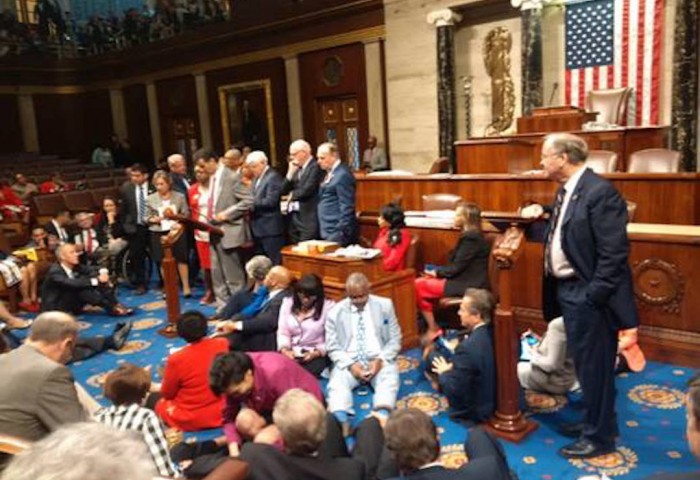
But let us not forget the Democrat’s role in this subversion of the will of the people. Both parties will blame the other for refusing to negotiate in a civilized respectful manner, but no matter who is to blame (I suspect both are ) they don’t seem to talk to each other anymore. The Democrats have said to hell with decorum and are engaged in a sit in within the house chambers. Perhaps this is progress, an indicator that they have matured beyond preadolescence  and have adopted a strategy more popular with college age kids.

The current situation could possibly be resolved by luring the Republicans into the house chamber with the Democrats and locking the door with the admonition that could not come out until differences were resolved. There is the risk; however, that that this could degenerate into an out and out physical brawl which has some precedent in other countries.

Since facts about the issues surrounding guns are hard to find if one only listens to the politicians, I found a video that presents “just the facts.” Enjoy, and let your representative know what you think.

Indeed, a government by the people needs to hear from the people in order to be effective. Email, write, call your congressional representatives. Click this link for contact information.

THE WATER MISSION

THE WATER MISSION
There are basically two approaches in the treatment of an illness.

  1. There is symptomatic treatment, which as the name implies, consists of alleviating the physical discomforts associated with the problem
  2. There is the elimination of the cause which in most cases is preferable.

For example there was a time when typhoid fever was incurable and often fatal. Treatments consisted of attempts to keep the patient hydrated, control the pain and diminish bowel hyperactivity.

When it was determined that the most common source of the infection was in contaminated drinking water it was possible to eliminate the cause of epidemics of the disease. Later, effective antibiotics would be developed; however, it is obviously much preferable to avoid contracting the disease in the first place.

Although typhoid fever has been all but eliminated in our country, many throughout the world are still at risk for a variety of water borne illnesses. Water is necessary for life as we know it, and we humans cannot live longer than a few days without it. Consequently, we are forced to drink whatever is available. The most recent example is the situation in Flint Michigan where bureaucratic bungling and an apparent blatant disregard for public health and welfare has put thousands at risk for various neurological problems. In children the extent of brain damage due to lead poisoning may not be apparent for years to come.

Unfortunately, these kinds of problems are not unique to Flint, but are often accepted as a fact of life when they occur in developing nations. When masses of people live in conditions of extreme poverty, they are often eager to welcome any kind of development which could improve their lives. These are often the same places where public health facilities are either scarce or non-existent, citizens are not made aware of the health problems that can accompany resource extraction, and there is little regulation to protect the worker or his environment. A dysfunctional or corrupt government may look the other way while outside influences plunder the nation, and more powerful nations may influence public policy.
It surprised me to learn that this problem continues to exist today even though the age of imperialism is supposed to be long gone. It was brought to my attention in an unlikely place when I attended a presentation at my church by a missionary from Bolivia. She did not fit the image often times ascribed to missionaries as staid and boring, but turned out to be a vivacious and positive young lady. In a subsequent one on one conversation I found Chenoa to be also quite charming in addition to being dedicated to her cause.
Her cause was to restore the water supply in La Paz, the third largest city in Bolivia. The city’s water was supplied by a river which ran through the city, and had its origin in mountain glaciers. Consequently the water was pristine until what some have called the “resource curse” came to bare. That was when mining for minerals began upstream and the waste was dumped into the river. The water supply became polluted with a variety of contaminates which made it unfit to drink. I was pleased to learn that Chenoa and her affiliates were seeking to cure the cause rather than just the symptoms of the problem. To temporize by passing out bottled water for example would obviously do little to cure the illness, and healing could only begin if the mining company would get their act together.
In order to encourage better behavior the Presbyterian Church which sponsors Chenoa wisely teamed up with an activist group called “Joining Hands”. As its name implies this organization is non-denominational and includes not only other churches but multiple other activist groups native to Bolivia. This inclusiveness should go a long way toward reducing the perception by some that missionaries invade their land to tell them what to do. One of the focuses of this organization is on Extractive Industries and Water with the following stated goals:
“Uphold transparency and oppose corruption in countries where mineral and resource extraction create wealth for a few and rampant poverty for the vulnerable majority…Deal with the impact of the extractive industries on communities of people and the environment, advancing the right of the people to access clean water, protected from pollution.”
It was gratifying to hear that a new generation of missionaries are determined to not only talk the talk, but walk the walk. That is not to say that others have not been concerned about global issues; however they have had little power to effect change. Many missionaries have given their lives in their struggles to improve quality of life for their subjects, and indeed that persists today as we hear of clergy who are slaughtered because of their beliefs. The willingness to suffer all manner of privations, sacrifices, and dangers in order to alleviate the suffering of his fellow man requires a dedication beyond my ability to comprehend.
One such person who accepted that challenge was, Dan Reynolds, one of my classmates in medical school. He admitted that he was in medical school only because he wanted to be a medical missionary. My first thought was that this kid must be nuts. Who in the world would want to spend all those years in school just to go hang out in the jungle. Granted, most of us were motivated at some level to be able to help people, but the fact that we would be paid pretty well for doing it was icing on the cake. After twenty years in that jungle in Africa, Dan was honored by our class with a plaque for his service, and he became my dear friend.
Historians would point out that the Christian missionary movement has not always been very Christian in its implementation, but hopefully that has become a thing of the past. The most extreme of these cases was when the conquistadors were instructed to convert the populace of the southern hemisphere to Christianity. One needs only to look at the churches in South America to realize they were quite successful. Their method was very effective. It consisted of giving the prospective church member the choice between conversion or death. We now hear that same strategy is used by ISIS.
One success story in the struggle to provide safe drinking water did not involve church sponsored missionaries, but rather the dedication of one caring individual.

150803-jimmy-carter-file-jsw-158p_5e66b4113f7db8e269482f0f50105c95-nbcnews-fp-1200-800In 1986 Jimmy Carter with the encouragement of the World Health organization set out to eradicate the guinea worm. His success may well represent the most monumental and least noted medical achievement of the century. In the nineteen eighties there were an estimated 3.5 million cases of guinea worm infection world-wide. In 2015 there were 22 cases reported. In the poignant announcement of his affliction with a malignant brain tumor, Mr. Carter announced that he only hoped he would be able to outlive the last guinea worm on earth. The significance of this event cannot be overemphasized as it would be only the second disease (after smallpox) to be totally eradicated.
Guinea worm infection or dracunculiasis as it is called is a horrible disease. It is passed to humans by drinking water containing water fleas infected with the guinea worm larvae. The fleas die, but the larvae persist and penetrate the intestinal wall. They migrate through the body growing to as much as forty inches in length over a period of from 10 to 14 months at which time they exit the body through the foot. This results in an intense burning sensation leading to an impulse to put the foot in water into which the worm discharges thousands of larvae. Since surface water is all that is available, the contaminated water is drunk and the cycle is repeated.
The only treatment available is to entwine the worm around a twig as its head exits the body and to very slowly twist the twig in hopes of removing the worm in toto. This must be done very slowly over a period of several days in order to avoid pulling the worm apart and leaving a portion inside the body. There can be many complications from the infection including amputation.
Since there is no treatment for this disease, prevention is the only option. Of course the ideal solution would be to provide clean drinking water for all. Unfortunately this goal is often not achievable in some parts of the world. It was discovered that the larvae would not pass through a simple cloth filter which could be made inexpensively. When people were made aware of the cause of the infection, they readily complied with use of the filters, and even improved upon them by developing a simpler and more portable version. The success of the eradication venture depended on an intense educational program to some of the most remote areas of the world. The results of that effort demonstrate clearly that ignorance is not synonymous with stupidity.
The problems associated with maintaining potable drinking water are not limited to less developed parts of the world. Mountain top mining is said to pollute otherwise pristine mountain streams in West Virginia, and some insist that fracking has affected their sources of water. The great lakes, a source of drinking water for millions, have been affected by the runoff of fertilizers. Since the Flint Michigan fiasco we have learned that the incidence of lead and other toxic materials in water all across the country have been vastly under-reported. When I was a kid, I was taught that water which came from the side of a hill was always safe to drink, and indeed many farm families relied on springs from those hills for their drinking water. We certainly could no longer rely on the earth to filter out all the poisons from the water we dump on it, and “spring water” could no longer considered to be safe to drink.
It seems to me that governments are very good at proposing solutions to problems but not so good at implementing them, and that is the reason we need people like Jimmy Carter and Chenoa. They deserve our unconditional support support and extreme gratitude.
In this paper I have only addressed concerns about the quality of water, while an even more pressing problem may turn out to be the quantity needed for our species to survive. Some futurists have predicted that competition for diminishing supplies of water may result in more world-wide conflict than that to which we are already accustomed. The squabbles over water currently taking place in California may be a harbinger of worse conflicts to come. For this and other more pressing reasons we can no longer assume that there will always be an inexhaustible supply of life’s most vital substance.

GRUMPY OLD MEN KNOW BEST

GRUMPY OLD MEN KNOW BEST
This morning I awakened in my grumpy old man mood; consequently decided to do what we grumpy old men do best which is to criticize everything. We rarely offer any solutions to the world’s problems, other than to suggest we go back to the way things were in the “good old days.”

IMG_2375

This is a favorite picture of my two grandsons who are now graduating from college. Proof that I am indeed an old man.

There are a few bright spots in my dark grumpy old man mood, not the least of which is that I did awaken this morning. In addition to that, my two grandsons who are about to graduate from college, will do so after receiving several honors which are more than sufficient to make even a grumpy old man pop his shirt buttons with pride for his progeny.

In spite of those bright spots, there is no dearth of issues for any grumpy old man to criticize, and that may also apply to those who are neither old nor grumpy. The first and most obvious thing which comes to mind is this election campaign which shows no sign of ending. If history is prologue we can expect it to start all over again as soon as this one is over.
You may recall from a previous blog that I am a co-dependent spouse of a CNN addict. As such I am accustomed to a continuous barrage of “breaking news” so named even if it is weeks old. After years of listening, I had become sufficiently desensitized to be largely able to ignore that noise that emanated from our kitchen TV. Now after months of listening to all that election campaign claptrap, I am ready to trade in my hearing aids for ear plugs.


There has been an endless parade of political experts who are standing in line to grace us with their expert opinions and prophecies. These are the same experts who assured us that Donald Trump was merely an oddity who would not survive for longer than a few weeks. Among them are journalists, campaign workers, officials of all stripes from the major parties, academics, politicians, and members of various “think tanks.” That last category has always fascinated me, and I have wondered what members of think tanks do other than think. To me, it always conjures up images of a bunch of naked people sitting around with their chin in their hands like a group of incarnate Rodin statues.There also appear to be a plethora of folks who are introduced as republican or democratic strategists. There must be a lot of “strategizing” going on, since there seems to be a bunch of them, which furthers my contention that politics is big business.
Regardless of the title given the participants in these interviews, the preferred format appears to be the use of the split screen with those of opposing loyalties each occupying their half of the screen. The content soon goes from each talking about what a wonderful person his/her candidate is to how terrible the opponent is. It seems to me the moderator is more interested in the interaction between the participants than policy matters. When they talk of the wondrous things their candidate will do, there appears to be no follow-up questions as to how those wondrous things will be accomplished.
Journalists and pseudo-journalists long ago learned that reporting of conflict gets people’s attention. The TV networks have sponsored many (too many for my taste) so called debates encouraging and reporting on the conflicts between participants while the issues get short shrift. It appears that the TV celebs (sorry but I find it hard to call them journalists) would like nothing better than one of those debates to degenerate into a massive food fight so that they might have some “breaking news” to report.

Enter Mr. Donald Trump the unrepentant narcissist and showman who had spent a lifetime seeking attention. It turned out that those years of practice served him well, for he has certainly received attention from the media, so much so that he has not found it necessary to spend any money on advertising. In addition to personally insulting and denigrating everyone who did not pay homage, he was able to be totally outrageous in the process. His overly simplistic statements about domestic and foreign policies were hailed as proof that he was an outsider and not a double talking politician. He pointed out that his talents as a business man could be useful in solving the country’s economic woes. He portrayed himself as a Manhattan version of Horatio Alger, and true enough we know that he started his career with a paltry one million dollars given to him by his father, later inherited a few million more and parlayed that into over a billion while filing only four bankruptcies in the process. He also inherited a few more million along the way, but insists that he is a self-made man.
Well, enough about the prince of the rednecks. I started out with the goal of bitching about the news media. Their coverage of the campaign has alerted me to the magnitude of the business side of politics. As I mentioned previously, there appears to be an endless supply of people selling their opinions. I assume that all of these people are employed somewhere since they all well dressed, and do not appear to be poverty stricken. There certainly are hundreds and maybe even thousands of such people employed in the politics industry. If we were to add all those salaries and book sales to the one billion dollars estimated to be spent by the candidates in this campaign, you might say we are talking real money. It might even be enough to fix some pot-holes, and if any were left we could waste it by feeding some of those kids who go to bed hungry each night.
In the midst of writing this rant, I just took a coffee break, and on my way to the kitchen was fortunate enough to see CNN was announcing more “breaking news”. The big news of the day is that North Carolina is suing the Feds over the bill about who can go to which bathroom. Undoubtedly, this is the most pressing issue of our time. No matter their faults one must give a lot of credit to CNN for securing this scoop. While some people are worried about such trivia as planetary destruction leading to the extinction of the human race, or our apparent penchant for warfare, these guys maintain a laser like focus on the really important news.

As I sipped my coffee, I was surprised to see Carl Bernstein (the reporter of Watergate fame) for whom I have a great deal of respect, appear to for an interview. He appears to me to be the type of journalist who seems more interested in the news than in his own celebrity. I was a little disappointed when I found that his primary reason for being there was to sell his latest book, but my mood improved dramatically when he began to talk about the news media in general. It soon became apparent that he was a grumpy old man also, and a kindred spirit when he complained that both broadcast and print media were very superficial in their coverage of the election campaign.
It seems that the combination of Carl and the coffee have conspired to make me much less grumpy, so now I think I will go watch some TV news and  see if I can learn more about the Donald’s hairdo.


10 Ways To Screw Up Your Kids Without Even Trying

During my years in the practice of psychiatry, I frequently heard parents of children who were in trouble lament: “Where did I go wrong? I did my best to be a good parent.”  Some might even point out they had read Dr. Spock cover to cover more than once and Dr. Brazelton’s Touchpoints books.  I always tried to reassure them that they were not the only people influential in their kid’s lives and that we parents are probably not as powerful as we think we are.  Most people would agree that children are quite capable of screwing up their lives without help; however, I think there are some ways in which parents can contribute to the process.

1)   Protect and serve

I recently had a conversation with a retired school teacher who mentioned her difficulty dealing with the so-called helicopter parents who fly in at the first sign that anyone dare suggest their little cherub could do something wrong, or be imperfect in any way.  A note to the parent suggesting something less than perfection in behavior or scholastic achievement is likely to result in a visit from the enraged parent to defend her poor little helpless child.  The parent’s explanation is to blame someone else, usually the teacher, for the problem.

helicopter-parent

My teacher friend seemed have less than a high regard for helicopter parents (but to be precise, “helicopter mothers”). However, my teacher friend apparently had not considered that this behavior could be of immense value to the child in learning to cope with the exigencies of life.  She did not take into account that the assumption of responsibility is not a highly valued quality in modern society, and that for little Johnny to learn to blame others for his problems could smooth the way  for him to grow up to be very successful should he choose the right vocation.  A career in politics comes to mind.


Additonally, the helicopter parent may also benefit from the practice of always defending little Johnny for these skills might be valuable later in juvenile court.

2)   Don’t snoop

Most kids seem to feel they have a constitutional right to privacy.  In my personal experience, nothing a parent can do is apt to generate more ire in kids than the violation of this precept, and to snoop places a parent at great risk.  Besides, the discovery of a stash of condoms, or weed could lead to a lot of trouble.  From the little I know about the electronic stuff, it seems virtually impossible to snoop. Therefore, a parent might as well hope for the best about what is going on in their child’s life.  Your child is apt to guard the password to his/her computer with their life, and you certainly would not want to suggest he/she is untrustworthy.

snooping

It is mandatory that your child has a TV and/or computer in his room where he can escape from the family and watch skin flicks without interruption.  It is important to remember like what the airplane has done for transportation, TV porn has done for sex education with the added advantage that there is no need to have that embarrassing conversation about the birds and the bees. In short you can avoid a lot of controversy by treating the door to Johnny’s room as if it were the entrance to a bank vault.

3)   Don’t listen

not listeningSome so-called experts advise that children should be allowed to express      themselves.  I grew up hearing that “children should be seen not heard” which seemed to work out alright for me, as I grew to be as opinionated as the next guy.  I suggest that kids are already mouthy enough, so it makes sense to tell them to shut up and do as they are told.
4)   Encourage in-home activities

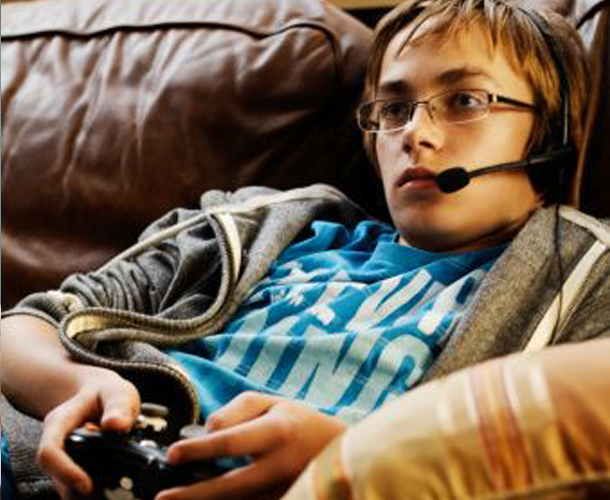
Much has been made about the detrimental effects to children of video games and cell phones.  In my opinion these instruments have become the greatest boon to motherhood since Similac.  No longer does Mom need to worry about little Johnny or Mary being accosted by some predator.  She no longer needs to deal with muddy and grass stained clothes nor scrapes, bruises, or even an occasional broken bone.  She always knows where to find them for they are either in front of the TV or on their cell phone.

video games.png

Some people insist that these gadgets lead to a sedentary lifestyle resulting in problems such as obesity, poor muscle tone and a variety of medical problems such as type 2 diabetes and delayed reasoning skills, but they must not have noticed the dexterity of kids’ thumbs in action when they are texting.  One can safely assume that as our digital age progresses, such a skill could be more valuable to your child than a burgeoning muscle mass.

5) Overindulge whenever possible                  

In this age of materialism, the most effective way to show our children we love them is to shower them with gifts.

overindulged childrenIf you celebrate Christmas you should consider that the kids are unlikely to remember any of that religious stuff, but they will never forget Santa Claus.  Possessions are also an important measure of one’s status in society, and this principle applies not only to the kids but to the entire family.  Our society has made giant strides in this area since I was a kid.  When I was in high school there was only one student with a car and his dad owned a car lot.   Now when I pass the high school parking lot it is jammed with cars with an overflow across the street in the church parking lot.  It is true that some are not late models, but even those less wealthy kids need not suffer the humiliation of being seen boarding a school bus.

I am well aware that this may put a strain on the family budget; however one should bear in mind that credit card companies are usually very accommodating when it comes to increasing your credit limit.  If all else fails Dad can always get a second job or a third one if he already has two.

6) Keep them guessing

There has been much made by so called authorities on child rearing about the importance of consistency, but I feel consistency is overrated.  B. F. Skinner’s experiments have clearly demonstrated that intermittent positive reinforcement is the most effective tool to shape behaviors; consequently, house rules should never be rigidly fixed, but fluid and subject to change at the whim of those in charge.  To be confident of the reaction to his actions is apt to render him a lazy thinker, while confusion as to an outcome will require deductive reasoning.  Some kids are likely to initiate certain behaviors in order to see what reaction it will generate.


It is also helpful if the parents disagree on many issues.  This can result in valuable training in how to manipulate people, e.g., play one against the other.  In the matter of discipline most of us can remember the old “wait until your dad gets home threat.”  In the event that Mom remembered to tell him his response would largely depend on his mood or if he had stopped for a couple of beers on the way home.   It could result in anything from “a good talking to” to a trip to the woodshed.  In the latter case with today’s attitudes towards corporal punishment confiscation of the perpetrator’s cell phone would be necessary to prevent him/her from calling Children’ s Service.

7) Shame them whenever possible

I once wore a dunce cap.  Few who read this will be old enough to remember the power of the dunce cap.  It was usually cone shaped and made of paper, and its adornment was accompanied by a sentence of standing in the corner for a lengthy period of time.  Its presence announced to the world that one had done something terrible.   In my case, I had the audacity to talk in class.  It was a two-room school and I was in the second grade. I was spared the paddle, which was displayed prominently behind the teacher’s desk, but was assured that it would find my backside were my behavior not to change.  To make matters worse, the teacher was my uncle which guaranteed that my parents would learn all about my transgression.

dunce-cap2_8945

The humiliation was made complete by the teasing I suffered at the hands of the other kids not to mention the “dressing down” (The time out strategy had yet to be invented) by my parents.  The whole experience was remarkably effective as I never talked in class again.  From that incident and others I suggest you not hesitate to use ridicule, and shame to shape your child’s behavior.

8) Teach humility

Children are born with an exaggerated sense of their own importance.   Babies seem to know that if they cry people will hop to and immediately make them happy.   In many cases this persists through the teen years, and has been accentuated by the propaganda of Mr. Roberts who was able to convince legions of rug rats that they were special.  The process of comparing your child to those with superior talent or success will go a long way towards bringing him down to earth.  It will also provide him with goals, but at the same time help him face his limitations so as not to waste energy or time on trying to become something he is not.  Children need to face reality; consequently, if they are stupid, ugly, awkward,  or weird they need to know about it. Yes, I am aware of all that psycho- babble about self-esteem, but if the kid is a slob like his old man, he needs to be told about it.

9) Don’t have dinner together

This is a subject dear to my heart for mealtime is my favorite time of the day, but come to think of it all the time is mealtime for me.  However; I don’t feel that I am unique in that regard for modern families have given up the ritual of all sitting down together at an appointed time to break bread.  That is probably just as well as a lot of time is wasted on such things as reviewing each person’s day, and making small talk.  It was often the only time of the day when the entire family would spend time together.  There were also the obligatory lessons in table manners, nutrition and hand washing.  At times minor squabbles would energize the experience, but all in all it was not very exciting.eating togetherModern families (not the one on TV) have no time for such foolishness.  There are too many activities and conflicting schedules to even consider such an old fashioned habit.  Mom may have trouble making it home from work in time for dinner let alone prepare a full course meal.  Often ordering a pizza or stopping by for a sack of Big Macs makes a lot of sense, but responsible parents will all be sure to keep a jar of peanut butter as backup.   Crock pots have been a boon to today’s families as food can be made available at anytime and the ordeal of eating together can be avoided.   The old policy of sit down family dinners pales when compared to the convenience of an every man for himself system.


10) The responsibility myth

One of the most difficult problems for families is deciding who should be responsible for taking out the trash.  If the kids are assigned to take turns, there will be endless loud and disturbing bickering about who did it last.  The timeworn strategy of listing a schedule on the refrigerator rarely works as it is subject to editing and will often disappear before it is implemented.  When responsibility is fixed, you will witness such creative thinking in the formulation of reasons why the chore was not done that you can be very proud.

1211_trashbingirl_rotator

Eventually, you will come to realize that the energy required to fix responsibility, not to mention the frustration involved will lead you to conclude that the best solution is for you to take it out yourself.

I am reminded of an incident in my own family from many years ago involving my son.  Barb had become very frustrated with him.  She complained that his room was a mess. When she ordered him to pick up the clutter on his floor he simply shoved it all under the bed.  She was incensed and insisted that I “do something.”  When I asked what I should do, she replied: “Go up there and stay with him and make him be responsible.” My brilliant retort was:  “If I do that, then who is responsible?” I did come up with an equally brilliant solution however.  I simply walked upstairs and closed the door to his room.

You cannot force your child to be responsible so let him/her go.  As an adult they will learn all about the wages of irresponsibility soon enough, besides you don’t need the hassle. It’s just a lot of work.

Conclusion

Some of you may not wish to screw up your children’s lives, but before you come to that conclusion you might want to consider all the ways they have screwed up yours.  Think of all the sleepless nights, the school PTA/PTO meetings, volunteering, chauffeuring, the crying, whining, and the dirty diapers not to mention the enormous sums of money spent on them.  You will need to decide if it is worth it.  In spite of my best efforts to screw up my kids’ lives, they l have all turned out well.  Go figure.

DISLAIMER:  I strongly deny receipt of any remuneration from the American Psychiatric Association in return for the recruiting of patients.


FAMILIES

FAMILIES

In previous blogs I have discussed the importance of relationships in our lives; however none are more important than our relationships with our family of origin. They will be a powerful influence as to how we view the world and other people.  More importantly, these experiences will be major determinants in the development of our personalities.  Those fortunate enough to grow up in nurturing environments will find it easier to nurture their offspring.   To feel loved is likely to protect one’s self-esteem, and allow one to experience the joy of loving others.  Our values are in many ways shaped by family for even if one is rebellious and rejects what he has been taught, his new found truths often originate from the nature of his family relationships.

Apprenticeship to Adulthood

We humans are unique among mammals in the length of time required for us to reach maturity. Not only is our rate of growth slow, but there is much to learn if we are to survive and thrive in a complex society.  Although much is determined by our genetic make-up, we learn behaviors and perceptions primarily by unconsciously mimicking others.  In that sense, growing up is much like an apprenticeship.

The 21st Century Family

An accurate definition of family is now difficult to pin down. There are no longer traditional roles for family members, such as were the norm in my generation.  Since most parents work, there are fewer stay-at-home moms.   We now see an occasional stay-at-home dad, something unheard of in my time.  Other than widows, single mothers were not nearly as prevalent during my youth as they now are.  Modern mobility has limited the number of nuclear families who can experience the support of extended family members.  Many of our children grow up barely even knowing the names of their cousins.  Blended families composed of his, hers and their children can face special challenges.

The Power of the Family Bond

In spite of these changes, the bonds between family members are among the strongest of all our relationships. This is evidenced by the fact that one of the first phases of recruitment by cultists is to alienate the prospect from family members, usually leaving siblings and parents confused and devastated.  The same tactics are used by those who would attempt to relieve the elderly and infirm of their possessions.  In both cases, they discredit the families of origin and attempt to break the bonds between the victim and the victim’s biological family.  Those in positions of leadership of all stripes realize the strength of familial relationships, and seek to provide an atmosphere in which a surrogate family can develop.  Street gangs likewise are said to provide family like bonds, which have been lacking in the lives of those they recruit.  The search for the type of relationships found in families seems to be a common human need.

“I found it difficult to remain therapeutic while feeling homicidal.”

Although families offer the best environment for rearing children, they can also be the scene of horribly abusive behaviors. I have had little experience dealing with such problems, especially when they involve children.  I generally avoided treating such cases as I found it difficult to remain therapeutic while feeling homicidal.  In like manner I find that the understanding of other cultural practices such as honor killings, genital mutilation and such to be way above my pay grade, and in spite of being paid quite well.  Consequently, I will confine my remarks to treatment of more mundane problems.

Who is the “real” patient?

Most families seeking help are usually concerned about the behavior or mental status of one of their members. They are often coerced into treatment by the identified patient’s therapist.  That term (identified patient) is useful in that one may find that the person in treatment may be the healthiest member of the family, and labeled as sick because he is out of step with the rest of the family (i.e., the identified patient is actually the most emotionally healthy of the group who is reacting to an unhealthy family dynamic).

The importance of family therapy

There are multiple reasons that I believe involvement of family is critical in the treatment process:

  1. Family members may be able to provide valuable information about the patient’s behaviors.
  2. It allows the therapist to view family relationships first hand and thus provide insights as to the stresses in the patient’s environment.
  3. Family members may provide a more complete family history
  4. It allows the therapist to assess the level of support available, and to encourage such support
  5. Perhaps most importantly, it is a mechanism in which the dilemma of providing family with needed information about their loved one’s illness without violating the confidentiality inherent in the doctor-patient relationship. This becomes even more important in those cases where there are paranoid tendencies, or there has been a great deal of conflict.

The Complexity of Family Relationships

Although the average family size has shrunk considerably over the last century, relationships between members can still be complex. It must come as no surprise that there are often conflicts within families.  Since it is difficult to walk away from one’s family, those conflicts are not easily resolved, and over time may escalate.  To be chronically angry can be debilitating and painful, and as such, blaming another for those feelings comes easily.

The Blame Game

As mentioned in previous blogs it is important that the therapist avoid joining in the search to establish who is at fault, for to do so merely perpetuates the problem. He must be able to analyze the problem from the outside looking in, that is, learn how to be a meta-communicator. Hopefully, the members will find it difficult to continue blaming each other if the therapist redefines the problem as blaming rather than defining the problem as identification of who is at fault.

The Power of Brevity

In order for the therapist’s comments to be effective, they must be brief if they are to be remembered. The importance of brevity as with most things in my practice was learned from a former patient during a chance encounter, during which he thanked me for having helped him several years previously.  He credited his recovery to one statement of mine.  He said: “The thing that helped me most was when you said ‘you think too much’ and now whenever I start to worry about all the things which could go wrong those four words come into my head and I am able to move on.”  I cannot take credit for any brilliant insights for I didn’t even remember the incident, but it is an example of how an offhand comment may be more effective than hours of therapy.  The same principle applies to our everyday lives, as the most memorable comments are those expressed in a few words.  The lengthy ones are often forgotten before they are completed.

Obviously there are many reasons for families to seek counseling other than to deal with hostility, but no matter the problem it is helpful to look at it as a communication system gone awry. Imbedded in many different behaviors is a message, and thus can be seen as a form of communication.  For example, what is the message being sent by a teenager who is acting out?  It could be that they are angry about limits set, unrealistic expectations from parents, lack of trust by parents, sibling rivalry, or resentful that not enough limits have been set, or for reasons which have nothing to do with the family.  Of course, the teenager is almost certain to be the last person likely to divulge such information.  Disclosure can many times offer a pathway to an understanding, which may be therapeutic.

Can’t see the forest for the trees

It was not my intent for this paper to be a treatise on family therapy; however I thought it might be useful to see how some of the concepts could be useful in understanding not only our own families, but relationships in general. As I mentioned in a past blog as with marital relationships, it is almost inevitable that one will be so caught up in seeing the trees that he will become oblivious to the forest.  That is, he will not realize what is going on even though he can hear the words.  This was brought home to me several years ago when following a party a colleague said “Smith I can’t believe how you treat your wife.”   I was shocked, could he be talking to me, the couples therapy and family expert?  After all, I had no doubt that I was among the world’s best husbands, but Barb later confirmed that my friend was correct in his assessment.  As has been said, “None are so blind a those who will not see.”

Reframing

For example though all have separate personalities, they also have different roles to play as family members. For example it is common for families to have a star and a black sheep.  Parents may lament that they don’t understand why the black sheep can’t be more like the star, and continue listing all of black sheep’s misdeeds and faults.  In such a case the therapist might address the black sheep kid by saying, “That is such a loving thing, doing all that stuff to make your sibling look good.” No matter the response the system is changed, and this is apt to open up some different dialogue. This is a process therapists call “reframing.”

Scripting

There are many roles that kids and parents may unconsciously adopt. There are the placaters or people pleasers, the mascot or clown, the lost child or withdrawn person, and as mentioned in the previous vignette the hero or achiever, and the black sheep or scapegoat, to mention a few.  Family roles may develop in order to fill a need or may come about by the process of scripting.  I mentioned previously the role families play in the development of our identity, and when they convince us we are a certain type of person, we are apt to follow that script.  Some have gone so far as to say if you can convince someone he is a homicidal rapist, he is apt to become a homicidal rapist.  Obviously, there are many influences other than our families which affect our identity; however, the opinions of our parents and siblings are undoubtedly the most powerful.

Disagreements

In this time of rapidly changing mores, it is not surprising that there will be frequent disagreements between we old folks and the kids. Of course disagreements between siblings seem to be written into their DNA, and disagreements between parents is certainly not unusual.  When family members cannot agree to disagree, an argument is likely to occur, and such arguments often lead to verbal or even physical attacks.  I don’t mean to suggest that disagreements are all bad for as Walter Lippmann famously said, “Where all think alike, no one thinks very much”.  When we tell our kids what to think while telling them we want them to learn to think for themselves it is little wonder they become frustrated for that is a classic double bind, or in today’s vernacular a no win situation.

Systems of Conflict Resolution

If a disagreement reaches the point that one feels threatened or under attack, either verbally or physically, he may respond in a variety of ways.

Attack/Attack system

He may retaliate in kind which is an attack-attack system. This is almost guaranteed to increase the level of anger, as each participant attempts to outdo the other.  These are the types of interaction which can lead to violence.

Attack/Placate system

The attack-placate system is often seen in cases of spouse abuse, when the abused attempts to talk hubby out of his anger by reassuring him and in other ways spreading oil over the troubled waters. This too usually fails as the abuser may feel patronized.

Attack/Divert System

Another type is the attack-divert system which as you might imagine can become rather bizarre. This might be effective in minor skirmishes, but simply changing the subject in the face of overt hostility is weird, and leaves the problem unresolved.

Acknowledge the Affect

For the best method to deal with such emotionally laden situations, I hearken back to my mantra of “acknowledge the affect.” In such cases, the message the attacker is trying to send is that he is feeling some kind of negative affect such as: anger, hurt, envy, jealousy, or fear.  Statements such as “I can see you really feel strongly about that” or “are you angry with me?” will often defuse the situation.  It is not necessary to change your opinion or point of view, but simply to communicate that you understand how he feels.  If your attacker’s affect is not available then one can use his own such as: “I feel …………” The concept has wider application, for in any emotionally charged situation it only makes sense to deal with the emotions rather than to ignore them.

What’s Next?

In my next blog, I plan to focus on child rearing. I am well aware there are probably hundreds of books written by people who are convinced they know better than you how you should raise your kids.  I don’t plan to do that since I have made plenty of mistakes in that department; although my kids all turned out well in spite of my screw-ups.   Rather than directions as to how one can raise perfect little people, I plan to provide helpful hints on how to screw up your kids lives: I call it “How to screw up your kids without even trying.”

Thanks for reading!