
Since our fearless leader arrived on the scene, there has been much debate over the matter of truthfulness. Though the word truth may not be as fashionable as it once was, it is still used a great deal in everyday language. I have my own ideas about the definition of the word, but etymologists tell us language is in a constant state of flux. With that in mind I decided to look up the definition of the word to see if its meaning had changed during the past 80 or so years. It seemed to not have changed appreciatively since the day a few decades ago when I lied about throwing a hatchet at my brother.
The definitions of the word “truth” I found confusing in most cases; for example, one was “the quality or state of being true,” which I did not find to be helpful. It reminded me of the meaningless cliche “it is what it is.” However, I was pleased to learn that some of the synonyms used  for truth, such as candor, honesty, and sincerity, are still associated with the word. Along with a few million other kids I was indoctrinated with the fable of George Washington and the cherry tree. The moral of that story was very clear that lying about the deed was as bad or worse that the deed itself. To that end when my father confronted me about a misdeed, and said “don’t lie to me” I soon learned that I was more likely to escape corporal punishment if I confessed.
Truthfulness in the “good ole days”
According to my recollection, truthfulness was highly regarded in those days; although there were situations in which lying was condoned. For example, horse traders, much as the used car salesmen of today, were famously expected to lie. In those days I am told that transactions involving horses were seen as a competition testing the ability of the buyer or trader to judge horses, and the rules about truthfulness were suspended. In most situations however; truthfulness was considered a virtue and liars were regarded as on the same level as wife beaters.
My indoctrination into those ideas about truth was successful, and I value them even today, although I must confess that I have transgressed a few times. In most cases I have rationalized by telling myself they are only white lies, minor exaggerations, or embellishments, and that there are times when truth can be hurtful. As a consequence, I tend to classify lies as to their size in order to excuse my behavior. However, according to the Smith classification, any prevarication uttered by the most powerful man in the world is a whopper with the potential of dire consequences for the entire world.
I Don’t Care if Trump Lies
With all that in mind, you can imagine my chagrin when I ran across an article in the January 23 issue of “The Daily Wire” titled 5 REASONS I DON’T CARE IF TRUMP LIES. It was written by John Nolte who had previously been editor of the far right web based Breitbart News which was also the former home of Steve Bannon, Mr. Trump’s advisor. Mr. Nolte justifies the lying by using “the old everybody does it” strategy we used in grade school by saying: “Politicians lie. That is what they do.” He goes on to say “In politics lying is a tactic, and if you don’t use that tactic, you’re screwed.” 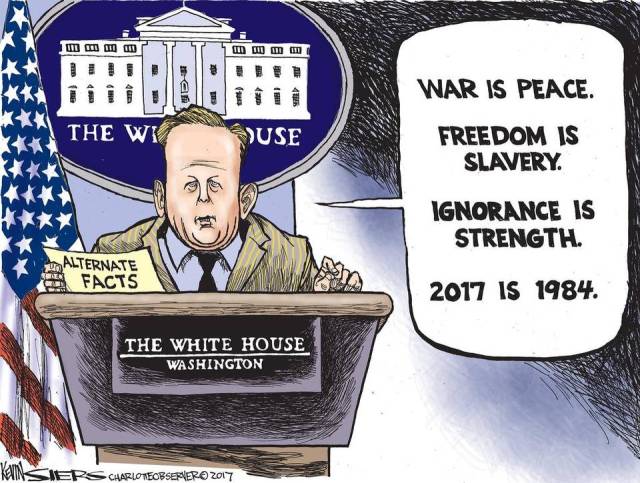 How many times in history have we heard that. If indeed the most talented at lying have an advantage at the polls, it might explain why there appears to be so much dissatisfaction about the performance of our elected officials. Nolte is not so charitable with the major news outlets that he describes as “evil” due to their dishonesty, but assures us that “I will not lie.” Yes, I am sure George Washington would be pleased to know someone is following in his footsteps.
Fake News. Confirmation Bias. The Internet Conundrum.
 The term “fake news” has been bandied about a lot lately, but that seems to me an oxymoron. If it is fake, it is simply a lie, certainly not news. No matter what it is called, the internet has become a fertile field for its growth. It allows any individual to send whatever lie he chooses with impunity to large numbers of people who are then capable of spreading it to others like an epidemic. The more outrageous or unusual the story, the more likely it is to be widely dispersed. The volume of such misinformation is such that there is something for everybody so that a person is more likely to believe something if it supports his own beliefs or prejudices, and discard that with which he disagrees. This has been called the confirmation bias.
As he continues to surf the web, he will be drawn to those sites, truthful or not, which confirm his beliefs. So armed, he becomes even more entrenched in his opinions and more unlikely to listen to alternative ideas. In my opinion this is one of the major contributors to our divisiveness. Unfortunately his conclusions may have been influenced by faulty evidence.
In an optimistic essay in the December 29, 2011 issue of the Atlantic, by Rebecca Rosen titled TRUTH, LIES and the INTERNET, she acknowledges that the internet is a repository for much misinformation, but comforts us by insisting “the internet has brought a golden age of Fact Checking,” and goes on to say “…..the good news is that the Internet is nurturing accuracy.”
So much for prophecies: here we are six years later with the development of wonderfully complex lie machines, which are not only capable of reaching millions of people, but can actually tailor their lies to appeal to certain groups or even individuals. In the face of such onslaughts, all the fact checkers in the world could not keep up with their output.
Not only has the internet provided a convenient platform for the delivery of lies, new techniques such as the twitterbot are now used to overwhelm and prevent access by competing messages.
In contrast to the Atlantic article, Richard Clarke’s book, Cyber Warfare has turned out to be prophetic. He had warned in his book that the US was sorely lacking in preparedness for cyberattacks. Russia has proven him correct in his assessment by their role in attempting to undermine our electoral process. I have heard several comments on TV which attempt to assure us that the outcome of the election was not affected by these cyberattacks; however I find it hard to believe that anyone could be certain of that since there are so many intangibles which may affect such outcomes.
Whatever the effects they may have had on the outcome of the election, the specter of even the possibility of an illegitimate presidency or treasonous staff members is a win for the Russians due to the loss of confidence in the process. Slanderous comments about various politicians are accepted as fact by some which further undermines the trust in our system. Attitudes so developed may also result in a cynicism about our government which may discourage our brightest and most dedicated from a career in public service.
Facts. The truth. The whole truth. And nothing but the truth.
When testifying in a court of law all people must swear to tell “the truth, the whole truth, and nothing but the truth”. This oath is said to have been traced to the 13th century. Those guys must have been pretty smart, for they already were aware of how one could make a lie appear to be the truth. Unfortunately, counterfeit truth tellers are not required to take such an oath in ordinary situations. They can avoid telling the “whole” truth by taking something out of context, usually a word or modifying phrase that changes the meaning of what is said. The “nothing but the truth” phrase forbids the mixing in a lie or two which can also change the gist of the message. Such strategies seem to me to be used more frequently now than in days past.
 Beliefs and opinions are not facts. Facts are a necessary component of truth; however truth is more than that. Truth requires an understanding of the meaning of the facts, their relevance to the issue at hand, and their context. Truth is necessary for our survival. Truth is essential for development of trust. Without trust, chaos reigns and society disintegrates. Truth is honest, sincere, and respectful. Truth is especially important in today’s messy world, but currently seems to be in short supply.
Since I began this essay, I noted that Time Magazine featured a lead article on truthfulness. Although I was initially dismayed to have been scooped, I was nevertheless heartened that the issue is getting the attention it deserves. Of course lying is not a recent development. It has been said that THE TRUTH WILL SET YOU FREE which leads one to ponder the question of the effect of its absence. Plato addressed its seriousness a bit before my tenure when he said:
“FALSE WORDS ARE NOT ONLY EVIL IN THEMSELVES, BUT THEY INFECT THE SOUL WITH EVIL.

 eshrinkblog