Introduction: In the post The Way It Was: Part 1 eshrink shared his earliest memories in southeastern Ohio as a child born in 1930. He described the complex world of Jim Crow and race relations from his perspective and his earliest memories. Born during The Great Depression, eshrink (my dad) has first-hand memories of what that era was like for a boy growing up in Ohio. In this segment, you’ll get a glimpse of life, activities, and the experiences that had a major influence on his life. Even more, you’ll get a historic picture of the 1930s and 40s in middle America. Dad doesn’t suffer from revisionist history that romanticizes nostalgia as “the good ole days” and illustrates the struggles as well as the joys of the era from his perspective.
Happy Reading!
There but for the grace of God go I…
As for the depression, I did not suffer, but it was impossible to ignore the beggars on virtually every street corner or the hoboes (often referred to as “bums”) who would appear at the back door begging for food. Much has been written about hunger during the Great Depression, but I don’t recall ever going to bed hungry. It would be 50 years later when my older brother would remind me that there were times when Mom and Dad told us to eat first. Likewise, it was long after their deaths that I learned that my maternal Grandfather (Spinney), a carpenter, had built them a house as a wedding present, which they had lost when the factory where my father worked shut down during the depression.
“Scrappy” was Required for Survival During the Depression
I do recall learning that we had moved four times by the time I was 5 years old, but somehow, probably due to my father’s ingenuity, we managed to escape homelessness. Dad was not one to miss an opportunity to make a buck and was willing to present himself as having expertise where none existed. In those days, most houses had wallpaper throughout since interior walls and ceilings were plastered and subject to developing cracks. Thus, when a more affluent neighbor reported they were looking for a paper hanger he presented himself as an expert though he had never so much as touched a roll of wallpaper. Likewise, when Roosevelt passed the Rural Electrification Act, there was an immediate demand for electricians to wire houses and barns throughout the country. He seized the moment, declared himself an electrician and set about wiring houses after consulting with a bona fide electrician friend in order to learn the essentials.
Homelessness and Hoovervilles during the Depression
The unemployment rate was over 25%, but due to vagrancy laws homelessness was largely confined to the shanty towns constructed of scavenged materials. Such areas were referred to as Hoovervilles in reference to Herbert Hoover who was largely blamed for the depression. They were usually located on the outskirts of cities and towns in inconspicuous areas and were at risk for raids from law enforcement. On the other hand, many unemployed men played a cat and mouse game with local law enforcements wandering from town to town to escape jail time. The vagrancy laws, which were established to control the black population following the Civil War, were resurrected in order to assure that homelessness would be kept out of sight. Hope was in short supply which many had lost after months of fruitless attempts to find work. A significant number of these men were veterans of World War I who suffered from “shell shock”, disabling physical injuries, or chronic lung disease resulting from exposure to mustard gas. Veteran’s pensions proved hard to get and these alienated souls traveled from town-to-town hitch-hiking, walking, or hopping freight trains. Hoboes developed their own subculture with hidden campsites throughout the country, usually migrating to the south in winter, though it was not unusual for a farmer to discover one who had misjudged the onset of cold weather sleeping in his haymow. They shared information as to the most tolerant communities, favorable routes, and even freight train schedules.
A Day in the Life of a Kid during the Depression
In spite of all the problems that surrounded us, we kids were busy doing what kids do. In winter, we prayed for snow and kept the runners on our sleds polished in case it happened. Since school was so highly regimented, we were out the door as soon as we got home, weather permitting. There were no television shows or video games to keep us in the house, but there were radio programs designed for us such as: JACK ARMSTRONG ALL AMERICAN BOY, THE LONE RANGER, and THE SHADOW. In the summer there were even more incentives to be outside, since without air conditioning the outdoors was more comfortable. May 1st may have been a time of celebration for communists, but it was the officially designated time my brother and I were allowed to go barefooted. It would take us several weeks to get our feet tough enough to handle walking on gravel roads. Summers were glorious times, and Labor Day was the worst holiday of the year for the next day school resumed. I used a lot of energy as an unwelcome “tagalong” chasing my brother and his friends. We ran all day, swam in the creek, climbed trees, rode bikes (I inherited my brother’s beat up version), shot marbles, played cowboys and Indians, follow the leader, and all kinds of kid organized ball games. We followed the ice truck through the neighborhood looking for chunks of ice that often fell off when the driver grabbed a chunk of ice with his tongs. There were arguments, which were usually resolved without interference of adults, and times when a kid could learn to enjoy solitude by lying on his back in the grass watching the clouds. Rainy days were good for making model airplanes and reading comic books. I memorized the Boy Scout manual for I desperately wanted to be a Boy Scout. However, we never stayed in one place long enough for me to make contact. There was also the expense of a uniform, which presented a problem.
The BIG Event: The CIRCUS comes to town

The county fair was a big summer event, but it paled in the face of the appearance of the Ringling Brothers, Barnum and Bailey Circus. Even if you couldn’t afford it, it still lived up to its mantra as “the Greatest Show on Earth”. I was able to attend one year and was absolutely mesmerized. There were other circuses, but none compared to P.T. Barnum’s version. One year, to my delight, the parade to the fairgrounds, where the circus was to set up, a show unto itself, went down the street in front of the house where we lived. We watched in awe as the elephants, and caged wagons with lions and tigers passed by. People lined the streets, for the parade was a show unto itself. Whenever there was a circus in town, we went to watch them miraculously set up the whole operation in a few hours with the help of elephants who effortlessly raised the tent poles to their full height. Following the last performance, Dad would take us to join the crowd at the train station to watch them load the huge tent, people, wagons, and animals. That frantic activity would take them into the wee hours of the night until the train pulled out, headed for the next town, where what appeared to us kids as an exciting glamorous scenario, would play out again. Consequently, threats by disgruntled kids to “run away and join the circus” were not uncommon.
Newspapers and Paper Routes: The Way It Was

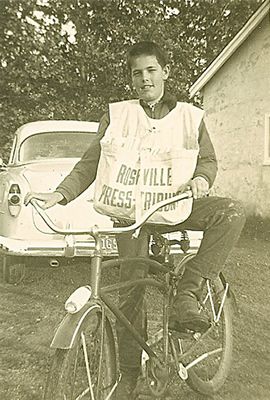
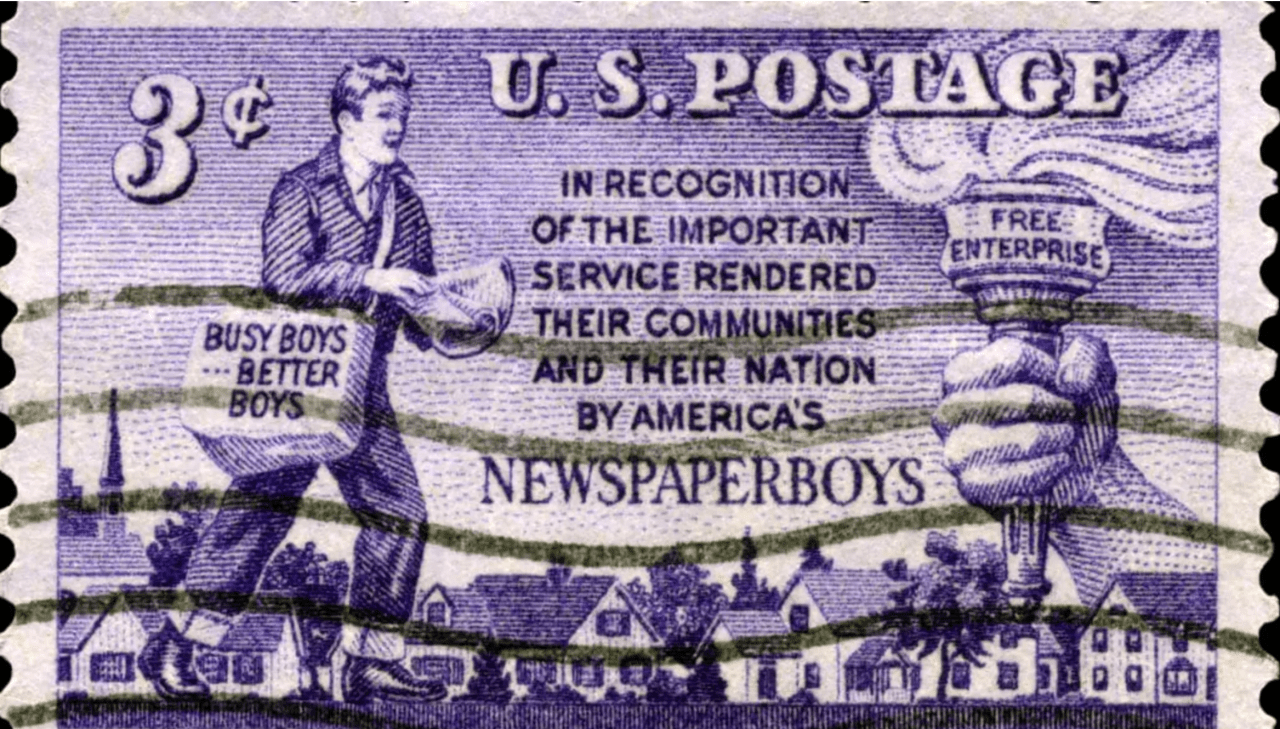
Many kids had paper routes, and there was competition for the larger ones with houses close together, although the routes for the morning paper which required one to get up by 5 AM were less popular. Although many depended on radio for news the newspaper was still the major source of information, and reporters were held in high regard. To take over a paper route provided a kid with a crash course in business. His papers were dumped at a designated street corner where he picked them up, folded them into individual rolls and headed off on his route via a bicycle if he was fortunate enough to own one. The paper boy was in effect a retailor who bought his papers and sold them to his customers. Collecting the
money for his sales was his problem, and it was not all that unusual for a carrier to be stiffed by his customers. In other words, when assuming the contract to become a “paper boy”, he had become a full-fledged retail businessperson with all its benefits and problems.
The printed word was an important part of everyday life since it was virtually the only source of information about the goings on outside of one’s own neighborhood. There was intense competition, as was seen in my small town where there were at one time three separate daily papers, while some surrounding counties also had their own weekly papers of mostly local news. The printing of a paper was very labor intensive, requiring the services of not only the men who operated the huge presses that produced the paper, but a cadre of skilled workers called typesetters who were responsible for arranging all that type to form words. Speed was of the essence for as the name implies if it is not new it is not news. Consequently, most daily papers were capable of producing at a moment’s notice “extras” (i.e., special editions featuring important events).
Many foreign correspondents who covered WWII became famous. Ernie Pyle who was killed while covering action in the South Pacific gained fame for his interviews with ordinary soldiers on the front lines. Walter Cronkite would end his career as an anchor man on television and was hailed as the nation’s most trusted source of news. Edward R. Murrow who would later be credited for helping bring down Joe McCarthy, (perpetrator of the red scare), broadcasted from allied planes on bombing missions while on assignment in London during WWII. Bill Mauldin’s cartoons featuring G.I. Joe portrayed the pathos and humor experienced by foot soldiers. Photojournalists also became more important as magazines such as Life and Look gained wider circulation.
Radio
Although during my childhood, newspapers remained the most popular source for news, radio had gained a strong presence in a few short years. I remember listening to station KDKA in Pittsburgh, which bragged that they sent out the strongest signal in the nation. They were the first to broadcast to large areas of the country. Although the technology had existed for some time, such broadcasting had only begun in 1920. In the 1930s, owning a radio became a high priority, and a new Fairbanks-Morse radio was the centerpiece of the average family’s living room. It would be many years before FM radio was available and AM had many limitations. Foremost was the fact that AM reception was affected by weather, and the signal strengths of other stations, which could sometimes intrude on other frequencies. It was not until 1926 that the first radio broadcasting network, (NBC) began the process of linking local stations so that programs could be transmitted nationally.

It didn’t take long for politicians to recognize the value of radio as a communications tool, and I recall listening to FDR giving one of his “fireside chats”. Although I had no idea what he was talking about, I was fascinated because everyone was listening attentively to his every word. I even remember listening to the infamous antisemitic Catholic priest (Father Coughlin). His Sunday evening broadcasts of fascist rants attracted millions of listeners and was felt by many, to have contributed to the initial reluctance of many Americans to support Britain in their struggle against Hitler. During its hey-day in the 1930s and 40s there was something for everyone on the radio. With the overwhelming majority of women spending full time in the home, the so-called soap operas found a ready audience during the day, and many mothers arranged their work schedule around their favorite shows. The serial format of those broadcasts assured that the listener would return the next day to find out how the latest crisis had been resolved. Late afternoon was time for the after-school programs. My favorites were the Lone Ranger and I Love a Mystery. As was chronicled in the TV show, The Christmas Story, there were all kinds of gimmicks designed to attract kids.
Evenings were difficult, for in our house much of prime time was taken up by Lowell Thomas who was dad’s favorite news commentator. I thought he was really cool due to his involvement in the glamorizing of T. H. Lawrence (Lawrence of Arabia). I can still remember his soothing baritone voice as he signed off with the words: “So long until tomorrow”. H. V. Kaltenborn had gained a large audience and was said to broadcast his news and commentary without benefit of a script. Walter Winchell was an ex-vaudevillian who gained fame as a gossip columnist, but later was credited with destroying the careers of multiple famous Hollywood personalities by supporting Senator Joe McCarthy’s communist witch hunt. Winchell’s Sunday night broadcasts were rapid and staccato. His opening intro was: “Hello Mr. and Mrs. North and South America and all the ships at sea”. I could never figure out where that thing about the ships at sea came from. He was indeed a colorful figure who was alleged to consort with criminal elements during prohibition, but later in his career became a snitch for Hoover’s G-men.
Sports
Radio must have been a boon to professional sports, as sporting events could now be reported upon as they happened. In those days baseball was dubbed “the national pastime”, Babe Ruth was everyone’s hero, and towns of all sizes fielded their own teams, which provided opportunities for sports aficionados, such as Ronald Reagan to become play by play announcers.
Boxing was also very popular, and one of a few professional sports in which African Americans were allowed to participate. The myth of racial superiority of white people had been damaged when Jack Johnson (nicknamed the Galveston Giant) became heavyweight champion a few years previously. His win spawned riots, and he further infuriated us bigots by marrying a white woman. In the 1920s, white Jack Dempsey was everyone’s hero, but in the 1930s along came a black fighter named Joe Louis who is widely regarded as the greatest fighter of all time. I recall lying on the floor in front of our Zenith radio listening to the play by play of his fights which usually did not last long as he had a string of knockouts in early rounds. Louis was spared from the vituperation endured by Johnson as circumstances would lead this man of humble origins to become a national hero. In the late thirties Louis had lost to Max Smelling a German, and Hitler crowed about the superiority of the Arian race. In a rematch, Louis knocked out Snelling in the first round, and became an instant geopolitical hero even though there remained a significant number of Americans who continued to hope for “a great white hope” to unseat him. Nevertheless, Louis had further discredited Hitler’s myth, which Jesse Owens’s had trashed in the 1936 Olympic games.
Radio Dramas and the Attack of Aliens
Prior to the development of television, in addition to news and music of all kinds, drama was an important part of radio programming. Many programs were live, and for actors to play roles without benefit of audience or set presented many problems. Some were even able to play two separate roles at the same time. Sound engineers became proficient at providing sound effects, which in one instance, caused a near panic nationwide. In 1938 a young Orson Welles presented an adaptation of H.G. Wells’s THE WAR OF THE WORLDS, which was so realistic that thousands of people, me included, thought we were actually being invaded by aliens, and panic ensued in some cases. Fortunately, Dad was able to reassure me that it was not real. As with most people, I am a big fan of television, yet there are times when I yearn for those days of yore when listening to the radio forced me to use my own imagination to picture the action. However, the best week of our summers were the ones my brother and I spent at our grandparents’ farm.
Editor’s Note: Stay tuned for How It Was: Part 3 for a glimpse of farm life in the 1940s with my dad’s favorite past-time highlighted: eating (he was a “foodie” before it was cool).

 eshrinkblog